Shibida Logistics Team
Logistics Expert
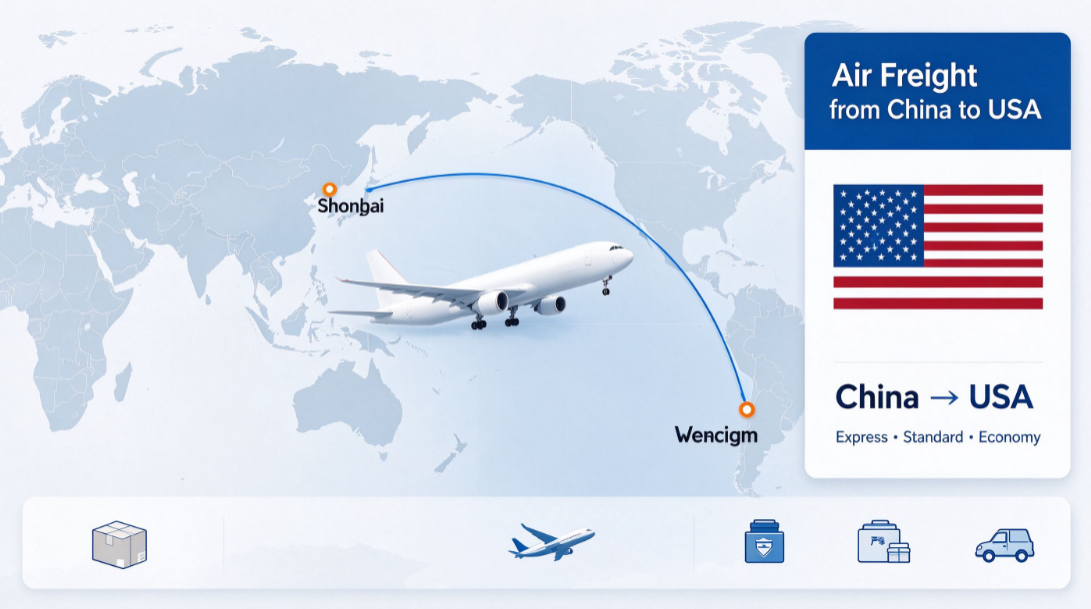
Executive Summary: International supply chains depend heavily on the trade corridor between China and the United States. When time is critical, inventory is running dangerously low, or products hold high commercial value, air freight from China to USA becomes the ultimate logistics solution. Unlike ocean shipping, which can take anywhere from 20 to 45 days depending on port congestion and ocean routing, air freight slashes transit times down to a matter of days. However, navigating the world of air cargo requires a thorough understanding of chargeable weight calculations, airport hubs, customs compliance, documentation, and cost structures. This comprehensive guide, written from the perspective of seasoned freight forwarding professionals, breaks down everything you need to know to optimize your supply chain, minimize unexpected fees, and ensure seamless delivery from factory floor in Shenzhen or Yiwu to your warehouse in Los Angeles, Chicago, or New York.
1. Introduction: Why Choose Air Freight from China to USA?
Global commerce moves at a blistering pace, and e-commerce growth, sudden market demand spikes, and high-value tech product launches have made air shipping indispensable. While ocean freight remains the undisputed champion for heavy, bulk shipments due to its low cost per kilogram, air freight from China to USA offers unmatched speed, reliability, and security.
Importers typically turn to air shipping under specific business scenarios:
Shibida Logistics(Top China freight forwarders)Cross-Border Logistics Line
Services: Sea Freight, Air Freight, DDP, FCL, LCL, Amazon FBA First Mile
Shibida Logistics(Top China freight forwarders) specializes in door-to-door one-stop shipping to the US, Europe, the Middle East and Southeast Asia. We deliver reliably with high on-time rates, own container pickup & trailer fleet, 18 years of experience, and have served over 30,000 enterprises.
View Logistics Solutions Get Detailed Quotation
Contact Us
📞 Phone: +86 15813899064
📧 Email: 732175850@qq.com
💬 WeChat ID: 15813899064
Scan WeChat QR Code

Product Launches & Seasonal Inventory: When missing a holiday shopping window (like Black Friday, Cyber Monday, or Christmas) means missing an entire fiscal year’s profit, air freight bridges the gap.
High-Value & Fragile Goods: Consumer electronics, precision medical devices, luxury apparel, and semiconductor components require minimal handling and swift transit to reduce risk of damage or theft.
Inventory Replenishment (Just-In-Time): Maintaining lean inventory levels prevents capital from being tied up in massive warehouse stocks, using air freight to quickly replenish fast-selling SKUs.
Sample Deliveries & Prototyping: Rapid iteration during manufacturing requires physical samples to fly across the Pacific in days rather than weeks.
2. Major Origin Airports in China and Destination Hubs in the USA
Understanding the geography of air cargo is vital for optimizing trucking costs and transit times. China features several mega-airports equipped with state-of-the-art logistics infrastructure, while the US boasts major inland and coastal entry gateways.
Key Origin Airports in China
Depending on where your manufacturer or supplier is located, your freight forwarder will route your cargo through one of the primary Chinese air hubs:
Shanghai Pudong International Airport (PVG): Located in East China, PVG is the largest cargo gateway in mainland China. It handles a massive volume of general cargo, textiles, and electronics originating from manufacturing powerhouses like Jiangsu and Zhejiang provinces.
Shenzhen Bao'an International Airport (SZX) & Guangzhou Baiyun International Airport (CAN): Situated in the Pearl River Delta (Guangdong province), these hubs specialize in electronics, consumer goods, apparel, and cross-border e-commerce parcels (such as SHEIN, Temu, and Amazon FBA stock).
Hong Kong International Airport (HKG): HKG operates under a unique customs regime and is the premier global hub for shipping sensitive cargo, including lithium batteries, cosmetics, brand-name luxury goods, and electronic items. Hong Kong allows far more flexible export regulations compared to mainland China.
Beijing Capital International Airport (PEK): Serving Northern China, PEK handles heavy industrial machinery parts, scientific equipment, and high-end manufacturing goods.
Key Destination Gateways in the USA
Once flights cross the Pacific—often refueling in Anchorage, Alaska (ANC)—they land at major US import gateways:
Los Angeles International Airport (LAX) & San Francisco International Airport (SFO): The primary entry points for West Coast cargo, ideal for distribution across California, Washington, and the western states.
Chicago O'Hare International Airport (ORD): The undisputed heart of US air cargo distribution. ORD connects international flights to the Midwest and serves as a massive rail and trucking interchange for the entire country.
John F. Kennedy International Airport (JFK) & Newark Liberty International Airport (EWR): Essential hubs for East Coast distribution, retail replenishment, and European/transatlantic connections.
Miami International Airport (MIA): The primary gateway connecting Asia and North America to Latin American markets.
| Route / Hub | Primary Specialization | Average Flight Time |
|---|---|---|
| PVG to LAX | General cargo, e-commerce, apparel | 11 - 14 hours |
| SZX/CAN to ORD | Consumer electronics, industrial parts | 13 - 16 hours |
| HKG to JFK | Batteries, high-value tech, luxury goods | 15 - 18 hours |
3. Types of Air Freight Services and Transit Times
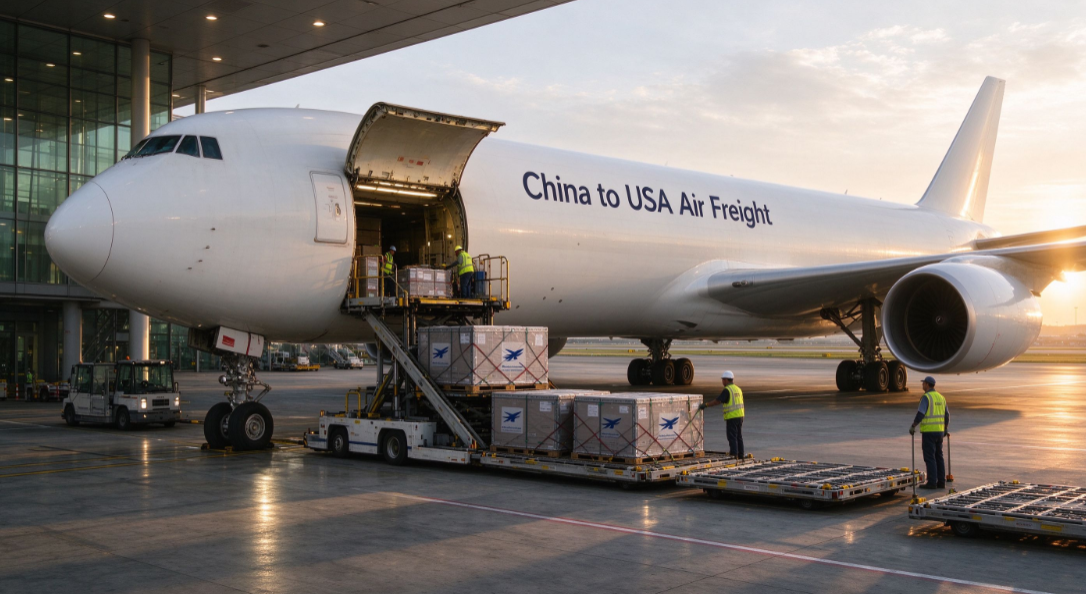
Not all air freight moves at the exact same speed or cost. Depending on your budget and urgency, you can choose from several distinct service tiers:
1. Express Courier Services (DHL, FedEx, UPS)
Transit Time: 1 to 3 business days.
Best For: Documents, high-value samples, emergency replacement parts, and small e-commerce orders under 150 kg.
How it works: Door-to-door service where the courier handles everything from factory pickup to destination customs clearance and final delivery. It is the most expensive option per kilogram but requires zero logistical management on your end.
2. Standard Air Freight (Airline Direct & Consolidated)
Transit Time: 3 to 7 business days.
Best For: Commercial shipments weighing between 150 kg and 1,000+ kg.
How it works: Cargo is consolidated with other shippers' goods or booked directly on passenger belly-hold flights or dedicated freighters. Requires airport-to-airport or door-to-door arrangements via a freight forwarder.
3. Economy Air / Deferred Air / Air-Sea Hybrid
Transit Time: 8 to 15 days.
Best For: Budget-conscious shippers who need faster transit than traditional ocean freight but cannot justify standard air freight rates.
How it works: Often involves flying cargo to an intermediary hub (such as Dubai, South Korea, or Los Angeles via specialized charter networks) followed by domestic trucking, or combining air legs with ocean legs.
4. How Air Freight Cost is Calculated: Chargeable Weight Explained
One of the most common shocks for first-time importers is discovering that the final freight bill is significantly higher than the bathroom scale weight of their cargo. In air freight, airlines charge based on Chargeable Weight, which is the greater of two metrics: Gross Weight (actual physical weight) or Volumetric Weight (dimensional weight).
The Volumetric Weight Formula
Because airplanes have limited cargo space relative to weight capacity, bulky, lightweight items take up valuable space that could otherwise carry heavy cargo. The standard IATA volumetric divisor for air freight is 1:6000 (sometimes 1:5000 for express couriers):
Volumetric Weight (kg) = [Length (cm) × Width (cm) × Height (cm)] / 6,000
If you are measuring in inches:
Volumetric Weight (kg) = [Length (in) × Width (in) × Height (in)] / 166
Practical Calculation Example
Imagine you are shipping 5 cartons of plush toys from Shanghai to Chicago. Each carton measures 60 cm × 50 cm × 40 cm, and each carton has a gross scale weight of 15 kg.
Total Gross Weight: 5 cartons × 15 kg = 75 kg.
Volumetric Weight per carton: (60 × 50 × 40) / 6,000 = 12,000 / 6,000 = 20 kg.
Total Volumetric Weight: 5 cartons × 20 kg = 100 kg.
Because the volumetric weight (100 kg) is greater than the actual gross weight (75 kg), the airline and freight forwarder will charge you based on 100 kg of chargeable weight. This highlights why optimizing packaging—reducing empty space inside boxes and vacuum-packing soft goods—is critical for saving shipping costs.
Breakdown of Additional Surcharges
When you receive an air freight quote, it rarely consists solely of the base air freight rate ($/kg). A complete quotation typically includes:
Fuel Surcharge (FSC / BAF): Fluctuates monthly based on global jet fuel prices.
Security Surcharge (SSC): Covers X-ray screening and airport security mandates at origin.
Terminal Handling Charges (THC): Fees charged by warehouse operators at both origin and destination airports for building/breaking down palletized ULDs (Unit Load Devices).
Export Customs Clearance & Documentation Fees: Filing export declarations with Chinese customs.
Customs Brokerage & Import Fees: Processing entry through US Customs and Border Protection (CBP).
5. US Customs Clearance, Documentation, and Compliance
Successfully flying goods across the ocean means nothing if your cargo gets stuck in US Customs at LAX or ORD. Compliance is paramount.
Essential Shipping Documents
Commercial Invoice: Details the buyer, seller, accurate product descriptions, material composition, HTS codes, and total commercial value.
Packing List: Outlines exact carton counts, dimensions, gross weights, and net weights for every single pallet and box.
Air Waybill (AWB): The contract of carriage issued by the airline or forwarder. It acts as the receipt of goods and tracking document.
Certificate of Origin / Manufacturer Certifications: Required for specific commodities to verify manufacturing origin and determine applicable tariffs.
Navigating Tariffs, Duties, and Section 301
Importers bringing goods from China to the USA must pay close attention to Harmonized Tariff Schedule (HTS) codes. Under ongoing US trade policies (including Section 301 tariffs), many Chinese manufactured goods incur additional punitive tariffs ranging from 7.5% to 25% on top of standard MFN (Most Favored Nation) duty rates. Working with a licensed US customs broker before booking your shipment ensures you know your landed cost in advance.
Furthermore, if your products fall under regulated agencies—such as the FDA (food, cosmetics, medical devices), FCC (wireless and electronic devices), or EPA (vehicle parts, chemicals)—you must provide compliance certificates, lab reports, or manufacturer registrations prior to customs release.
6. Step-by-Step Air Freight Workflow
Knowing the operational lifecycle of an air freight shipment helps you anticipate milestones and avoid bottlenecks. Here is how a standard shipment moves from China to the USA:
Step 1: Booking & Quotation
You provide your freight forwarder with cargo details (weight, dimensions, commodity, pickup address, destination zip code). The forwarder issues a formal quote and books space with the airline or consolidator.
Step 2: Factory Pickup & Origin Warehousing
Local trucking collects the goods from your supplier's warehouse in China and brings them to the forwarder’s airport transit station (e.g., near PVG or SZX). Here, cargo is inspected, weighed, measured, and palletized onto airline ULD containers.
Step 3: Export Customs Declaration
The forwarder submits export documentation to Chinese customs. Once cleared, the cargo is locked into the airline manifest.
Step 4: Flight Across the Pacific
The aircraft departs, often stopping briefly in Anchorage (ANC) for refueling and crew changes before touching down at a major US gateway airport (like ORD or LAX).
Step 5: US Customs Entry & Clearance
Your US customs broker files the entry with US Customs and Border Protection (CBP). Duties and processing fees are paid, and customs issues the release status.
Step 6: Breakdown & Final-Mile Delivery
The airline breaks down the ULD pallets at the destination terminal. The cargo is loaded onto a domestic line-haul truck or courier network (such as FedEx freight or UPS) for final delivery to your commercial warehouse, 3PL facility, or Amazon FBA fulfillment center.
7. Mastering Incoterms in Air Shipping
Choosing the right Incoterms 2020 dictates where your financial liability and risk begin and end. The most common incoterms used in air freight from China to USA include:
EXW (Ex Works): You (the buyer) are responsible for everything from the factory floor in China, including export clearance, local trucking, air freight, and US import. Recommended only for experienced enterprise importers.
FOB (Free On Board): The supplier handles export clearance and delivers the cargo to the origin airport. You pay for the air freight and US import. This is the most popular B2B incoterm.
DDP (Delivered Duty Paid): The supplier or their logistics partner handles 100% of the journey, including all freight charges, customs clearance, and import duties delivered right to your door. Highly popular among Amazon FBA sellers and e-commerce brands who want hassle-free shipping.
8. Practitioner Secrets & Peak Season Strategies
Experienced supply chain managers know that air freight rates and capacity fluctuate dramatically throughout the year. Keep these insider tips in mind:
Beware of Q4 Peak Season: From September through December, pre-holiday shopping and product releases swamp air cargo capacity out of China. Rates can double or triple overnight. Book your space at least 2–3 weeks in advance.
Plan Around Chinese New Year (CNY): Factories close for weeks, and a massive rush occurs right before the holiday as companies scramble to stock up. Secure your cargo flights early or shift non-critical inventory to ocean freight ahead of time.
Optimize Box Design: Work with your manufacturer to eliminate dead air space. Using custom carton dimensions that fit perfectly onto standard airplane pallets prevents volumetric weight penalties.
Consolidate Shipments: Shipping many tiny 20kg express parcels is far more expensive than consolidating them into a single 300kg standard air freight shipment.
9. Frequently Asked Questions (FAQs)
Q1: How long does air freight from China to USA take?
Standard air freight typically takes 3 to 7 days from airport to airport (or 5 to 9 days door-to-door). Express courier services take 1 to 3 days, while economy or consolidated air can take 8 to 15 days.
Q2: Can I ship lithium batteries via air freight?
Yes, but lithium batteries are classified as Class 9 Dangerous Goods (DG). They require special packaging, UN markings, Material Safety Data Sheets (MSDS), and DG declaration fees. Many shippers route lithium batteries through Hong Kong (HKG) due to more permissive processing standards for regulated electronics.
Q3: Is air freight cheaper than ocean freight?
No. Air freight is generally 4 to 6 times more expensive than ocean freight per kilogram. It is utilized when speed, time-to-market, or high product value outweighs the higher transportation cost.
Q4: What is the cheapest way to send cargo from China to USA by air?
Consolidated air freight (where your cargo shares space on a scheduled flight with other shippers) combined with door-to-door DDU or DDP services through an experienced freight forwarder is typically the most cost-effective commercial method.
How to Book
To take advantage of these new routes and services, simply:
- Contact our dedicated 【air freight from china to usa】 desk at Contact
- Provide details of your shipment (cargo type, volume, pickup location)
- Receive a customized quote within 24 hours
- Confirm your booking and prepare your goods for shipment
Our team specialists is ready to assist with all aspects of your shipment, from documentation to delivery.
About Shibida Logistics
Shibida Freight Forwarding is a leading private logistics service provider based in China, offering comprehensive export logistics and warehousing services, international freight forwarding, FBA dedicated logistics, US overseas warehouses, and international logistics services from China to the world by land, air, and sea.
With our headquarters in Shenzhen and branch offices/agents covering almost all major cities and seaports in China, we strive to deliver your cargo to any destination worldwide safely, timely, and at reasonable prices.
For more information about our new Australia routes or to request a quote, please contact us today.