Shibida Logistics Team
Logistics Expert
Summary / Executive Summary:
Importing goods from China to the United States is the backbone of global e-commerce and retail supply chains, yet it involves complex customs regulations, volatile freight rates, and strict compliance rules. Choosing the right freight forwarder from China to USA allows businesses to leverage carrier volume discounts, streamline Chinese export clearance, execute mandatory US Customs filings (ISF 10+2, Section 301 tariffs), and manage end-to-end door-to-door delivery. This comprehensive, battle-tested guide provides an insider’s look into shipping options (Air, FCL/LCL Ocean, Express, DDP), real-world transit schedules, detailed freight cost structures, customs bond requirements, Amazon FBA logistics, and practical risk-mitigation strategies used by industry veterans.
1. What Does a China-to-USA Freight Forwarder Do?
A freight forwarder acts as an international logistics architect. Rather than owning the container ships, cargo planes, or long-haul trucks, they aggregate volume to negotiate wholesale rates with primary carriers (such as Maersk, COSCO, Matson, Cathay Cargo, or FedEx) and handle every touchpoint along the supply chain.
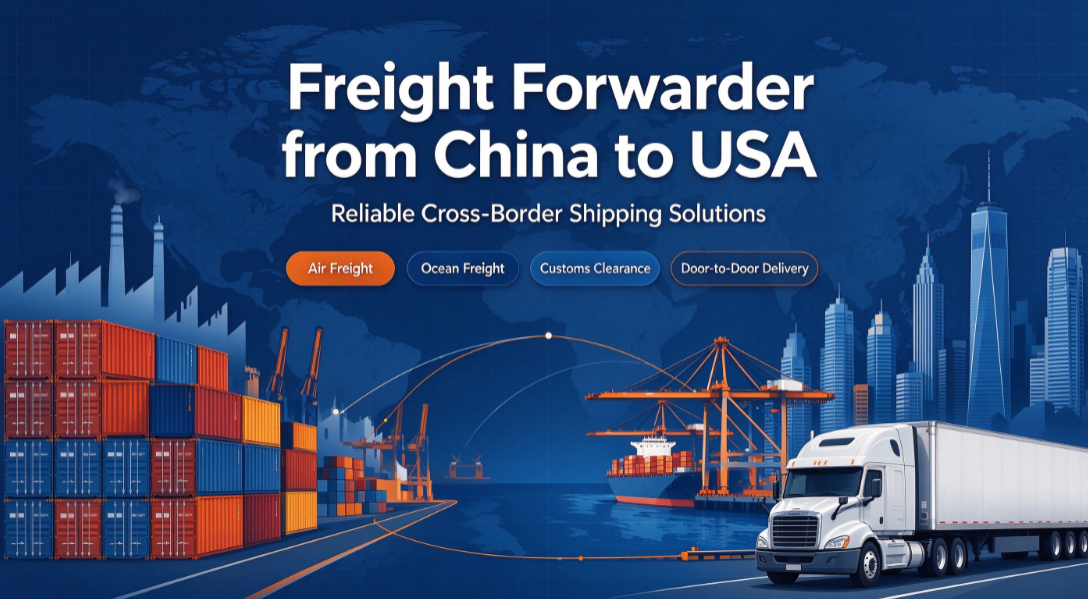
When you work with a specialized freight forwarder from China to USA, their scope of work covers both sides of the Pacific:
Shibida Logistics(Top China freight forwarders)Cross-Border Logistics Line
Services: Sea Freight, Air Freight, DDP, FCL, LCL, Amazon FBA First Mile
Shibida Logistics(Top China freight forwarders) specializes in door-to-door one-stop shipping to the US, Europe, the Middle East and Southeast Asia. We deliver reliably with high on-time rates, own container pickup & trailer fleet, 18 years of experience, and have served over 30,000 enterprises.
View Logistics Solutions Get Detailed Quotation
Contact Us
📞 Phone: +86 15813899064
📧 Email: 732175850@qq.com
💬 WeChat ID: 15813899064
Scan WeChat QR Code

Origin Operations in China: Factory pick-up (drayage), multi-supplier warehouse consolidation, export documentation, China Customs declaration (H2000 system), and port terminal loading.
International Transportation: Booking container space (FCL/LCL) on ocean liners or securing air cargo charter/scheduled flights.
US Destination Clearance: Partnering with licensed US Customs Brokers to file Importer Security Filings (ISF), clear Automated Commercial Environment (ACE) entries, manage FDA/CPSC compliance, and pay duties/taxes.
Last-Mile Delivery: De-consolidation at US bonded warehouses, transloading onto domestic dry vans, intermodal rail transfer, or final delivery to commercial warehouses, Amazon FBA fulfillment centers, or residential doors.
2. Complete Comparison of Shipping Modes
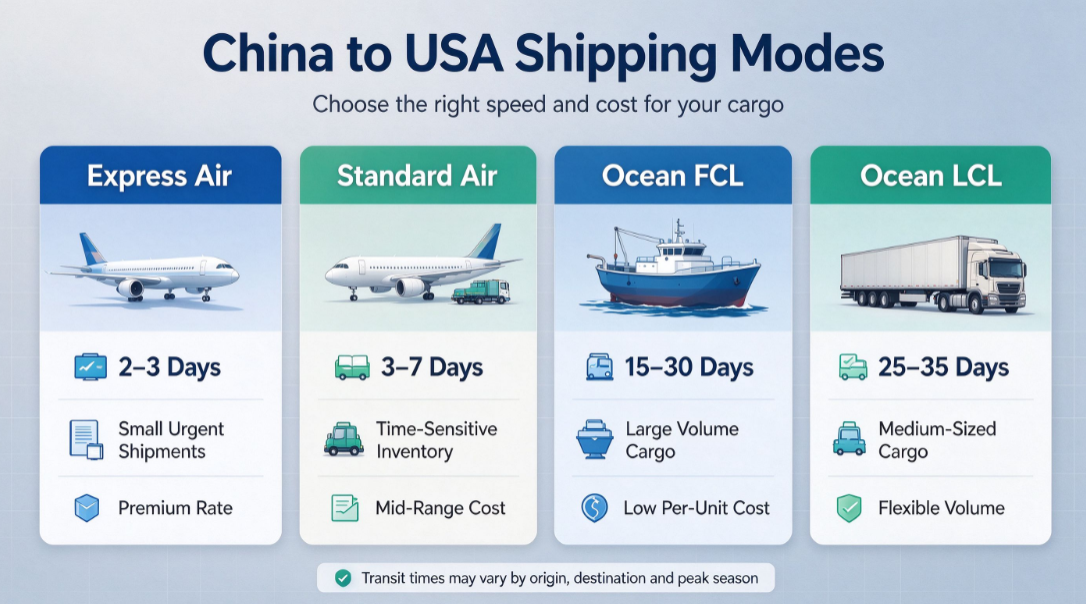
Selecting the optimal transport method depends on your shipment's total volume (CBM), gross weight (KG), unit value, and target lead time.
| Shipping Mode | Ideal Weight / Volume | Door-to-Door Transit Time | Cost Scale & Structure | Best Suited For |
|---|---|---|---|---|
| Courier Express (DHL / FedEx / UPS) | < 100 kg / < 0.5 CBM | 3 – 5 Days | Highest ($6.00–$10.00 / kg) | Product samples, urgent restocks, high-margin micro-batches. |
| Standard Air Freight (Airport-to-Airport) | 100 kg – 1,000 kg | 6 – 10 Days | High ($4.00–$7.00 / kg) | High-value electronics, seasonal apparel, tight deadline goods. |
| Fast Sea Freight (Matson / Mason Express) | > 1 CBM or 200+ kg | 12 – 18 Days (US West Coast) | Moderate ($1.50–$3.00 / kg equivalent) | E-commerce sellers who need near-air speed at sea prices. |
| Sea Freight: LCL (Less than Container Load) | 1 CBM – 15 CBM | 25 – 40 Days | Low ($120–$250 / CBM) | Small-to-medium palletized commercial cargo shared in a container. |
| Sea Freight: FCL (20GP / 40GP / 40HQ) | > 15 CBM (Full Container) | 18 – 35 Days (West vs East Coast) | Lowest cost per unit volume | Bulk factory production runs maximizing container capacity. |
| DDP Air / DDP Sea (Delivered Duty Paid) | Any size (e-commerce ready) | Air: 8–12 Days Sea: 20–35 Days | All-inclusive price (Freight + Tax + Trucking) | Amazon FBA sellers & importers wanting zero customs hassle. |
3. Key Ports & Transit Timelines (China Major Origins to US Destinations)
Transit times vary significantly based on whether cargo is bound for the US West Coast (USWC) or East Coast (USEC). China's primary departure ports include Shanghai, Ningbo, Shenzhen (Yantian/Shekou), Guangzhou (Nansha), and Qingdao.
Ocean Freight Port-to-Port Transit Breakdown:
China to US West Coast (Ports of Los Angeles / Long Beach / Oakland): 12 to 16 Days (Fast vessels like Matson) | 16 to 22 Days (Standard services like COSCO, CMA CGM, ONE).
China to US East Coast (Ports of New York / New Jersey / Savannah / Charleston via Panama Canal): 25 to 35 Days.
China to US Midwest (Chicago, Dallas, Memphis via MLB - Mini Land Bridge Rail): 22 to 30 Days.
Note: Add 5 to 7 days for origin pick-up, loading, US customs processing, and final warehouse drayage to obtain total door-to-door timeline.
4. Crucial International Commercial Terms (Incoterms 2020)
Choosing the correct Incoterm with your Chinese supplier dictates where liability shifts and who pays for each segment of transport.
FOB (Free On Board - Highly Recommended): The Chinese factory handles inland trucking, export declaration, and port loading fees in China. You (via your freight forwarder) control international shipping, choice of carrier, insurance, and US import clearance. This prevents suppliers from padding shipping margins.
EXW (Ex Works): You are responsible for picking up cargo directly from the factory floor in China and paying all Chinese export fees, inland freight, and export clearance. High control, but high operational complexity.
CIF / CFR (Cost, Insurance & Freight): The seller arranges transport to the US arrival port. Warning: Sellers often select low upfront ocean freight rates with hidden destination port charges (CISF fees) that you will be forced to pay upon arrival in America.
DDP (Delivered Duty Paid): The forwarder or seller handles everything—origin pickup, shipping, US clearance, duty payment, and final delivery to your door. Ideal for Amazon FBA sellers who do not want to manage tax payments directly.
5. Step-by-Step Practical Shipping Workflow
Executing an import order smoothly requires staying ahead of critical operational milestones:
Step 1: Quoting & Space Reservation
Provide your forwarder with cargo specs: commodity name, HS code, carton counts, total weight, total CBM, pickup address in China, and destination ZIP code in the US. Lock in carrier booking 10–14 days before production completes.Step 2: Cargo Inspection & Factory Pickup
Upon cargo readiness, your forwarder dispatches a container truck to the factory or receives goods at their consolidation warehouse (Shenzhen, Yantian, Yiwu, or Shanghai).Step 3: Export Clearance in China
Customs brokers submit the Chinese export license, commodity clearance documents, and commercial papers. Container passes terminal gates and loads onto the vessel.Step 4: Mandatory Pre-Filing (ISF 10+2)
At least 24 hours before the vessel departs China, your forwarder submits 10 data elements (importer of record, manufacturer, buyer, seller, etc.) plus 2 carrier elements to US Customs and Border Protection (CBP). Late filing triggers an automated $5,000 fine per shipment.Step 5: Ocean Transit & US Customs Clearance
While en route, your forwarder files the 7501 Entry Summary with CBP. Duties, Harbor Maintenance Fees (HMF), and Merchandise Processing Fees (MPF) are calculated.Step 6: Terminal De-consolidation & Final Drayage
The ship docks. Containers pass physical X-ray inspections (if flagged). Goods are transloaded or hitched to chassis trucks for final delivery to commercial hubs or Amazon FBA fulfillment centers.
6. Required Documentation & US Customs Compliance
Improper documentation causes cargo holds, customs exams, demurrage penalties ($150–$350/day per container), and potential seizures. Ensure your forwarder verifies all paperwork before departure:
Commercial Invoice (CI): Must detail buyer/seller details, country of origin (China), exact item description, unit price, total value, and 10-digit HTS Code (Harmonized Tariff Schedule).
Packing List (PL): Details total packages, carton marks, individual carton dimensions, gross weight, and net weight for accurate warehouse handling.
Bill of Lading (B/L) / Air Waybill (AWB): The title document issued by the carrier or NVOCC. Can be issued as a Master B/L (MBL) or House B/L (HBL). Express Telex Release is common for fast clearance.
US Customs Bond: Mandatory for importing commercial goods into the US valued over $2,500.
Single Entry Bond (SEB): Good for one individual shipment; costs roughly $50–$100 + duty percentage.
Continuous Customs Bond: Covers all shipments over a 12-month period. Recommended if importing more than 3 times a year (~$450–$600 annually).
Section 301 China Tariffs: Additional punitive duties (ranging from 7.5% to 25%+) applied to specific Chinese-origin products under List 1 through List 4A. Always verify your HTS code duty exposure in advance.
Partner Government Agency (PGA) Declarations: Special permits required for regulated items: FDA (food contact, medical, beauty), CPSC (children's toys), FCC (wireless electronics), or EPA (emissions/chemical items).
7. Amazon FBA Freight Forwarding (Specialized Requirements)
Shipping direct to Amazon fulfillment centers (ONT8, GYR1, FTW1, etc.) requires compliance with strict Amazon seller guidelines:
FNSKU Labeling: Each unit must have an scannable Amazon FNSKU barcode before packing.
Palletization Rules: US Amazon warehouses accept GMA Standard 48" x 40" wooden pallets, max height 72 inches, wrapped in clear stretch film with 4 location labels on each side.
CARP Booking: Delivery trucks must schedule strict delivery appointments via Amazon’s Carrier Appointment Request Portal (CARP). Experienced forwarders manage this automatically.
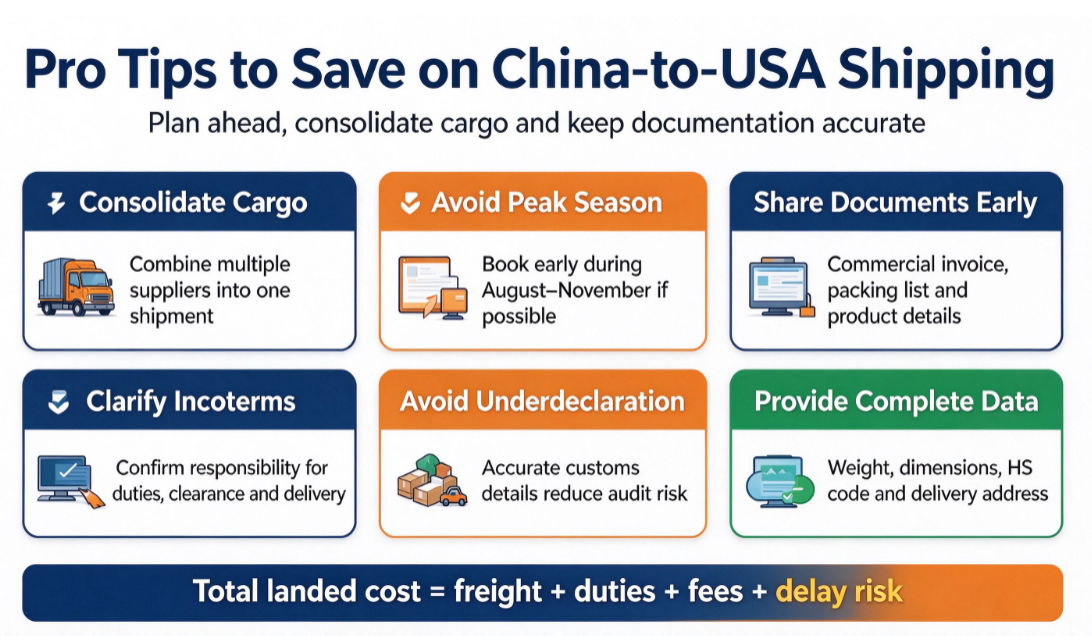
8. Veteran Operational Tips: How to Lower Freight Expenses & Avoid Delays
Insider Rules of Thumb for Importers:
1. Master Chargeable Weight Calculations: Express and air carriers charge based on Dimensional (Volumetric) Weight if it exceeds gross weight.
Formula: Air Volumetric Weight (KG) = Length (cm) × Width (cm) × Height (cm) / 6000 (or 5000 for Courier). Instruct factories to minimize master carton dead space!
2. Prepare for Major Chinese Holidays: Production shuts down completely during Chinese New Year (Jan/Feb) and Golden Week (Oct 1–7). Lock in container space at least 3 to 4 weeks prior to holiday cut-offs to avoid rolled bookings and freight rate spikes.
3. Verify NVOCC Licensing: Ensure your freight forwarder holds a valid FMC (Federal Maritime Commission) license and NVOCC status in the US, or a Class-A freight forwarding license in China. This guarantees legal standing and direct access to carrier ocean contracts.
4. Audit Your Freight Invoices: Watch for hidden destination line items such as chassis split fees, pier pass, congestion surcharges, or peak season surcharges (PSS). Request an itemized, binding quote before booking.
How to Book
To take advantage of these new routes and services, simply:
- Contact our dedicated 【freight forwarder from china to usa】 desk at Contact
- Provide details of your shipment (cargo type, volume, pickup location)
- Receive a customized quote within 24 hours
- Confirm your booking and prepare your goods for shipment
Our team specialists is ready to assist with all aspects of your shipment, from documentation to delivery.
About Shibida Logistics
Shibida Freight Forwarding is a leading private logistics service provider based in China, offering comprehensive export logistics and warehousing services, international freight forwarding, FBA dedicated logistics, US overseas warehouses, and international logistics services from China to the world by land, air, and sea.
With our headquarters in Shenzhen and branch offices/agents covering almost all major cities and seaports in China, we strive to deliver your cargo to any destination worldwide safely, timely, and at reasonable prices.
For more information about our new Australia routes or to request a quote, please contact us today.