Shibida Logistics Team
Logistics Expert
Executive Summary: Shipping freight from mainland China to Honolulu, Hawaii presents a unique logistical architecture. Unlike direct trade lanes to the US West Coast (such as Los Angeles or Long Beach), cargo bound for Oahu undergoes a two-leg maritime transit or specialized air routing. Ocean freight predominantly travels from major Chinese origins (Shanghai, Ningbo, Shenzhen, Qingdao) to US Pacific Southwest ports before transshipping via Jones Act-compliant domestic carriers (e.g., Matson, Pasha Hawaii) to Honolulu Harbor (Port Code 3201). This complete guide analyzes modal selection (FCL vs. LCL vs. Air Freight), vessel classification standards, regulatory compliance (CBP, ISF, USDA Hawaii Agricultural Declarations), door-to-door delivery costs, realistic transit times, and actionable case studies for commercial importers, e-commerce brands, and Amazon FBA sellers.
1. Vessel Classification & Strategic Cargo Routing to Hawaii
Understanding vessel specifications and shipping mechanics is critical when planning trans-Pacific supply chains to island economies. Hawaii’s geographic isolation makes it 100% dependent on maritime and air supply chains, where ship capabilities dictate freight integrity, lead times, and cost structures.
Below is an operational breakdown of commercial cargo vessel classifications utilized across the primary and secondary legs of the China-to-Honolulu shipping corridor:
Shibida Logistics(Top China freight forwarders)Cross-Border Logistics Line
Services: Sea Freight, Air Freight, DDP, FCL, LCL, Amazon FBA First Mile
Shibida Logistics(Top China freight forwarders) specializes in door-to-door one-stop shipping to the US, Europe, the Middle East and Southeast Asia. We deliver reliably with high on-time rates, own container pickup & trailer fleet, 18 years of experience, and have served over 30,000 enterprises.
View Logistics Solutions Get Detailed Quotation
Contact Us
📞 Phone: +86 15813899064
📧 Email: 732175850@qq.com
💬 WeChat ID: 15813899064
Scan WeChat QR Code

| Vessel Classification | Operational Capacity | Primary Cargo Handled | Routing Relevance to Honolulu |
|---|---|---|---|
| ULCV & Neopanamax Container Ships | 14,000 to 24,000 TEU | Standard ISO Containers (20ft, 40ft, 40ft HQ, 45ft HQ) | Trans-Pacific Leg 1: Operates deep-sea routes from Shanghai/Shenzhen to US West Coast gateway hubs. Cannot berth directly at Honolulu due to draft limitations. |
| ConRo & Jones Act Vessels | 1,500 to 3,600 TEU / Wheeled Units | Containers, Rolling Stock, Heavy Equipment, Vehicles | Pacific Leg 2: US-flagged domestic feeder vessels (Matson / Pasha Hawaii) operating between California (LA/LGB/Oakland) and Honolulu Harbor (Sand Island Terminal). |
| General Cargo & Multi-Purpose Ships (MPV) | 10,000 to 30,000 DWT | Breakbulk, Heavy Machinery, Steel Coils, Oversized Structures | Direct charter or breakbulk routing to Pier 31/32 at Honolulu Port for industrial construction or infrastructure projects. |
| Reefer Vessels / Specialized Reefer Ships | 200,000 to 600,000 cu. ft. | Temperature-Controlled Produce, Frozen Seafood, Pharmaceuticals | Cold-chain logistics from China. Utilizes integrated refrigerated containers (Reefers) via mainliners with continuous power monitoring at transshipment points. |
The Two-Leg Transshipment Architecture: Over 95% of ocean container freight moving from China to Honolulu does not travel on a single direct vessel call. The logistics chain is broken into two mandatory operational legs:
Leg 1 (International Ocean Transit): Container is loaded at Chinese ports (e.g., Shanghai, Ningbo, Yantian) and sails across the Pacific to major US West Coast ports—primarily Los Angeles (LA), Long Beach (LGB), or Oakland (OAK).
Leg 2 (Domestic Jones Act Intermodal Transfer): Cargo clears US Customs or enters a bonded transfer zone, where the container is drayed across town or transferred directly to a US-flagged, US-built, and US-crewed domestic vessel (governed by the Merchant Marine Act of 1920 / Jones Act) for final transit to Honolulu Harbor.
2. Main Chinese Origins & Honolulu Destination Gateways
To optimize domestic haulage in China and minimize transit friction in Hawaii, shippers must align origin seaports and airports with destination postal routes on Oahu or neighbor islands.
Primary China Export Hubs:
East China (Yangtze River Delta): Shanghai Port (PVG/SHA) and Ningbo-Zhoushan Port. Best for general merchandise, industrial machinery, textiles, electronics, and goods sourced from Zhejiang, Jiangsu, and Anhui provinces.
South China (Pearl River Delta): Shenzhen (Yantian/Shekou - SZX), Guangzhou (Nansha - CAN), and Hong Kong (HKG). Ideal for consumer electronics, furniture, building materials, and fast-fashion e-commerce. HKG provides unmatched air-freight capacity.
North China: Qingdao Port and Tianjin Port (TSN). Primary export hubs for heavy machinery, raw materials, solar panels, and hardware from Shandong and Hebei regions.
Southwest / Central China: Xiamen Port, plus inland air hubs at Chengdu (TFU) and Chongqing (CKG) via feeder networks.
Hawaii Destination Coverage & Delivery Zones:
Honolulu serves as the primary distribution hub for the entire state of Hawaii. Once cargo reaches Oahu, freight is either dispatched for local door delivery or staged for inter-island barge transfer.
| Destination Hub / Zone | Facility & Port Code | Primary Services & Handling Capabilities |
|---|---|---|
| Honolulu Port (Oahu Core) | Sand Island Terminal / Pier 51–53 (Port Code: 3201) | Primary container terminal for FCL/LCL ocean imports. Handles all major Jones Act vessel arrivals and local container drayage. |
| Honolulu Airport (HNL) | Daniel K. Inouye International Airport (HNL) | Main air cargo gateway. Equipped with cold-storage facilities, express courier hubs (DHL, FedEx, UPS), and customs clearance facilities. |
| Industrial Delivery Zones (Oahu) | Mapunapuna, Iwilei, Campbell Industrial Park (Kapolei) | Concentration of commercial warehouses, wholesale distributors, and Amazon FBA Fulfillment Centers (e.g., HNL1 / HNL6). |
| Neighbor Island Transshipment | Kahului (Maui), Hilo/Kawaihae (Big Island), Nawiliwili (Kauai) | Secondary ocean freight distribution via Young Brothers inter-island barge services from Honolulu Harbor. Adds 3–6 days total transit time. |
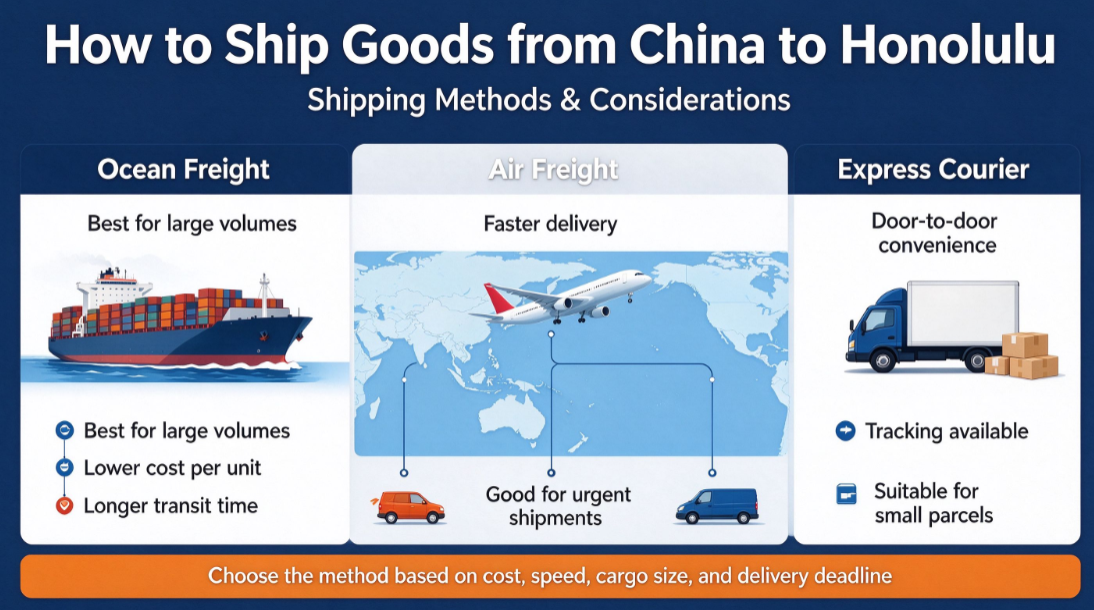
3. Shipping Modes: FCL, LCL, Air Freight & Express
Choosing the correct shipping mode depends on four factors: cargo volume (CBM), gross weight (KG), budgetary constraints, and inventory urgency.
A. Full Container Load (FCL) Ocean Freight
Best suited for shipments exceeding 15 Cubic Meters (CBM) or high-volume commercial goods. You rent an entire container exclusively for your cargo.
20ft Standard Container: ~28–30 CBM usable capacity; maximum payload ~21,500 kg.
40ft Standard Container: ~56–58 CBM usable capacity; maximum payload ~26,000 kg.
40ft High Cube (HQ): ~65–68 CBM usable capacity; ideal for voluminous, lightweight products.
B. Less than Container Load (LCL) Ocean Freight
Designed for smaller shipments ranging from 1 CBM to 15 CBM. Cargo from multiple shippers is consolidated into a single shared container at a Container Freight Station (CFS) in China (e.g., Shanghai CFS) and de-consolidated at a CFS near Honolulu Harbor.
C. Standard Air Freight
Recommended for urgent, high-value, or low-volume goods (100 kg to 2,000 kg) such as electronics, fashion samples, or medical equipment. Air cargo moves via passenger lower-deck space or dedicated freighters from hubs like HKG, PVG, or CAN, connecting via LAX/SFO/SEA to HNL. Chargeable weight is calculated on actual gross weight vs. volumetric weight ($L \times W \times H \text{ in cm} / 6000$), whichever is greater.
D. Express Courier (Door-to-Door)
Best for urgent small parcels, critical documentation, or product samples under 100 kg. Premium couriers (DHL, FedEx, UPS) handle pickup, international flight transit, US import clearance, and final mile delivery on Oahu with end-to-end tracking.
4. Freight Cost Breakdown & Transit Time Benchmarks
Shipping to Hawaii involves ocean ocean freight charges, US West Coast port handling, Jones Act domestic ocean freight, customs duties, and local Oahu delivery. Below are realistic market benchmarks for planning imports from China to Honolulu.
| Shipping Mode | Estimated Cost Benchmark | Port-to-Port Transit | Door-to-Door Lead Time (Honolulu) |
|---|---|---|---|
| FCL (20ft Container) | $4,200 – $6,200 / container | 16 – 22 Days | 22 – 30 Days |
| FCL (40ft HQ Container) | $5,800 – $8,500 / container | 16 – 22 Days | 22 – 30 Days |
| LCL Ocean Freight | $130 – $190 / CBM (Door to Door) | 20 – 26 Days | 28 – 35 Days |
| Standard Air Freight | $6.50 – $12.00 / kg | 3 – 5 Days | 6 – 10 Days |
| Express Courier (DHL/FedEx) | $9.00 – $15.00 / kg | 2 – 3 Days | 3 – 5 Days |
Critical Ancillary & Destination Fee Checklist:
When requesting quotes (DDP vs. DDU/DAP), ensure your freight forwarder accounts for these line-item fees to avoid unexpected billing:
Origin Charges (China): Export customs declaration, terminal handling charges (THC), CFS consolidation fee (for LCL), pick-up drayage.
International Ocean / Air Freight: Base ocean rate, Bunker Adjustment Factor (BAF), Low Sulfur Surcharge (LSS), Peak Season Surcharge (PSS).
US Customs & Statutory Fees:
Merchandise Processing Fee (MPF): Ad valorem fee of 0.3464% of cargo value (formal entry minimum and maximum caps apply).
Harbor Maintenance Fee (HMF): 0.125% of cargo value (applies to ocean imports).
Customs Brokerage Fee: Standard entry filing (~$120–$180 per entry).
Single/Continuous Customs Bond: Required for commercial imports into the US.
Section 301 Tariffs: Additional tariffs applied to specific China-origin HTS classifications.
Destination & Island Charges (Hawaii):
West Coast transshipment and drayage fees.
Hawaii Terminal Handling Charge (DTHC).
Hawaii Agricultural Inspection Fee.
Liftgate truck delivery or Oahu warehouse staging fees.
5. Customs Compliance, Documentation & Hawaii Regulations
Importers shipping from China into Honolulu must strictly comply with both US Federal (CBP) regulations and State of Hawaii Department of Agriculture requirements.
1. Import Security Filing (ISF 10+2)
For ocean freight, the ISF must be transmitted electronically to US Customs and Border Protection (CBP) at least 24 hours before the vessel is loaded at the Chinese port of origin. Late or inaccurate filing results in a mandatory $5,000 penalty per violation from CBP.
2. Essential Shipping Documents
Commercial Invoice: Must outline seller/buyer details, exact Harmonized Tariff Schedule (HTS) 10-digit codes, itemized values, currency, and Incoterms.
Packing List: Details net/gross weight, box dimensions, carton counts, and packaging types (e.g., wooden pallets).
Bill of Lading (BOL) or Air Waybill (AWB): The official contract of carriage. Master BOL for ocean carriers; House BOL provided by freight forwarders.
Certificate of Origin: Necessary to prove manufacturing origin and determine applicable tariff rates.
3. Hawaii Agricultural Inspection & Wood Packaging (ISPM-15)
Due to Hawaii's vulnerable ecosystem, incoming cargo is subjected to stringent biosecurity controls:
ISPM-15 Compliance: All solid wood packaging materials (pallets, crates, dunnage) originating in China must be heat-treated (HT) or fumigated with methyl bromide and bear the official IPPC stamp. Non-compliant wood packing will result in immediate rejection, quarantine, or re-exportation at the importer's expense.
Hawaii Department of Agriculture (HDOA) Declaration: Shipments containing plants, plant products, soil, timber, organic matter, or food products require prior notification and physical inspection upon arrival at Honolulu Harbor or HNL Airport.
6. End-to-End Operational Shipping Process
Executing a successful shipment from factory floor to an Oahu warehouse requires careful management across six distinct operational steps:
| Phase | Key Action Items | Responsible Parties |
|---|---|---|
| Step 1: Booking & Cargo Ready Date (CRD) | Confirm order completion with Chinese supplier. Select shipping mode (FCL/LCL/Air). Book space with a freight forwarder specializing in Hawaii lanes. | Importer & Freight Forwarder |
| Step 2: China Pick-up & Export Clearance | Arrange container drayage or LCL truck pickup. Transport cargo to origin port (e.g., Shanghai/Ningbo). Complete Chinese export customs declaration. | Supplier & Forwarder’s Local Agent |
| Step 3: Filing & Main Ocean/Air Transit | Submit ISF 10+2 at least 24 hours prior to vessel departure. Ocean liner departs China for US West Coast gateway hub (LA/LGB). | US Customs Broker & Ocean Carrier |
| Step 4: US West Coast Transshipment | Cargo arrives at West Coast port. Container is transferred to a domestic Jones Act carrier (Matson/Pasha) bound for Honolulu Harbor. | Domestic Terminal Operator & Jones Act Line |
| Step 5: US Customs & Hawaii Clearance | Broker files entry summary (CBP Form 7501), pays MPF/HMF/Duties. HDOA conducts agricultural screening if applicable. | CBP, HDOA, Customs Broker |
| Step 6: Final Mile Oahu Delivery | Container or LCL lot is dispatched from Sand Island Terminal or HNL air cargo hub. Trucker delivers to destination (e.g., Kapolei warehouse or Amazon FBA HNL1) via liftgate/flatbed. | Local Drayage Trucker & Importer |
7. Real-World Case Studies
Case Study A: E-Commerce Furniture Importer (FCL Ocean Route)
Background: A commercial home decor brand based in Kapolei, Oahu imported outdoor modular furniture from a manufacturing facility in Foshan (Guangzhou), China.
Shipment Profile: 1 x 40ft High Cube Container (~62 CBM, Gross Weight: 9,500 kg).
Logistical Execution: Cargo loaded at Foshan factory, trucked to Nansha Port (Guangzhou). Sailed via ocean liner to Long Beach, CA (14 days ocean transit). Transferred at Long Beach to a Matson domestic service vessel arriving at Honolulu Sand Island Terminal (5 days transit). Total port-to-port time: 19 days.
Financial Breakdown:
Base Freight & Sur-charges (China to West Coast + West Coast to Honolulu): $6,850
Origin Drayage & Customs Clearance in China: $450
US Customs Brokerage, ISF Filing, MPF & HMF Fees: $380
Destination Drayage (Honolulu Harbor to Kapolei Warehouse): $650
Total Door-to-Door Investment: $8,330
Lead Time Outcome: Total door-to-door transit completed in 27 calendar days.
Case Study B: High-End Boutique Retailer (LCL Ocean Route)
Background: A resort wear retailer in Waikiki ordered seasonal apparel from a supplier in Ningbo, China.
Shipment Profile: 4 CBM, total weight 850 kg (packed on 4 ISPM-15 heat-treated pallets).
Logistical Execution: Supplier delivered goods to Ningbo CFS for LCL consolidation. Consolidated container sailed to Los Angeles CFS, de-consolidated, and transferred via LCL feeder service to Honolulu harbor CFS.
Financial Breakdown:
All-inclusive LCL Ocean Freight Rate ($155 per CBM x 4 CBM): $620
Customs Entry Clearance & Single Continuous Bond allocation: $220
Destination CFS Handling & Local Oahu Delivery to Waikiki store: $280
Total Door-to-Door Investment: $1,120
Lead Time Outcome: Delivered in 31 days from factory pickup to store receipt.
8. Frequently Asked Questions (FAQ)
Q1: Why does shipping ocean freight from China to Honolulu take longer than shipping to Los Angeles?
Because there are virtually no direct commercial container liner calls from mainland China to Honolulu. Cargo must first travel to major US West Coast hub ports (LA, Long Beach, Oakland), clear customs or bonded transfer processes, and be re-loaded onto domestic Jones Act-compliant vessels servicing the California-to-Hawaii lane.
Q2: What is the Jones Act, and how does it impact shipping rates to Hawaii?
The Merchant Marine Act of 1920 (Jones Act) requires that all waterborne cargo transported between US coastwise ports (such as California to Hawaii) be carried on ships built in the United States, flagged in the US, and owned/crewed by US citizens. Because domestic carrier operating costs are higher than international flags, the second leg of shipping to Honolulu adds a fixed structural cost to Hawaii logistics.
Q3: Can I ship goods from China directly to Amazon FBA warehouses in Hawaii?
Yes. Amazon operates fulfillment facilities on Oahu (e.g., HNL1, HNL6). However, your freight forwarder must offer DDP (Delivered Duty Paid) services, handle all US import customs clearance under your Importer of Record (IOR) details, and schedule mandatory delivery appointments through Amazon’s Carrier Central portal prior to dispatching trucks to the warehouse.
Q4: Are there specialized customs requirements for importing wood furniture or bamboo products into Hawaii?
Yes. Beyond standard US Customs tariffs, any agricultural, plant-based, or wooden items imported into Hawaii are scrutinized by the Hawaii Department of Agriculture (HDOA). Wood packaging materials must strictly bear valid ISPM-15 stamps demonstrating heat treatment or chemical fumigation to prevent invasive pest introductions. Raw plant or untreated timber products may require specialized import permits.
How to Book
To take advantage of these new routes and services, simply:
- Contact our dedicated 【How to Ship Goods from China to Honolulu, Hawaii, USA】 desk at Contact
- Provide details of your shipment (cargo type, volume, pickup location)
- Receive a customized quote within 24 hours
- Confirm your booking and prepare your goods for shipment
Our team specialists is ready to assist with all aspects of your shipment, from documentation to delivery.
About Shibida Logistics
Shibida Freight Forwarding is a leading private logistics service provider based in China, offering comprehensive export logistics and warehousing services, international freight forwarding, FBA dedicated logistics, US overseas warehouses, and international logistics services from China to the world by land, air, and sea.
With our headquarters in Shenzhen and branch offices/agents covering almost all major cities and seaports in China, we strive to deliver your cargo to any destination worldwide safely, timely, and at reasonable prices.
For more information about our new Australia routes or to request a quote, please contact us today.