Shibida Logistics Team
Logistics Expert
Executive Summary: FOB (Free on Board) is one of the most widely used Incoterms (International Commercial Terms) in global trade and ocean freight shipping. Defined by the International Chamber of Commerce (ICC), FOB establishes the precise geographic point where financial costs, operational responsibilities, and cargo loss risk transition from the seller (exporter) to the buyer (importer). Under standard FOB terms, the seller is responsible for inland transportation, export customs clearance, and loading the cargo onto the vessel at the named port of origin. Once the goods pass the ship's rail (or are safely loaded aboard), the buyer assumes full control, paying for main international ocean freight, destination customs, marine insurance, and final delivery. Understanding the critical differences between FOB Shipping Point and FOB Destination, along with practical cost breakdowns and risk mitigation strategies, is essential for optimizing supply chain efficiency and avoiding expensive logistical disputes.
1. Introduction: What Does FOB Mean in Shipping?
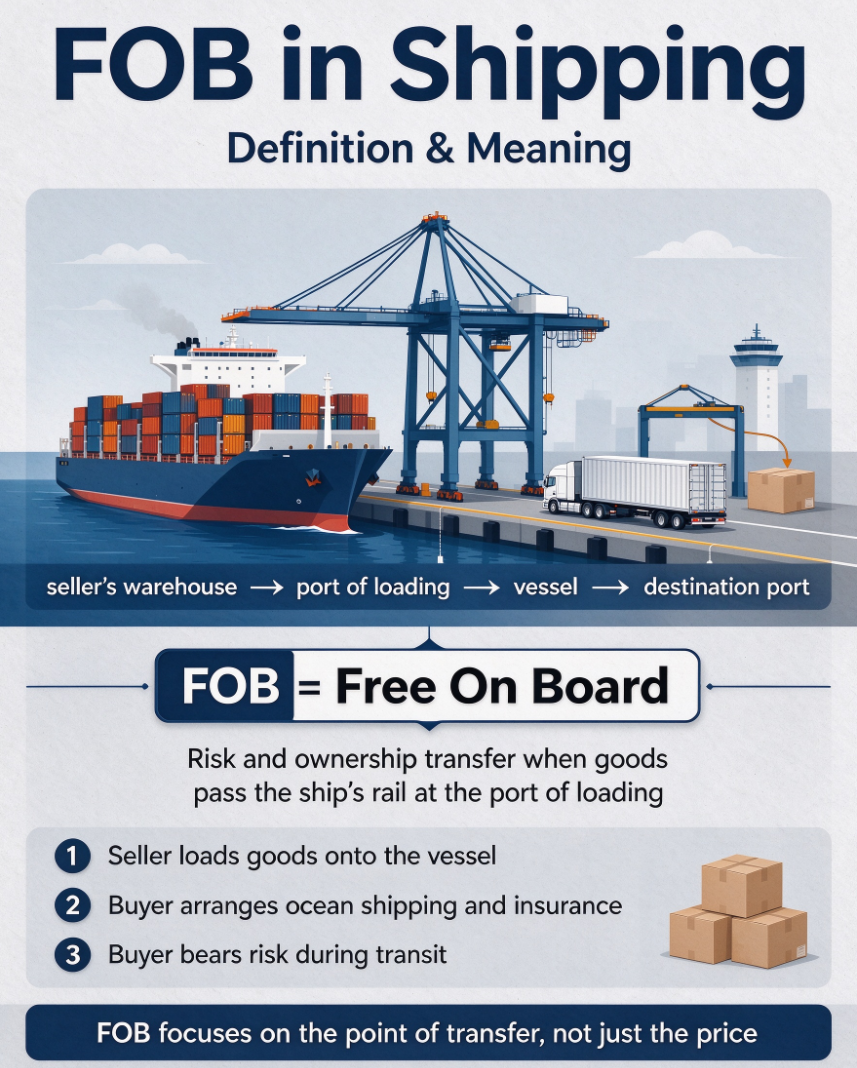
If you have ever sourced products overseas or managed an international supply chain, you have undoubtedly encountered the acronym FOB. Standing for "Free on Board" (or historically "Freight on Board"), FOB is an internationally recognized standard contract term maintained by the International Chamber of Commerce (ICC) under the Incoterms® framework.
At its core, FOB answers three fundamental questions for buyers and sellers engaged in cross-border commerce:
Shibida Logistics(Top China freight forwarders)Cross-Border Logistics Line
Services: Sea Freight, Air Freight, DDP, FCL, LCL, Amazon FBA First Mile
Shibida Logistics(Top China freight forwarders) specializes in door-to-door one-stop shipping to the US, Europe, the Middle East and Southeast Asia. We deliver reliably with high on-time rates, own container pickup & trailer fleet, 18 years of experience, and have served over 30,000 enterprises.
View Logistics Solutions Get Detailed Quotation
Contact Us
📞 Phone: +86 15813899064
📧 Email: 732175850@qq.com
💬 WeChat ID: 15813899064
Scan WeChat QR Code

Cost Allocation: Who pays for each leg of the journey, from the factory floor to the final warehouse?
Risk Transfer: At what exact moment does the risk of cargo damage, loss, or theft transfer from the supplier to the buyer?
Operational Responsibility: Who is legally obligated to arrange export documentation, customs clearance, vessel loading, and main ocean carriage?
The word "Free" in Free on Board refers to the seller's obligation: once the seller loads the goods onto the specified vessel at the designated port of shipment, they are "free" of further responsibility or financial liability. From that exact juncture, all risks and freight expenses shift directly to the buyer.
2. The Core Mechanics of FOB: How Risk and Cost Shift
To master FOB shipping, one must understand the precise boundary line where duties change hands. In shipping terminology, this boundary is commonly referred to as the Point of Transfer.
Under modern Incoterms rules (such as Incoterms 2020), FOB is strictly reserved for ocean and inland waterway transport. It should not technically be used for multimodal container shipments (where terms like FCA - Free Carrier are more appropriate), though in real-world trade practices, merchants often apply FOB broadly to containerized ocean cargo.
The Two Phases of an FOB Transaction
| Logistics Step / Cost Element | Seller's Responsibility | Buyer's Responsibility |
|---|---|---|
| Commercial Packaging & Labeling | YES — Prepares cargo for export | NO |
| Factory Pickup & Inland Trucking (Origin) | YES — Pays drayage to origin port | NO |
| Export Customs Clearance & Duties | YES — Handles export declarations | NO |
| Origin Port Terminal Handling Charges (THC) | YES — Pays origin terminal fee | NO |
| Vessel Loading (Goods placed on board) | YES — Risk shifts once loaded | NO |
| Main Ocean Freight Charge | NO | YES — Contracts freight forwarder |
| Marine Cargo Insurance | NO (Optional for own risk) | YES — Highly recommended |
| Destination Port THC & Demurrage | NO | YES — Pays arrival charges |
| Import Customs Clearance, Tariffs & Taxes | NO | YES — Acts as Importer of Record |
| Final Inland Delivery (Destination Warehouse) | NO | YES — Arranges final delivery truck |
3. Key Variations: FOB Shipping Point vs. FOB Destination
While international ocean trade strictly adheres to the ICC Incoterms definition of FOB (Named Port of Shipment), North American domestic trade (under the Uniform Commercial Code - UCC) frequently categorizes FOB into two primary sub-types: FOB Shipping Point and FOB Destination.
Distinguishing between these two variations is critical because they dictate revenue recognition for accountants and liability boundaries for logistics managers.
A. FOB Shipping Point (FOB Origin)
Under FOB Shipping Point, title of ownership and risk of loss pass to the buyer the moment the goods are handed over to the carrier at the seller’s loading dock or origin port.
Risk Transfer: Occurs at the origin. If the truck crashes 10 miles after leaving the seller's factory, the buyer bears the loss.
Freight Costs: The buyer typically pays all freight charges directly to the carrier.
Accounting Impact: The buyer records the inventory on their balance sheet immediately when it leaves the origin facility. The seller recognizes sales revenue at dispatch.
B. FOB Destination
Under FOB Destination, the seller retains ownership, control, and risk until the goods physically arrive at the buyer's specified location (e.g., a distribution center in Los Angeles).
Risk Transfer: Occurs upon delivery at the destination door. If goods are damaged during transit across the ocean, it is entirely the seller's problem to solve with the carrier or insurer.
Freight Costs: The seller pays all transportation costs up to the buyer’s premises.
Accounting Impact: The seller retains the cargo on their balance sheet throughout transit and cannot recognize revenue until delivery is completed.
4. Cost Breakdown: What Fees are Included in an FOB Quote?
When an overseas manufacturer quotes you a price of "$15.50 per unit FOB Ningbo", what exactly are you paying for, and what hidden costs must you budget for separately?
What is Included in the Supplier's FOB Unit Price?
Cost of manufacturing and commercial packaging.
Local inland trucking from factory to Ningbo container terminal.
Export licenses, customs filing, and inspection fees at origin.
Terminal Handling Charges (THC) and doc fees assessed by the origin port terminal operator.
Vessel loading charge (crane operations to move container onto the ship).
What the Buyer Must Pay Separately (Landed Cost Calculations)
To arrive at your true Total Landed Cost, you must add the following expenses to the supplier's FOB price:
Ocean Freight Rate: Base container rate (FCL) or volume rate (LCL) billed by your freight forwarder.
Bunker Adjustment Factor (BAF) & Peak Season Surcharges (PSS): Carrier-imposed fuel and season surcharges.
Cargo Insurance: Usually 0.15% - 0.5% of total commercial invoice value.
Destination Port Terminal Handling (DTHC): Unloading and terminal fees at destination.
Import Duties & Taxes: Local tariffs based on your product’s Harmonized System (HS) Code.
Customs Brokerage Fees & Entry Bonds: Fees paid to clear customs at destination.
Final Drayage / Trucking: Moving the container from destination port to your warehouse.
5. Comparing Incoterms: FOB vs. CIF vs. EXW vs. DDP
To understand why importers choose FOB, it helps to evaluate it alongside other common Incoterms. Choosing the wrong term can severely impact logistics transparency and profit margins.
| Incoterm | Term Name | Seller Risk Ends | Main Freight Paid By | Best Suited For |
|---|---|---|---|---|
| EXW | Ex Works | Factory Door | Buyer | Experienced buyers with local origin networks |
| FOB | Free on Board | Loaded on Ship | Buyer | Standard Ocean Freight (FCL/LCL) — Highest Buyer Control |
| CIF | Cost, Insurance & Freight | Loaded on Ship | Seller | Buyers who prefer supplier-managed ocean shipping |
| DDP | Delivered Duty Paid | Buyer's Doorstep | Seller | Hands-off buyers wanting turnkey delivery |
FOB vs. CIF: The Practical Freight Battle
Novice importers often prefer CIF (Cost, Insurance, and Freight) because the seller manages the shipping process and includes main ocean freight in their price. However, experienced supply chain professionals overwhelmingly favor FOB for several key operational reasons:
Freight Rate Control: Under CIF, suppliers often mark up ocean freight costs to create an extra profit margin. Under FOB, you work directly with your chosen Freight Forwarder to negotiate competitive, transparent market rates.
Schedule Flexibility: With FOB, your forwarder can route cargo across multiple ocean carriers, choosing faster transit times or better sailing windows. Under CIF, the seller will choose the cheapest, slowest vessel available.
Avoiding Destination Hidden Fees: Under CIF contracts, suppliers frequently use origin agents who inflate destination terminal handling fees (DTHC) upon arrival. With FOB, your nominated forwarder outlines destination costs upfront.
6. Real-World Operational Workflow: An FOB Case Study
To illustrate how FOB works in daily freight forwarder operations, let us examine a typical import transaction between a seller in Yantian, China, and a buyer in Rotterdam, Netherlands.
Step-by-Step Scenario: 40ft Container of Electronics
Commercial Contract Agreement: Buyer agrees to purchase 1,000 units at $50/unit under terms "FOB Yantian Port, Incoterms 2020".
Booking Freight: The Dutch buyer contracts their trusted freight forwarder in Rotterdam to book a 40ft container on an ocean carrier sailing from Yantian to Rotterdam.
Factory Loading & Export Drayage: The Chinese manufacturer loads the goods into the container at their Shenzhen factory and hires a local drayage trucker to transport it to Yantian Container Terminal.
Export Customs Clearance: Supplier’s local export broker submits export paperwork to Chinese Customs and pays port terminal charges.
Vessel Loading (The Critical Shift): The container crane lifts the box onto the ship. Once placed securely on board, risk officially shifts to the buyer.
Ocean Transit: The ship sails. During the 28-day voyage, the Dutch buyer holds risk. (If a storm damages the cargo, the buyer files a claim under their ocean cargo insurance policy).
Arrival & Import Clearance: Upon arrival in Rotterdam, the buyer’s freight forwarder handles import customs, pays local VAT and tariffs, collects the container, and trucks it to the buyer's distribution center.
7. Expert Tips & Common Pitfalls to Avoid in FOB Shipping
Even seasoned logistics practitioners can run into trouble when executing FOB contracts. Here are critical insights learned from years of ocean freight management:
1. Watch Out for Container Roll-overs and Demurrage at Origin
Under strict FOB terms, the seller is responsible for getting cargo loaded on the ship. However, if the ship is overbooked and the carrier rolls your container to the next week’s vessel, disputes often arise over who pays the resulting container storage fees at the origin terminal. Ensure your purchase agreement clearly states who covers port storage fees caused by carrier delays.
2. Do Not Use FOB for Air Freight or Containerized Cargo (Technically)
The ICC specifically updated Incoterms to clarify that FOB is intended for non-containerized sea cargo and bulk freight (where cargo is loaded over the ship’s rail directly). For container shipping (where containers are handed over at an inland container depot or container yard before vessel loading), the technically correct Incoterm is FCA (Free Carrier).
While the industry frequently uses "FOB" casually for container shipping, using FCA protects buyers from paying origin port charges twice and establishes a precise risk point at container yard gate-in.
3. Always Purchase Marine Cargo Insurance
A common misconception among new buyers is that the shipping line pays for cargo damage during transit. Carrier liability under international maritime law (such as the Hague-Visby Rules) is extremely limited (often as low as $500 per package or container). Under FOB, once the goods are on board, securing comprehensive marine insurance (Clause A cargo cover) is entirely the buyer’s safety net.
8. Summary Checklist for Buyers & Sellers
Before signing a commercial contract utilizing FOB shipping terms, use this quick checklist to ensure seamless execution:
✔ Specify the Port Name Clearly: Write "FOB [Port Name], Incoterms 2020" (e.g., FOB Shanghai Port, Incoterms 2020). Avoid vague terms like "FOB China".
✔ Nominate a Reliable Freight Forwarder: Appoint a forwarder with dedicated agents in the origin country to communicate smoothly with your supplier.
✔ Verify Export Licenses: Confirm that the supplier is qualified to clear export customs in their home country.
✔ Align Payment Terms: Standard FOB contracts often pair with payment terms such as 30% deposit upon PO issuance, 70% balance paid upon presentation of the ocean Bill of Lading (B/L).
Mastering international trade terminology empowers your business to optimize logistics spend, mitigate supply chain risks, and maintain full transparency over global freight operations.
How to Book
To take advantage of these new routes and services, simply:
- Contact our dedicated 【what does fob mean in shipping】 desk at Contact
- Provide details of your shipment (cargo type, volume, pickup location)
- Receive a customized quote within 24 hours
- Confirm your booking and prepare your goods for shipment
Our team specialists is ready to assist with all aspects of your shipment, from documentation to delivery.
About Shibida Logistics
Shibida Freight Forwarding is a leading private logistics service provider based in China, offering comprehensive export logistics and warehousing services, international freight forwarding, FBA dedicated logistics, US overseas warehouses, and international logistics services from China to the world by land, air, and sea.
With our headquarters in Shenzhen and branch offices/agents covering almost all major cities and seaports in China, we strive to deliver your cargo to any destination worldwide safely, timely, and at reasonable prices.
For more information about our new Australia routes or to request a quote, please contact us today.