Shibida Logistics Team
Logistics Expert
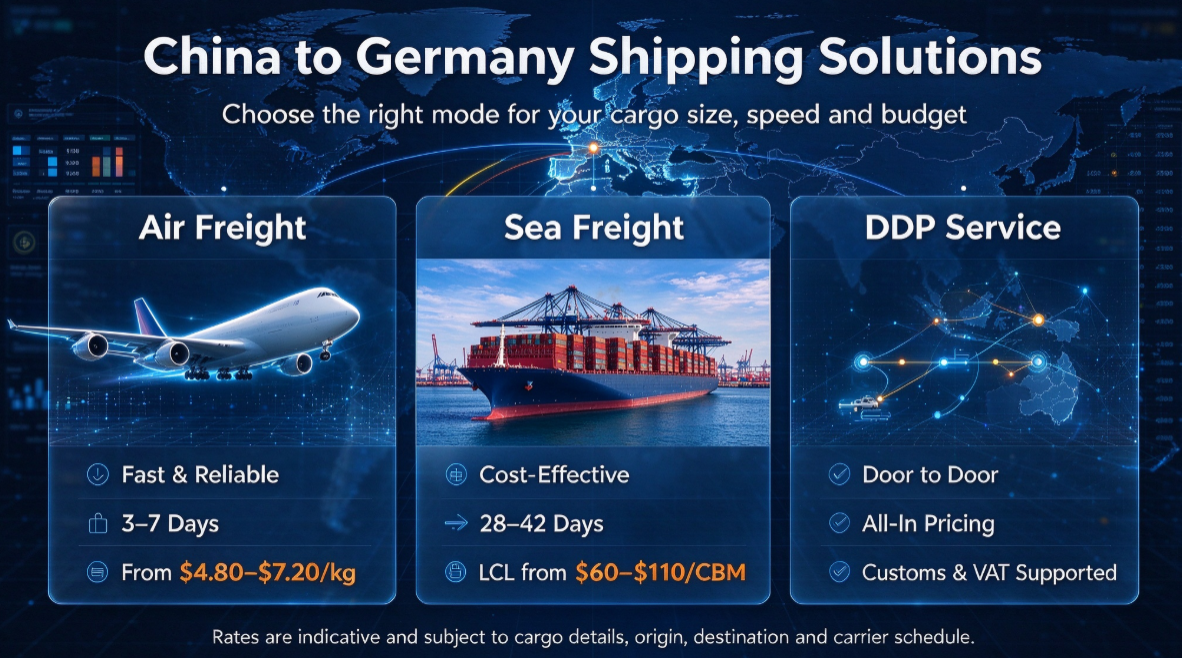
Summary: Freight shipping from China to Germany involves several transportation options, including air freight, sea freight, railway transportation, and Delivered Duty Paid (DDP) door-to-door services. The best choice depends on shipment weight, cargo volume, delivery deadlines, customs requirements, and total landed cost. Air freight is ideal for urgent and high-value shipments, while sea freight offers the lowest transportation cost for larger volumes. DDP shipping is particularly convenient for importers who prefer to have customs clearance, import duties, VAT, and final delivery coordinated by one logistics provider. As a general 2026 planning reference, air freight takes approximately 4–7 days, sea freight takes around 30–55 days, and DDP delivery generally takes 8–55 days depending on the transportation method. This guide explains shipping rates, transit times, freight calculations, German customs procedures, import taxes, required documents, and practical ways to avoid unexpected shipping expenses when importing goods from China to Germany.
Freight Shipping from China to Germany | Air, Sea & DDP Rates
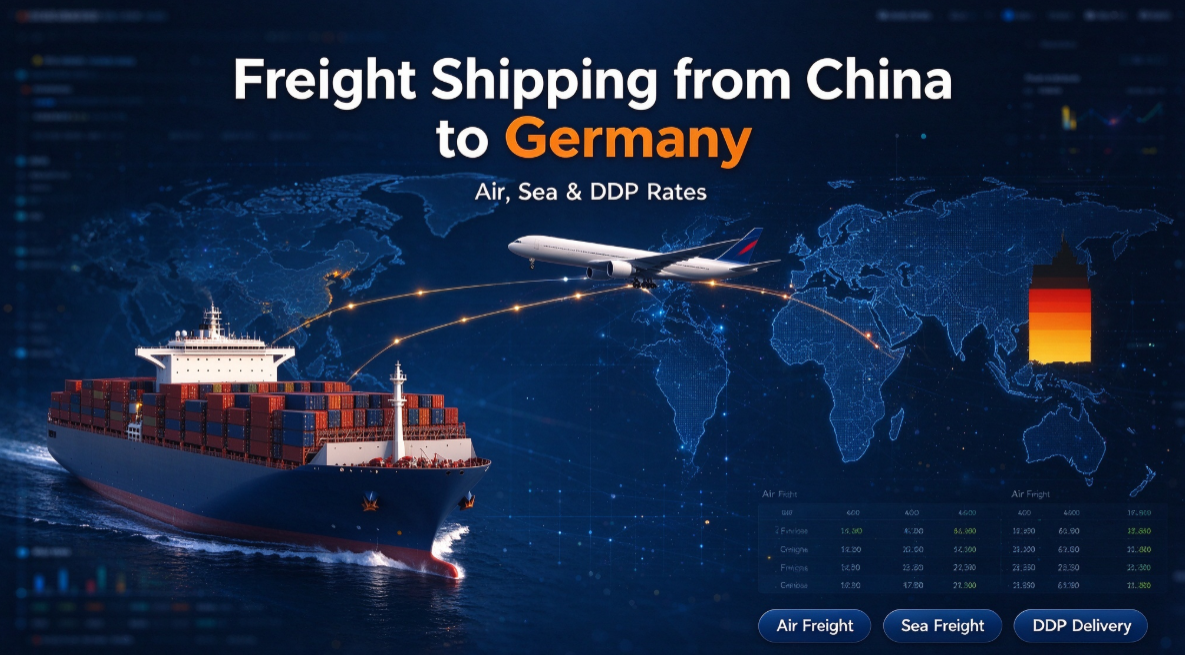
Germany is one of the most important import and distribution markets in Europe. From industrial machinery and automotive components to furniture, electronics, textiles, and consumer products, German businesses purchase a wide range of goods from Chinese manufacturers every year. China's extensive manufacturing network, competitive production costs, and established international logistics connections make it an important sourcing destination for German importers.
However, arranging freight shipping from China to Germany involves more than simply booking a vessel or an aircraft. Importers must consider transportation costs, cargo dimensions, export documentation, EU customs regulations, German import VAT, product compliance, and the delivery arrangements required at the destination.
Shibida Logistics(Top China freight forwarders)Cross-Border Logistics Line
Services: Sea Freight, Air Freight, DDP, FCL, LCL, Amazon FBA First Mile
Shibida Logistics(Top China freight forwarders) specializes in door-to-door one-stop shipping to the US, Europe, the Middle East and Southeast Asia. We deliver reliably with high on-time rates, own container pickup & trailer fleet, 18 years of experience, and have served over 30,000 enterprises.
View Logistics Solutions Get Detailed Quotation
Contact Us
📞 Phone: +86 15813899064
📧 Email: 732175850@qq.com
💬 WeChat ID: 15813899064
Scan WeChat QR Code

A shipment that appears inexpensive at the origin can become considerably more expensive after destination handling, customs brokerage, import taxes, storage, and inland transportation are added. This is especially common with less-than-container-load (LCL) shipments, where destination charges can represent a significant portion of the final logistics bill.
For this reason, experienced importers compare the total landed cost rather than choosing a shipping provider based only on the advertised price per kilogram or container.
This guide provides a practical overview of shipping from China to Germany, including air freight, sea freight, DDP shipping, indicative 2026 rates, shipping procedures, customs clearance, and the important details that businesses should confirm before sending cargo.
1. Shipping Options from China to Germany: An Overview
There are several ways to transport commercial goods from China to Germany. The most common options are air freight, sea freight, rail freight, express courier, and DDP door-to-door shipping.
Each service has a different balance of speed, price, capacity, and customs responsibilities. Selecting the right method requires understanding the actual characteristics of the shipment rather than simply choosing the fastest or cheapest advertised service.
Quick Comparison of Shipping Methods
| Shipping Method | Typical Transit Time | Cost Level | Best For |
|---|---|---|---|
| Air Freight | 4–7 days | High | Urgent cargo and high-value products |
| Sea Freight FCL | 29–55 days | Low for large shipments | Full containers and bulk cargo |
| Sea Freight LCL | 30–55 days | Medium | Small and medium-volume cargo |
| Rail Freight | 14–25 days | Medium | Shipments balancing cost and speed |
| Express Courier | 3–7 days (typical) | Very high | Samples, documents, and small parcels |
| DDP Air Freight | 8–15 days | Medium to high | Door-to-door urgent deliveries |
| DDP Sea Freight | 30–55 days | Low to medium | Cost-conscious commercial imports |
Important: These are indicative planning ranges, not guaranteed delivery commitments. Port-to-port transit time is different from door-to-door transit time. Cargo collection, export customs, consolidation, import clearance, warehouse handling, and final delivery may add several days.
The right transportation method should be selected according to the shipment's actual weight, dimensions, delivery location, and customs arrangements.
2. Air Freight from China to Germany
Air freight is one of the fastest and most reliable transportation methods for businesses that need to move goods from China to Germany within a relatively short period.
It is commonly used for electronic components, automotive spare parts, precision equipment, clothing collections, product samples, and high-value consumer products. It is also a practical option when a German importer needs to replenish inventory quickly or meet a fixed delivery deadline.
Although air freight usually costs more than ocean transportation, its shorter transit time can reduce inventory holding costs and help businesses avoid stock shortages.
2.1 How Air Freight Works
Air cargo generally moves through the following stages:
Supplier pickup: The freight forwarder collects the shipment from the factory or supplier's warehouse in China.
Export preparation: Cargo dimensions, weight, packing, commercial invoices, and other required shipping documents are checked.
Export customs clearance: The shipment is declared to Chinese customs and prepared for export.
Airport handling: Cargo is delivered to the departure airport, screened, weighed, and accepted by the airline.
International transportation: The goods travel from China to Germany, either on a direct flight or through a connecting airport.
Import customs clearance: The shipment undergoes the required EU and German import procedures.
Final delivery: Cargo is collected from the airport and delivered to the consignee, warehouse, or distribution center.
For ordinary commercial shipments, airport-to-airport transportation can take approximately 4–7 days depending on the route and available capacity. A door-to-door arrangement generally requires additional time for pickup, handling, import clearance, and delivery.
2.2 Main Airports for China–Germany Air Freight
Choosing the right departure and arrival airports can influence both transportation costs and delivery time.
| China Departure Airports | German Arrival Airports | Typical Cargo Sources or Destinations |
|---|---|---|
| Shanghai Pudong (PVG) | Frankfurt (FRA) | Industrial goods, electronics, general cargo |
| Guangzhou Baiyun (CAN) | Munich (MUC) | Consumer products, machinery, components |
| Shenzhen Bao'an (SZX) | Berlin Brandenburg (BER) | Electronics, accessories, technology products |
| Beijing Capital (PEK) | Düsseldorf (DUS) | Commercial goods and industrial supplies |
| Hong Kong International (HKG) | Hamburg (HAM) | International consolidated air cargo |
Frankfurt is a particularly important international air cargo gateway for Germany. However, choosing Frankfurt is not automatically the cheapest solution for every shipment.
For example, if the consignee's warehouse is located near Hamburg, selecting a suitable service arriving in Hamburg may reduce domestic trucking costs. Conversely, a shipment destined for southern Germany may benefit from a routing through Munich or Frankfurt.
Experienced freight forwarders compare the complete transportation route, including collection in China and delivery within Germany, instead of looking only at the international airline rate.
2.3 Air Freight Rates from China to Germany
Air freight is normally charged according to chargeable weight rather than actual weight alone. This is an important point because bulky but lightweight products can cost significantly more to transport than importers initially expect.
The following figures provide an indicative 2026 reference for general cargo on a Shenzhen-to-Germany air freight route.
| Shipment Weight | Indicative Air Freight Rate | Best Application |
|---|---|---|
| 100 kg | Approximately $11.00/kg | Smaller commercial shipments |
| 300 kg | Approximately $6.00/kg | Medium-volume cargo |
| 500 kg | Approximately $4.80/kg | Larger consolidated shipments |
These are illustrative transportation benchmarks based on published 2026 route pricing, not fixed market quotations. Actual air freight costs depend on airline capacity, cargo dimensions, service level, fuel surcharges, seasonality, and the final destination.
2.4 How to Calculate Air Freight Chargeable Weight
Air freight providers generally compare the shipment's actual gross weight with its volumetric weight. The larger figure is used as the chargeable weight.
For many standard international air cargo services, a common volumetric calculation is:
Volumetric Weight (kg) = Length × Width × Height (cm) ÷ 6,000
Some airlines or special services may use a different volumetric divisor, such as 5,000. Always confirm the applicable divisor with the forwarder before calculating your budget.
Practical example:
A shipment consists of five cartons, each measuring 60 × 50 × 40 cm. The total volume is:
5 × 60 × 50 × 40 = 600,000 cubic centimeters.
Using a divisor of 6,000:
600,000 ÷ 6,000 = 100 kg volumetric weight.
If the actual gross weight is 75 kg, the chargeable weight will normally be 100 kg rather than 75 kg.
This is why accurate carton dimensions are essential when requesting an air freight quotation. A difference of only a few centimeters per carton can change the total chargeable weight, especially for multiple packages.
2.5 When Should You Choose Air Freight?
Air freight is a good choice when:
The goods are urgently required in Germany.
The products have a high value relative to their weight.
The shipment is relatively small but commercially important.
Inventory shortages would cause significant financial losses.
The products have a limited sales season or a fixed launch date.
For example, a German automotive parts distributor waiting for a replacement component may prefer air freight even when the transportation cost is higher. The financial loss associated with delayed machinery or vehicle repairs may exceed the additional air freight expense.
On the other hand, shipping several tons of inexpensive furniture by air is rarely economical. Sea freight or railway transportation would generally be more appropriate.
3. Sea Freight from China to Germany
Sea freight is one of the most cost-effective ways to transport commercial cargo from China to Germany. It is particularly suitable for large shipments, heavy goods, furniture, building materials, machinery, and products that do not require immediate delivery.
Although ocean transportation takes considerably longer than air freight, its much greater cargo capacity makes it an attractive choice for manufacturers, wholesalers, importers, and e-commerce businesses managing regular inventory shipments.
Most China-to-Germany ocean freight services connect major Chinese export ports with German ports such as Hamburg and Bremerhaven.
3.1 FCL and LCL: What Is the Difference?
Sea freight is generally divided into two primary service types: Full Container Load (FCL) and Less than Container Load (LCL).
FCL (Full Container Load) means that the importer books an entire shipping container for one shipment. The container may not necessarily be completely full, but the space is reserved for that shipment.
LCL (Less than Container Load) means that cargo from different customers is consolidated into one container. Each importer pays for the volume or chargeable measurement occupied by their own goods.
| Comparison | FCL Shipping | LCL Shipping |
|---|---|---|
| Container Space | Entire container reserved | Shared container space |
| Pricing | Usually charged per container | Usually charged per CBM or revenue ton |
| Transit Time | Approximately 29–55 days | Approximately 30–55 days |
| Handling | Generally fewer consolidation stages | Requires consolidation and deconsolidation |
| Suitable For | Large shipments and regular imports | Smaller shipments and mixed cargo |
| Main Consideration | Container utilization and destination charges | Minimum charges and warehouse handling |
3.2 Common Container Types
Different types of shipping containers are available for different cargo requirements.
| Container Type | Approximate Internal Capacity | Typical Application |
|---|---|---|
| 20FT Standard | Approximately 28–33 CBM | Heavy industrial cargo and smaller FCL shipments |
| 40FT Standard | Approximately 56–67 CBM | Large-volume commercial cargo |
| 40FT High Cube | Approximately 66–76 CBM | Bulky goods and goods requiring extra height |
| Reefer Container | Depends on container size | Temperature-controlled cargo |
Actual loading capacity depends on the container specification, internal dimensions, cargo weight limits, packaging, and loading method. A container's theoretical volume should not be confused with its usable loading capacity.
3.3 Main Chinese Seaports for Germany Shipments
China has several major export ports serving the European market. The best departure port normally depends on the factory's location and the available shipping schedule.
Shanghai Port: A major international container gateway, suitable for cargo from Shanghai, Jiangsu, Zhejiang, and surrounding manufacturing areas.
Ningbo-Zhoushan Port: An important option for exporters in Zhejiang and eastern China, with extensive international container services.
Shenzhen Port: Commonly used for electronics, consumer goods, and manufacturing cargo from southern China.
Guangzhou Port: Serves manufacturers in Guangdong and the Pearl River Delta region.
Qingdao Port: An important departure point for exporters in Shandong and northern China.
Xiamen Port: Serves exporters in Fujian and southeastern China.
3.4 Main German Seaports
Germany has several major seaports that support international container transportation and European distribution.
Hamburg Port is Germany's best-known container gateway and an important logistics hub with established connections to inland rail and road networks.
Bremerhaven Port is another important container port, serving importers in northern Germany and providing access to wider European distribution routes.
Wilhelmshaven, Bremen, and other regional logistics locations may also be relevant depending on the carrier, destination, and type of cargo.
Importers should compare the total cost of delivering cargo from the arrival port to the final warehouse. A lower ocean freight rate does not necessarily mean a lower total logistics cost if inland transportation or destination handling is significantly more expensive.
3.5 Sea Freight Rates from China to Germany
Sea freight rates are influenced by container availability, shipping lines, fuel costs, vessel schedules, port congestion, and seasonal demand.
The following figures are indicative 2026 market reference prices for common container routes, using Shenzhen to Hamburg as an example.
| Shipping Type | Estimated Freight Cost | Typical Transit |
|---|---|---|
| LCL | Approximately $45–$125/CBM | 30–55 days |
| 20FT Container | Approximately $2,850–$3,900 | 34–57 days |
| 40FT Container | Approximately $3,800–$5,000 | 29–61 days |
Pricing note: These figures are budgetary benchmarks, not guaranteed all-in delivery prices. LCL ocean freight figures typically represent a transportation rate rather than the complete landed cost. FCL quotations must be checked for their precise origin and destination charge coverage. Port handling, documentation, customs brokerage, import duties, VAT, and final delivery may be charged separately.
3.6 Understanding LCL Pricing
For LCL shipments, freight forwarders usually calculate the charge using the shipment's volume or weight, whichever produces the higher chargeable measurement under the applicable tariff.
A common sea freight calculation uses one revenue ton based on either 1 CBM or 1,000 kg, whichever is greater.
For example, consider a shipment with the following details:
Total volume: 3 CBM
Actual weight: 1,200 kg
Volume-based measurement: 3 revenue tons
Weight-based measurement: 1.2 revenue tons
In this situation, the shipment will generally be charged according to its 3 CBM volume, subject to the forwarder's minimum charge and applicable tariff conditions.
However, there is another detail that experienced importers pay attention to: LCL destination charges.
Consolidation and deconsolidation fees, terminal handling, documentation, customs processing, and warehouse release charges may make a small LCL shipment surprisingly expensive. Always request a complete origin-to-destination quotation before confirming the booking.
3.7 When Is Sea Freight the Best Choice?
Sea freight is particularly suitable for:
Large shipments that occupy a substantial portion of a container.
Furniture, home accessories, and bulky consumer goods.
Industrial equipment and non-urgent machinery.
Construction materials and commercial supplies.
Regular wholesale imports with predictable inventory demand.
For a company importing several pallets of products every month, a scheduled sea freight arrangement can create more predictable logistics costs. It also allows the importer to plan factory production, loading dates, port arrival, customs clearance, and warehouse receiving in advance.
4. DDP Shipping from China to Germany
DDP stands for Delivered Duty Paid. Under Incoterms 2020, the seller is responsible for arranging transportation, export clearance, import clearance, and paying the applicable import duties and taxes to deliver the goods to the agreed destination.
For buyers importing products from China to Germany, DDP can simplify international logistics because many operational tasks are coordinated by the seller or its appointed logistics providers.
It is especially attractive to companies that do not have an established import department in Germany or do not want to coordinate separate transportation, customs brokerage, tax handling, and local delivery arrangements.
4.1 What Does a DDP Shipping Service Include?
A typical China-to-Germany DDP service may include the following:
Collection of goods from the Chinese supplier.
Export documentation and Chinese customs clearance.
International air, sea, or rail transportation.
Import customs declaration in the EU.
Applicable customs duty and import VAT arrangements.
Destination handling and customs-related administration.
Final delivery to the agreed German address.
The exact scope depends on the service agreement. Not every company advertising DDP offers the same coverage, so the importer should confirm which duties, taxes, handling fees, and delivery services are actually included.
4.2 DDP Air Freight Rates from China to Germany
DDP air freight combines international air transportation with import customs arrangements and final delivery. It is useful for importers who need relatively quick delivery without managing each logistics stage themselves.
| Shipment Weight | Indicative DDP Air Rate | Typical Delivery Time |
|---|---|---|
| 21 kg+ | Around $5.35/kg | 8–15 days |
| 45 kg+ | Around $5.04/kg | 8–15 days |
| 71 kg+ | Around $4.88/kg | 8–15 days |
| 101 kg+ | Around $4.74/kg | 8–15 days |
These are indicative published general-cargo rate examples. Battery cargo, restricted goods, oversized packages, and shipments requiring special handling may have different charges. It is also essential to verify whether the quoted rate includes all applicable import duties, VAT, customs handling, and final-mile delivery.
4.3 DDP Sea Freight Rates from China to Germany
DDP sea freight is a common choice for importers who want to reduce transportation costs while retaining a convenient door-to-door arrangement.
For general cargo, published 2026 market references suggest that DDP LCL services may fall within approximately $180–$380 per CBM, although actual prices vary considerably with shipment size, goods classification, delivery postcode, and tax treatment.
| DDP Sea Cargo Type | Indicative Reference Rate | Estimated Transit |
|---|---|---|
| General Cargo | $180–$250/CBM | 30–45 days |
| E-commerce Cargo | $200–$300/CBM | 30–45 days |
| Bulky Furniture | $220–$380/CBM | 35–50 days |
These ranges are planning references, not universal all-inclusive tariffs. Certain products may attract additional duties, special handling fees, or regulatory costs. For a DDP quotation, request written confirmation of the destination address, included tax amounts, customs declaration arrangement, and any exclusions.
4.4 DDP vs. DAP: What Is the Difference?
Importers sometimes confuse DDP with DAP because both can provide door-to-door transportation. However, their customs and tax responsibilities are different.
| Responsibility | DDP | DAP |
|---|---|---|
| Supplier Pickup | Seller arranges | Seller arranges |
| International Shipping | Seller arranges | Seller arranges |
| Import Customs Clearance | Seller responsible | Buyer responsible |
| Import Duties | Seller pays | Buyer pays |
| Import VAT | Seller responsible for the DDP import obligation | Buyer responsible |
| Final Delivery | Seller arranges | Seller arranges |
Under both arrangements, unloading at the agreed destination is generally the buyer's responsibility unless the parties agree otherwise.
When to choose DDP: Businesses that prefer predictable door-to-door shipping costs and do not want to arrange import clearance themselves may find DDP more convenient.
When to choose DAP: Established German importers with their own EORI registration, customs broker, and VAT processes may prefer DAP because they retain direct control over import procedures and tax documentation.
4.5 Important Considerations Before Booking DDP Shipping
DDP does not mean that German customs regulations no longer apply. Import requirements remain in place regardless of who arranges transportation and tax payment.
Before accepting a DDP quotation, ask the provider the following questions:
Are customs duty and German import VAT included in the quoted price?
Who is legally responsible for the import customs declaration?
Will the importer receive the relevant customs declaration or MRN documentation where applicable?
How are the goods' customs value and HS code determined?
Are delivery charges to the exact German postcode included?
Are inspection fees, storage charges, and special cargo surcharges excluded?
What happens if German customs requests additional product information?
One issue worth investigating is the importer of record. The legal party responsible for import clearance should be clearly identified. A logistics provider's promise to handle duties and VAT does not automatically establish the buyer's entitlement to reclaim import VAT.
For German businesses that intend to deduct import VAT, the customs declaration, named importer, accounting evidence, and applicable tax requirements should be reviewed with a qualified tax adviser.
5. Rail Freight from China to Germany: An Alternative Worth Considering
Although this guide focuses primarily on air, sea, and DDP services, rail freight deserves attention because it provides another option between expensive air cargo and slower ocean transportation.
Rail services connect Chinese inland logistics hubs with European distribution terminals. They can be useful for medium-sized commercial shipments, machinery parts, household goods, and other products that need a faster arrival than ocean freight but do not justify the cost of air transportation.
Typical transit time: Approximately 14–25 days, depending on the origin, route, terminal, border procedures, and final delivery arrangement.
Railway transportation is not completely immune to delays. Border congestion, terminal capacity, customs inspections, and changes in rail schedules can affect delivery dates.
For importers comparing several transportation methods, rail can be included in the quotation process when the shipment is too large for economical air freight but too urgent for conventional sea freight.
6. German Customs Clearance and Import Taxes
Customs clearance is one of the most important parts of shipping goods from China to Germany. Since Germany is a member of the European Union, imported products must comply with the applicable EU customs framework and the relevant German import procedures.
Before shipping, importers should understand the relationship between customs classification, declared value, import duties, import VAT, and product-specific regulations.
6.1 EORI Number Requirements
An EORI number means Economic Operators Registration and Identification number. It is used to identify businesses and other relevant operators involved in customs procedures within the EU.
Under EU rules, an EORI number is required for economic operators undertaking customs operations such as imports, exports, and transit where the registration requirement applies.
For German companies importing goods from China, obtaining and validating an appropriate EORI number should be one of the first steps when establishing a regular import process.
Importers established outside the EU may also need an EORI registration when undertaking relevant customs activities. The appropriate Member State for registration depends on the operator's circumstances and first customs activity.
Official information: European Commission – EORI Number.
6.2 Customs HS Codes and Import Duties
Every imported product must be classified under the appropriate customs tariff code. The Harmonized System (HS) provides the international foundation for product classification, while the EU uses the Combined Nomenclature (CN) and TARIC system to determine applicable customs measures.
Different products can have very different customs duty rates, even when they look similar or belong to the same broad commercial category.
For example, importing plastic household accessories, electronic components, stainless-steel products, and textile garments may involve different tariff classifications and import requirements.
Incorrect classification can result in underpaid or overpaid customs duties, additional customs inquiries, delayed cargo release, and possible penalties.
A practical approach is to collect the following information before booking:
Accurate commercial product name.
Product composition and primary material.
Main function and intended use.
Model number or technical specification where relevant.
Country of origin.
Suggested HS code from the supplier, subject to independent verification.
The supplier's suggested HS code should not automatically be treated as correct for EU import purposes. The importer or its customs representative should verify the appropriate CN/TARIC classification and applicable measures.
Official resource: European Commission – Tariff Classification of Goods.
6.3 German Import VAT
Germany applies a standard VAT rate of 19% to most goods and services. Certain qualifying products may be subject to a reduced rate, so the correct treatment should be verified according to the product category.
Import VAT, also known as Import Turnover Tax or Einfuhrumsatzsteuer (EUSt), is generally calculated using a taxable base that includes the customs value, applicable duties, and certain additional expenses.
The VAT calculation is therefore not necessarily based only on the product purchase price.
Example of an illustrative import calculation:
| Product Purchase Value | €10,000 |
| International Freight and Insurance Included in Customs Value | €1,000 |
| Illustrative Customs Value | €11,000 |
| Illustrative Customs Duty at 4% | €440 |
| Illustrative VAT Taxable Base | €11,440 |
| German Import VAT at 19% | €2,173.60 |
| Illustrative Total Including Duty and Import VAT | €13,613.60 |
This example is simplified for illustration. The 4% customs duty is an assumed rate, not a universal rate for Chinese products. The final VAT taxable base may also include qualifying incidental expenses, such as certain transportation costs to the first destination. Actual calculations must follow the applicable customs valuation and VAT rules.
For businesses that meet the relevant German tax requirements, import VAT may potentially be deductible as input tax. This depends on the importer's legal status, documentation, customs declaration, and the relevant tax rules. It should not be assumed that every shipment paid through a DDP arrangement creates a recoverable VAT credit for the German buyer.
Official information: European Commission – VAT Rules and Rates.
6.4 ICS2 and Entry Summary Declarations
Another important EU import requirement is the Import Control System 2 (ICS2).
ICS2 is the EU's advance cargo information system, designed to strengthen supply-chain security by requiring relevant cargo information before goods arrive in the EU.
Carriers and other responsible supply-chain operators must provide the required Entry Summary Declaration (ENS) information according to the applicable rules.
Since September 1, 2025, ICS2 has been fully operational across Member States for all transportation modes, including maritime, air, road, and rail, subject to applicable procedures and any specifically authorized derogations.
For importers, the practical lesson is simple: product descriptions, shipper and consignee information, and cargo details should be accurate and submitted on time. Incomplete or inconsistent data can create additional communication and handling requirements before the cargo is released.
Official information: European Commission – ICS2 and the Union Customs Code.
7. Product Compliance Requirements for Importing into Germany
Customs clearance does not automatically mean that imported products are legally permitted to be sold in Germany or elsewhere in the EU.
Importers also need to examine product safety, technical standards, labeling, environmental obligations, and other regulations relevant to the specific goods.
7.1 CE Marking
Many product categories placed on the European market are subject to CE marking requirements. Depending on the product, relevant legislation may include rules covering electrical equipment, machinery, toys, radio equipment, and other regulated categories.
Importers should not rely only on a supplier's statement that a product is CE certified.
They should verify whether the manufacturer has conducted the required conformity assessment, prepared the relevant technical documentation, and issued a valid EU Declaration of Conformity where required.
When importing products from China, the EU importer has legal responsibilities to check that the products meet applicable requirements before placing them on the market.
Official guidance: European Commission – Importers and Distributors.
7.2 Other Important Product Regulations
Depending on the product, an importer may need to examine several additional requirements:
RoHS: Restrictions on certain hazardous substances in electrical and electronic equipment.
REACH: EU rules covering the registration, evaluation, authorization, and restriction of chemicals.
WEEE: Producer responsibility and waste-management requirements for electrical and electronic equipment.
EU Battery Regulation: Requirements affecting batteries, including relevant safety, sustainability, labeling, and producer-responsibility obligations.
General Product Safety Regulation: Applicable product safety responsibilities for products within its scope.
These regulations do not apply to every product in the same way. Importers should identify the rules relevant to their specific goods before production and shipment, rather than waiting until the cargo arrives in Germany.
7.3 German Packaging Registration and LUCID
Businesses placing packaged goods on the German market may have obligations under German packaging legislation and the EU Packaging and Packaging Waste Regulation (PPWR).
The German LUCID Packaging Register is an important part of the national packaging compliance system.
Depending on the packaging and the company's role in the supply chain, businesses may need to:
Register with the LUCID Packaging Register.
Participate in an appropriate dual system for relevant packaging.
Report packaging quantities accurately.
Maintain the information and registrations required by the applicable rules.
There is also an important 2026 development: the PPWR entered into force on August 12, 2026, accompanied by changes to the German packaging framework. Foreign businesses without a German establishment that sell packaged products directly to German end users may now face an authorized representative requirement under the applicable rules. These requirements should be checked carefully according to the company's actual sales structure.
Official resources: German LUCID Packaging Register and Authorized Representatives.
7.4 CBAM Requirements for Certain Imported Goods
The Carbon Border Adjustment Mechanism (CBAM) is another regulation that may affect some imports entering the EU.
CBAM is relevant to specified carbon-intensive product categories rather than ordinary imported consumer goods in general. The definitive regime began on January 1, 2026.
For covered goods, qualifying importers may have obligations relating to authorization, embedded emissions reporting, and CBAM certificates. The European Commission currently specifies a single mass-based threshold of 50 tonnes for the relevant goods, subject to the detailed rules and applicable exemptions.
Businesses importing products such as certain iron and steel, aluminium, cement, fertilizer, electricity, or hydrogen products should verify whether CBAM applies before confirming the final landed cost.
Official guidance: European Commission – CBAM Definitive Regime.
8. Documents Required for Shipping from China to Germany
Preparing accurate documentation before shipment is one of the simplest ways to avoid unnecessary customs delays and logistics costs.
Although the exact documents depend on the type of goods and shipping method, most commercial shipments require several standard documents.
| Document | Purpose |
|---|---|
| Commercial Invoice | Shows seller, buyer, product descriptions, quantities, transaction value, and trade terms. |
| Packing List | Provides carton count, dimensions, gross weight, net weight, and packing details. |
| Bill of Lading (B/L) | Serves as the main ocean transport document and receipt for shipped cargo. |
| Air Waybill (AWB) | Provides shipment and carriage information for air freight. |
| Customs Declaration | Provides the required information for export or import customs procedures. |
| Certificate of Origin | Provides origin information when required for customs or commercial purposes. |
| Product Compliance Documents | Supports regulatory checks, such as conformity, safety, or chemical compliance requirements. |
| MSDS / Dangerous Goods Documents | Provides relevant safety and transport information for applicable chemicals, batteries, and dangerous goods. |
Not all documents are required for every shipment. For example, a certificate of origin may be unnecessary for a particular customs procedure, while a shipment containing lithium batteries may require additional transport documents and technical information.
The most important practical point is consistency. The product description, declared quantity, package count, and commercial value should match across the invoice, packing list, and customs documentation.
Descriptions such as "accessories," "samples," or "general merchandise" are often too vague for reliable customs classification. A clearer description, such as "stainless steel kitchen storage racks" or "plastic electrical equipment housings," provides more useful information.
9. Special Cargo Considerations When Shipping to Germany
Some products require additional checks before a freight forwarder can accept them for international transportation.
9.1 Lithium Batteries and Electronic Products
Lithium batteries are subject to specific transportation safety requirements. Whether batteries are shipped separately, packed with equipment, or contained within equipment can affect the applicable air or sea transport procedures.
Airlines and shipping lines may request relevant battery test documentation, including the applicable UN 38.3 test information, safety data, packaging specifications, and dangerous goods declarations where required.
Importers should disclose batteries when requesting a quote. Describing battery-containing cargo as ordinary general cargo without proper disclosure can lead to booking rejection, additional inspection, penalties, or transportation delays.
9.2 Wooden Packaging and Pallets
Wooden packaging materials used in international trade may need to comply with ISPM 15 requirements. This generally concerns applicable solid wood packaging, such as pallets and crates.
Importers should confirm that regulated wooden packaging is appropriately treated and marked before cargo leaves China. Otherwise, problems may occur during inspections at the EU border.
9.3 Oversized and Heavy Cargo
Machinery, industrial equipment, and unusually large cargo may require flat racks, open-top containers, special handling equipment, or dedicated transportation arrangements.
When requesting a quotation, provide cargo dimensions, total weight, individual package weight, lifting points, and loading requirements. This information helps the forwarder check whether the cargo can be handled using standard equipment.
10. The Complete Shipping Process from China to Germany
For importers arranging their first shipment, understanding the entire process makes communication with suppliers and logistics providers much easier.
A typical shipment follows the sequence below.
Step 1: Confirm the Product and Shipping Information
Start by collecting the product name, quantity, gross weight, carton count, dimensions, and packaging details.
Also confirm whether the goods contain batteries, chemicals, liquids, magnets, or other items that may require special handling.
At this stage, it is better to identify potential cargo restrictions than to discover them after the forwarder has already booked transportation.
Step 2: Request Shipping Quotations
Contact one or more freight forwarders and request quotations for the transportation methods that suit your shipment.
For example, a 2 CBM shipment might be suitable for LCL sea freight, while an urgent 200 kg shipment could be better suited to air freight.
Request separate pricing for transportation and door-to-door service wherever possible. This allows you to compare the actual costs and identify any items that have been excluded.
Step 3: Confirm Incoterms and Responsibilities
Check the agreed trade term with your supplier.
EXW, FOB, CIF, DAP, and DDP have different responsibilities for transportation, costs, and risk transfer. A quotation should clearly identify which Incoterm is being used and where the named place or port is located.
For example, FOB Shanghai is not the same as a complete door-to-door quotation from a factory in Shenzhen to a warehouse in Berlin.
Step 4: Arrange Pickup and Cargo Inspection
Once the booking is confirmed, the forwarder arranges collection or receives the goods at its designated warehouse.
The warehouse normally checks package quantity, cargo condition, dimensions, and weight. Some providers may also take cargo photographs to document packaging and verify shipment information.
For fragile or high-value products, consider confirming the packaging condition before the cargo is loaded or handed over to the carrier.
Step 5: Complete Chinese Export Customs Procedures
The cargo is prepared for export customs declaration in China.
The supplier and forwarder should ensure that the export documentation matches the actual shipment. If the goods are subject to export controls, licensing requirements, or special procedures, these should be resolved before the planned departure date.
Step 6: International Transportation
The cargo moves by air, sea, or rail according to the confirmed booking.
During transportation, importers should keep track of departure information, estimated arrival dates, transport documents, and any schedule changes.
It is also useful to ask the forwarder when the pre-arrival customs information needs to be completed, particularly for shipments requiring additional documentation.
Step 7: German Import Customs Clearance
Once the shipment reaches the EU, the required security, customs, and import procedures are completed.
The customs authorities may request additional information, inspect the goods, verify the declared value, or check the classification.
Providing correct product descriptions and complete documents in advance can reduce avoidable communication and clearance delays.
Step 8: Final Delivery to the German Destination
After the necessary customs and terminal procedures are complete, cargo is released for collection or domestic transportation.
For warehouse deliveries, confirm the receiving address, opening hours, unloading facilities, forklift availability, appointment requirements, and any delivery restrictions.
A shipment arriving at a port or airport does not mean that it has already reached the buyer's warehouse. The final delivery stage should always be included in the original logistics plan.
11. How to Reduce Freight Shipping Costs from China to Germany
Reducing freight costs is not simply about finding the cheapest forwarder. In practice, the most effective savings often come from better shipment planning, accurate cargo information, and avoiding unnecessary destination charges.
11.1 Optimize Carton Dimensions
Packaging has a direct effect on air freight chargeable weight and sea freight volume.
If products are packed in unnecessarily large cartons, the importer may pay for space that does not provide any additional protection or commercial value.
Work with suppliers to improve carton dimensions, remove unnecessary empty space, and use suitable protective materials.
However, reducing package dimensions should never compromise product safety. Damaged products can easily eliminate the savings achieved through cheaper transportation.
11.2 Compare More Than One Shipping Method
A shipment of 300 kg could potentially be sent by air freight, LCL sea freight, or rail freight, depending on its volume and deadline.
Requesting two or three transportation options provides a clearer picture of the cost-versus-time relationship.
For example, if air freight costs significantly more but saves only a few days compared with an appropriate rail service, rail may provide better overall value.
11.3 Consolidate Orders from Different Suppliers
If a German importer purchases products from several Chinese factories, consolidating the goods at a warehouse in China can sometimes reduce total transportation expenses.
Instead of sending several small shipments separately, products can be collected, inspected, repacked when necessary, and shipped together.
This approach may reduce repeated pickup fees, documentation charges, and minimum freight charges. However, consolidation also requires coordination between suppliers and enough time for every order to reach the warehouse.
11.4 Book Before Peak Shipping Seasons
International freight demand can increase before major shopping periods, public holidays, and the Chinese New Year holiday.
During busy periods, air cargo space may become limited and ocean freight schedules can change. Booking in advance can provide more flexibility and reduce the likelihood of paying last-minute premium rates.
11.5 Compare the Full Destination Cost
One of the most common mistakes made by inexperienced importers is comparing the ocean freight rate without examining destination charges.
For every quotation, check whether the following items are included:
Chinese pickup and export handling.
Origin customs declaration and documentation.
International freight and applicable surcharges.
German terminal or airport handling.
Import customs brokerage.
Customs duties and import VAT, if using a DDP service.
Final delivery and any delivery appointment fees.
Additional charges for inspections, storage, or exceptional handling.
A quotation that initially appears more expensive may actually be the better option if it includes services that competing providers charge separately.
12. Common Shipping Problems and How to Avoid Them
Even when transportation is arranged through an experienced logistics provider, poor preparation can create unnecessary problems. The following situations are particularly common in China-to-Germany shipments.
Problem 1: Incorrect Cargo Dimensions
A supplier may provide estimated dimensions before the final packaging is completed. When the cargo reaches the warehouse, its actual dimensions may be larger, increasing the air freight or LCL shipping cost.
Solution: Request final carton dimensions and gross weight after packaging. For important shipments, ask the warehouse to measure and confirm them before approving the final freight quotation.
Problem 2: Inaccurate Commercial Invoice
A commercial invoice with vague descriptions, inconsistent values, or incorrect product quantities can create customs questions.
Solution: Check the invoice against the purchase order, packing list, and actual cargo. Do not ask suppliers to reduce the declared customs value simply to make the shipment appear cheaper.
Problem 3: Misunderstanding DDP Pricing
Some logistics providers advertise very low DDP rates without clearly explaining which taxes or delivery charges are included.
Solution: Ask for a written service scope. Confirm the legal import arrangement, applicable taxes, customs documentation, and any possible extra charges before making payment.
Problem 4: Unexpected Customs Inspection
Customs authorities may select shipments for inspection based on risk analysis, commodity information, and other relevant factors.
Solution: Prepare accurate documents and allow additional time in the delivery schedule. No freight forwarder can guarantee that customs will never inspect a shipment.
Problem 5: Insufficient Delivery Planning
A container may arrive at Hamburg while the consignee's warehouse is not prepared to receive it. This can create additional storage, demurrage, detention, or redelivery expenses.
Solution: Coordinate the estimated arrival date with the receiving warehouse. Confirm free-time arrangements, unloading equipment, delivery appointments, and container return requirements in advance.
Problem 6: Ignoring Product Compliance
Some importers focus entirely on freight and customs costs, only to discover that their products lack required testing documents, labeling, or EU conformity information.
Solution: Review the applicable product regulations before manufacturing is completed. Compliance preparation should be part of the purchasing process, not an afterthought.
13. Frequently Asked Questions About Shipping from China to Germany
Q1: How much does it cost to ship from China to Germany?
The cost depends on the transportation method, shipment size, product type, departure city, destination, and required services. As indicative 2026 planning references, air freight may cost approximately $4.80–$11.00 per chargeable kilogram for certain consolidated routes, LCL ocean freight may cost around $45–$125 per CBM for basic freight, and 20FT FCL ocean freight may range from approximately $2,850–$3,900. DDP services have different pricing because customs, taxes, and delivery arrangements may be included. A specific quotation is required for an accurate comparison.
Q2: How long does shipping from China to Germany take?
Air freight generally takes around 4–7 days for the main transportation stage. Sea freight commonly takes 30–55 days depending on the route and service. Railway transportation usually takes around 14–25 days. DDP services may require additional time for pickup, import customs clearance, and final delivery.
Q3: What is the cheapest way to ship goods from China to Germany?
For large commercial shipments, sea freight is usually the most economical transportation method. FCL often provides good value when the cargo occupies enough container space, while LCL is suitable for smaller volumes. However, the cheapest option should be determined by comparing the total landed cost rather than the basic freight rate alone.
Q4: Is DDP shipping from China to Germany safe?
DDP can be a convenient and reliable shipping arrangement when the provider has a transparent customs process and the service agreement clearly identifies tax responsibilities, the importer of record, and delivery arrangements. Always verify the actual customs documentation and confirm who is legally responsible for the import declaration.
Q5: Do I need an EORI number to import goods into Germany?
EU-established economic operators generally need an EORI number for relevant customs operations. Non-EU operators may also require an EORI number when undertaking certain customs activities. The exact registration requirement depends on the importer's circumstances and the customs procedure being used.
Q6: What is the German import VAT rate?
Germany's standard VAT rate is 19%. Certain eligible goods may be subject to a reduced rate. Import VAT is calculated using the applicable import VAT taxable base rather than simply the purchase price of the goods.
Q7: Can I ship lithium batteries from China to Germany?
Yes, lithium batteries can be transported under applicable regulations, but they are subject to specific classification, packaging, documentation, and transport requirements. Airlines and shipping lines may request relevant UN 38.3 test information, safety documentation, and dangerous goods declarations depending on the shipment configuration.
Q8: Can I ship samples by air freight?
Yes. Air freight or express courier is usually suitable for samples. For very small packages or documents, express services such as DHL, FedEx, or UPS may be convenient. Larger commercial samples can be transported through consolidated air freight services.
Q9: What is the difference between airport-to-airport and door-to-door air freight?
Airport-to-airport transportation covers the international air cargo movement between the designated airports and normally excludes some or all pickup, export handling, import customs clearance, and final delivery services. Door-to-door service coordinates the shipment from the supplier's location to the buyer's agreed destination, subject to the quoted service scope.
Q10: Which German seaport is best for shipping from China?
Hamburg is a major gateway for container imports into Germany, while Bremerhaven is another important option. The best port depends on the shipping schedule, carrier availability, origin port, destination warehouse, and inland transportation costs.
Q11: Can I combine cargo from several Chinese suppliers into one shipment?
Yes. A freight forwarder can arrange warehouse consolidation when different suppliers are able to deliver their goods to the same warehouse in China. The cargo can then be checked, measured, and shipped together. This is particularly useful for importers purchasing several types of products from different factories.
Q12: Should I choose DDP or arrange customs clearance myself?
DDP may suit buyers who want a more integrated door-to-door service. Importers with an established German customs and tax process may prefer to arrange their own clearance under terms such as DAP. The decision should take into account the importer's EORI status, VAT arrangements, customs documentation needs, and internal logistics capabilities.
14. How to Choose the Right Freight Forwarder for China–Germany Shipping
Selecting an appropriate freight forwarder is just as important as choosing the transportation method. The provider should understand both Chinese export procedures and the relevant German and EU import requirements.
Before making a decision, consider the following factors.
Route Experience
Choose a provider familiar with regular China-to-Germany cargo movements. Experience with major Chinese export hubs, Hamburg and Bremerhaven port operations, German import clearance, and domestic delivery arrangements can help prevent avoidable problems.
Transparent Pricing
A professional quotation should clearly show the transportation method, transit time, chargeable weight or volume, service scope, and applicable surcharges.
For DDP shipments, customs duty, import VAT, and final delivery responsibilities should be specifically addressed rather than hidden behind a general statement such as "all charges included."
Customs and Compliance Knowledge
The freight forwarder should be able to identify documentation issues, advise on special cargo requirements, and coordinate with the appropriate customs representatives.
However, logistics support should not be confused with legal or tax advice. Importers remain responsible for understanding their regulatory obligations and should consult qualified customs or tax professionals when necessary.
Cargo Tracking and Communication
Reliable shipment updates help importers plan warehouse operations and inventory management. Ask how the provider communicates booking confirmation, departure dates, estimated arrival, customs progress, and final delivery arrangements.
Cargo Insurance
International transportation involves potential risks, including damage, loss, handling incidents, and other unforeseen events. Importers should evaluate whether cargo insurance is appropriate for the shipment's value and risk profile.
Do not assume that the freight quotation automatically includes comprehensive cargo insurance. Confirm the coverage, insured value, exclusions, and claims procedure separately.
15. Final Thoughts: Choosing the Best Freight Shipping Solution from China to Germany
Freight shipping from China to Germany requires a clear understanding of transportation costs, delivery time, customs procedures, and the final destination requirements. There is no single shipping method that is ideal for every business or every shipment.
Air freight is the preferred option when delivery speed is the priority. It is suitable for urgent orders, high-value products, replacement components, and relatively small commercial shipments.
Sea freight is generally the most economical choice for large and non-urgent cargo. FCL works well for substantial volumes, while LCL provides flexibility for importers who do not need an entire container.
DDP shipping offers a convenient door-to-door solution by coordinating international transportation, import customs clearance, duties, VAT, and final delivery under the agreed service arrangement. It is particularly useful for businesses that prefer a more integrated logistics process, provided the customs and tax arrangements are transparent and legally compliant.
For many importers, the best approach is to compare multiple transportation methods using the same cargo information, destination address, and service scope. This makes it easier to identify the right balance between shipping cost, delivery speed, and administrative responsibilities.
Before booking, prepare an accurate packing list, confirm the HS code, check applicable EU product requirements, verify the customs arrangements, and obtain a written breakdown of all transportation and destination charges.
With proper preparation and a reliable freight forwarding partner, businesses can build a more predictable supply chain, control landed costs, and transport goods from China to Germany with greater confidence.
Disclaimer: Freight rates and transit times in this article are indicative planning estimates based on published 2026 market references. They are not binding quotations or guaranteed schedules. Customs duties, VAT, product compliance obligations, and shipping requirements depend on the specific goods, transaction structure, and applicable regulations. Always confirm current costs and regulatory requirements before arranging shipment.
How to Book
To take advantage of these new routes and services, simply:
- Contact our dedicated 【Freight Shipping from China to Germany | Air, Sea & DDP Rates】 desk at Contact
- Provide details of your shipment (cargo type, volume, pickup location)
- Receive a customized quote within 24 hours
- Confirm your booking and prepare your goods for shipment
Our team specialists is ready to assist with all aspects of your shipment, from documentation to delivery.
About Shibida Logistics
Shibida Freight Forwarding is a leading private logistics service provider based in China, offering comprehensive export logistics and warehousing services, international freight forwarding, FBA dedicated logistics, US overseas warehouses, and international logistics services from China to the world by land, air, and sea.
With our headquarters in Shenzhen and branch offices/agents covering almost all major cities and seaports in China, we strive to deliver your cargo to any destination worldwide safely, timely, and at reasonable prices.
For more information about our new Australia routes or to request a quote, please contact us today.