Shibida Logistics Team
Logistics Expert
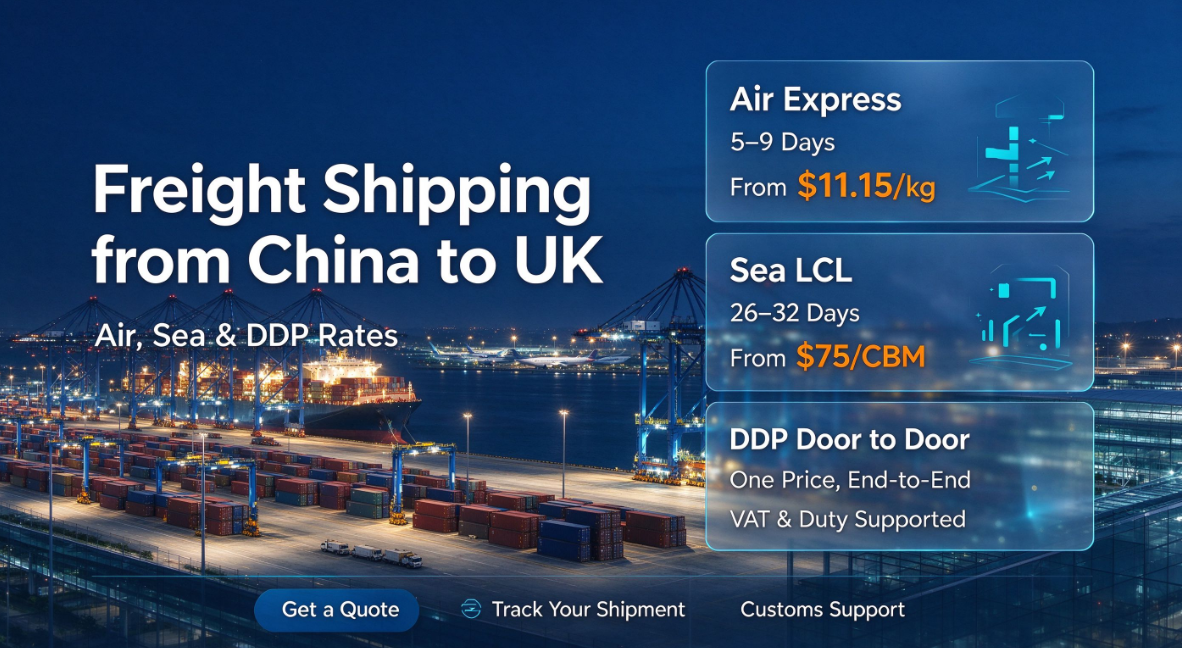
Freight Shipping from China to United Kingdom | Air, Sea & DDP Rates
Summary: Shipping freight from China to the United Kingdom involves more than choosing a carrier and paying an international freight rate. Importers need to consider cargo dimensions, transportation methods, customs clearance, import duties, VAT, delivery arrangements, and the total landed cost. Air freight is generally the preferred option for urgent, lightweight, or high-value shipments, while sea freight offers better cost efficiency for larger volumes. Businesses that want a more convenient shipping arrangement can also choose DDP (Delivered Duty Paid), which combines transportation, customs clearance, applicable duties, import VAT, and final delivery into an agreed service. This guide explains the main freight options from China to the UK, indicative shipping rates, transit times, UK customs requirements, and practical considerations to help importers select the right shipping solution.
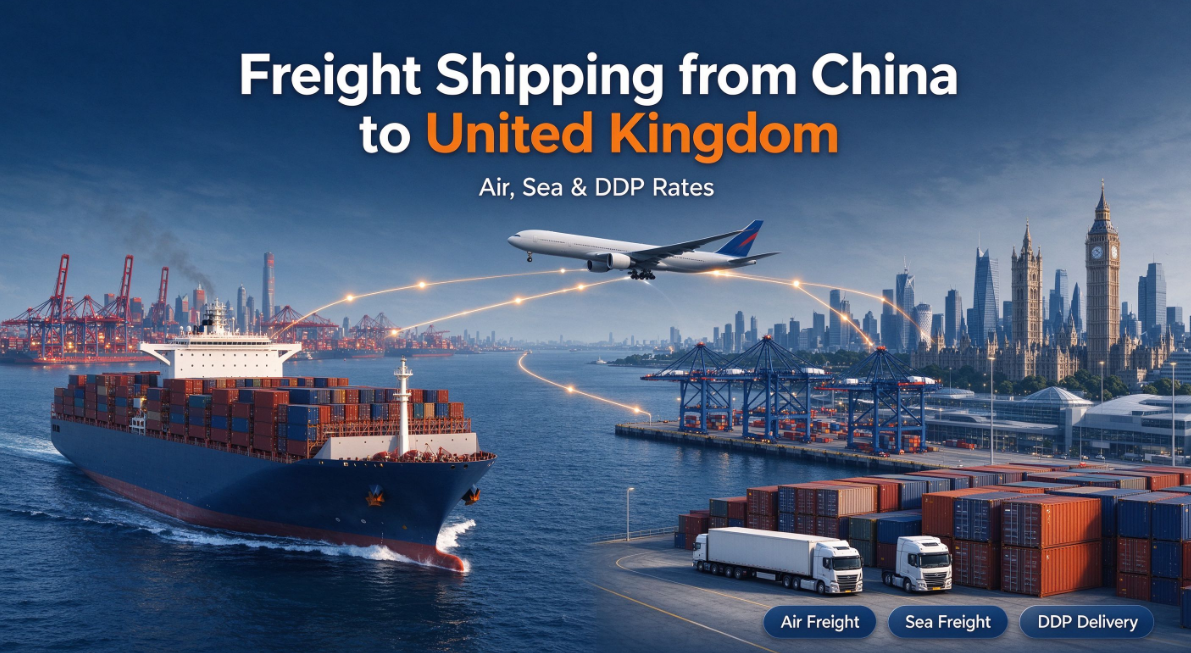
Freight Shipping from China to United Kingdom: Air, Sea & DDP Rates Guide
China is one of the UK's most important sourcing destinations, supplying everything from consumer electronics and clothing to furniture, machinery, household products, automotive components, and industrial equipment. For British importers, e-commerce sellers, wholesalers, and manufacturers, finding a reliable way to move products from China to the United Kingdom is essential for maintaining inventory, controlling operating expenses, and meeting customer delivery expectations.
Shibida Logistics(Top China freight forwarders)Cross-Border Logistics Line
Services: Sea Freight, Air Freight, DDP, FCL, LCL, Amazon FBA First Mile
Shibida Logistics(Top China freight forwarders) specializes in door-to-door one-stop shipping to the US, Europe, the Middle East and Southeast Asia. We deliver reliably with high on-time rates, own container pickup & trailer fleet, 18 years of experience, and have served over 30,000 enterprises.
View Logistics Solutions Get Detailed Quotation
Contact Us
📞 Phone: +86 15813899064
📧 Email: 732175850@qq.com
💬 WeChat ID: 15813899064
Scan WeChat QR Code

However, international freight shipping is not simply about comparing the lowest price per kilogram or container. A shipment that appears inexpensive at the departure end may become considerably more expensive after destination handling, customs clearance, import duties, VAT, storage, and domestic transportation are included.
For this reason, importers should evaluate the complete logistics process before booking. The right solution depends on shipment volume, cargo characteristics, delivery deadlines, customs arrangements, and whether the importer wants to manage the UK import process independently.
In this guide, we explain how freight shipping from China to United Kingdom works, compare air freight and sea freight, examine DDP shipping options, and provide practical advice on reducing logistics costs without creating unnecessary customs or delivery risks.
1. Shipping Methods from China to the United Kingdom
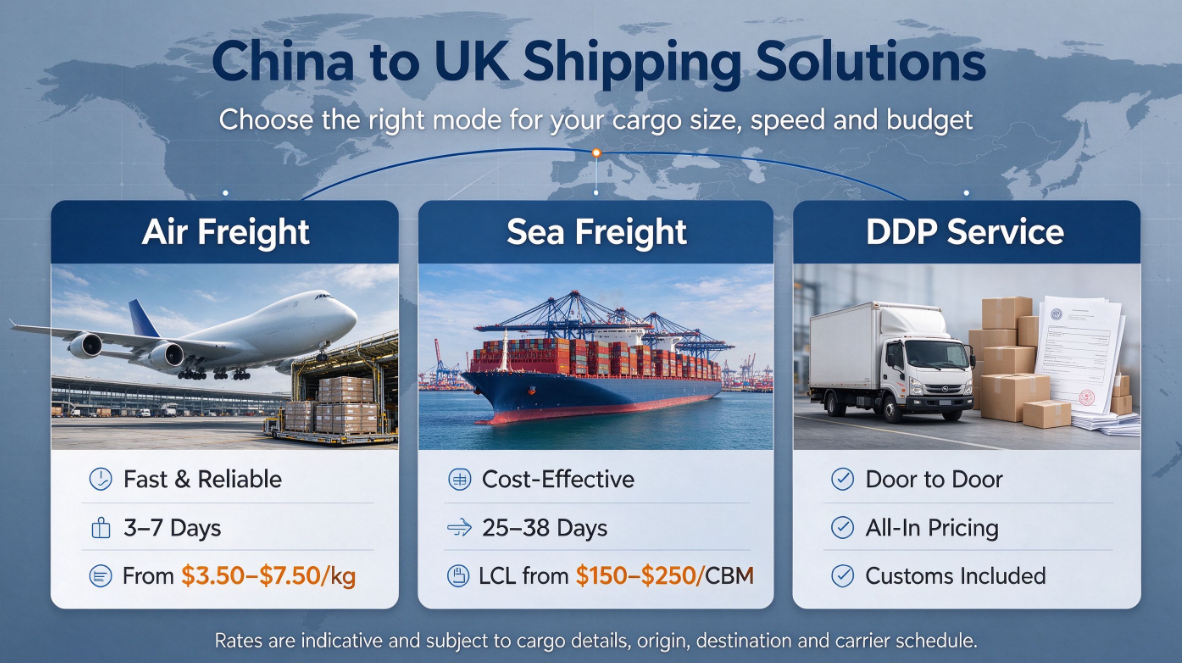
There are several ways to transport commercial cargo from China to the UK. The most common options are air freight, sea freight, and door-to-door DDP shipping. Express courier services are also available for small parcels and urgent samples.
Each method serves a different business requirement. Selecting the correct transportation method can make a substantial difference to the total landed cost of imported goods.
1.1 Air Freight from China to the UK
Air freight is suitable for importers who need relatively fast international transportation and are willing to pay more for speed and predictable handling.
Commercial air cargo generally travels from major Chinese airports to UK airports, particularly London Heathrow (LHR). Depending on the origin airport, airline schedule, cargo availability, and customs arrangements, shipments may move through direct or connecting services.
Common Chinese air cargo gateways include:
Shanghai Pudong International Airport (PVG)
Guangzhou Baiyun International Airport (CAN)
Shenzhen Bao'an International Airport (SZX)
Beijing Capital International Airport (PEK)
Hong Kong International Airport (HKG)
Hangzhou Xiaoshan International Airport (HGH)
On arrival in the UK, cargo is typically handled through Heathrow or another suitable airport gateway before customs clearance and final delivery.
Typical air freight transit time:
Airport-to-airport: approximately 2–5 days.
Door-to-door: approximately 5–10 days.
Economy air freight: approximately 7–14 days, depending on the service and routing.
These are planning estimates rather than guaranteed delivery commitments. The total transit time includes more than the actual flight. Export handling, cargo acceptance, airline schedules, import processing, and domestic delivery can all affect the final arrival date.
When Should You Choose Air Freight?
Air freight is particularly useful for:
High-value electronics and accessories.
Urgent product replenishment for online retailers.
Fashion products with short selling seasons.
Product samples and pre-production orders.
Small shipments where inventory availability is more important than transportation cost.
Replacement components needed to avoid production interruptions.
For example, a UK retailer waiting for a 150 kg shipment of electronic accessories may prefer air freight if an out-of-stock situation is already affecting sales. Although the freight cost per kilogram is higher than sea freight, the faster arrival may protect revenue and reduce the need to maintain excessive inventory.
By contrast, sending several tonnes of low-value furniture by air would rarely be commercially attractive unless there were exceptional delivery requirements.
1.2 Sea Freight from China to the UK
Sea freight is usually the most economical transportation method for medium-sized and large commercial shipments. It is particularly suitable for importers who purchase goods in bulk, regularly replenish stock, or need to move heavy and oversized products.
China has an extensive network of international container ports, and UK-bound cargo can depart from several major export gateways.
Common departure ports include:
Shanghai Port
Ningbo-Zhoushan Port
Shenzhen Port
Yantian Port
Guangzhou Port
Qingdao Port
Xiamen Port
Tianjin Port
Major UK arrival gateways include:
Port of Felixstowe: One of the UK's principal container ports, handling substantial volumes of international container traffic.
London Gateway: A major deep-sea container terminal serving London and surrounding distribution markets.
Port of Southampton: An important southern UK gateway for containerized cargo.
Port of Liverpool: A useful option for cargo destined for northwestern England and nearby regions.
The most suitable departure and arrival ports depend on the factory location, shipping service, vessel schedule, container availability, and final delivery address.
Typical sea freight transit time:
Port-to-port: approximately 25–40 days.
Door-to-door: approximately 30–45 days.
LCL shipments: often require additional time for consolidation and deconsolidation.
During peak shipping periods, port congestion, vessel rollovers, transshipment delays, and customs inspections can extend the actual delivery time.
1.3 FCL vs. LCL Sea Freight
Sea freight is generally divided into two main arrangements: Full Container Load (FCL) and Less than Container Load (LCL).
Full Container Load (FCL)
FCL means that an importer books an entire shipping container for their cargo. The container may be loaded at the supplier's factory or at a designated warehouse before being transported to the departure port.
The most common container sizes are:
| Container Type | Approximate Internal Capacity | Suitable Cargo |
|---|---|---|
| 20ft Standard | Approximately 33 CBM | Heavy cargo and medium-volume shipments |
| 40ft Standard | Approximately 67 CBM | Large commercial shipments |
| 40ft High Cube | Approximately 76 CBM | Bulky or lightweight cargo |
Actual usable loading capacity depends on container specifications, cargo dimensions, weight restrictions, packaging, and loading arrangements. The theoretical internal volume should never be treated as the guaranteed quantity of goods that can be loaded.
Advantages of FCL shipping:
Lower transportation cost per unit when the container is efficiently filled.
Less cargo handling compared with consolidated shipments.
Greater control over loading and sealing.
Suitable for regular import programs and large orders.
Potentially simpler cargo tracking and warehouse planning.
FCL is often a good choice for importers shipping furniture, machinery, building materials, packaging products, and large quantities of consumer goods.
Less than Container Load (LCL)
LCL allows several importers to share the same shipping container. Each customer pays according to the volume or chargeable measurement occupied by their cargo rather than paying for an entire container.
This is useful when an order is too large for air freight to be economical but too small to justify an FCL booking.
For example, a British importer purchasing 4 CBM of kitchen accessories from a Chinese supplier may find LCL more practical than booking a 20ft container.
Advantages of LCL shipping:
No need to pay for unused container space.
Suitable for small and medium-sized commercial orders.
Allows importers to consolidate products from different suppliers.
Provides access to economical ocean transportation without a full-container commitment.
However, LCL cargo normally requires additional warehouse handling, consolidation, and deconsolidation. These activities can increase both delivery time and destination charges.
One important operational detail is that LCL costs are not always calculated using the supplier's estimated CBM alone. Freight forwarders may apply minimum chargeable volumes, weight restrictions, or additional handling charges. Always confirm the final chargeable measurement before booking.
1.4 Express Courier Shipping
For very small shipments, international express services may be more practical than conventional air freight.
Major international courier networks include DHL, UPS, FedEx, and other express delivery providers.
Express shipping is commonly used for:
Documents and business samples.
Small parcels and low-volume orders.
Urgent replacement parts.
Online retail orders requiring individual delivery.
Door-to-door delivery may take approximately 3–7 working days, depending on the service, origin, destination, and customs requirements.
Express services are convenient because pickup, international transportation, tracking, and delivery are generally managed through one network. However, their pricing can be relatively high for heavy or bulky commercial cargo.
2. Air Freight vs. Sea Freight: Which Is Better?
There is no single shipping method that is best for every importer. The correct decision depends on the relationship between freight cost, inventory value, shipment volume, and delivery deadlines.
The following table provides a practical comparison of the main options.
| Shipping Method | Estimated Transit Time | Cost Level | Best For |
|---|---|---|---|
| Express Courier | 3–7 working days | High | Samples and small parcels |
| Standard Air Freight | 5–10 days door-to-door | Medium to High | Urgent commercial cargo |
| Economy Air Freight | 7–14 days | Medium to High | Time-sensitive but flexible shipments |
| Sea Freight LCL | 30–45 days door-to-door | Low to Medium | Small and medium cargo volumes |
| Sea Freight FCL | 30–45 days door-to-door | Low per unit at suitable volume | Bulk orders and large shipments |
| Sea DDP | 35–50 days | Depends on cargo and service scope | Importers seeking an all-in delivery arrangement |
Practical recommendation: If your shipment is urgent and relatively lightweight, request an air freight quotation. If your shipment is bulky, heavy, and not time-sensitive, compare LCL and FCL sea freight. If you want a single provider to coordinate transportation, customs, applicable taxes, and delivery, investigate a properly structured DDP service.
Do not compare an airport-to-airport air rate directly with a door-to-door sea rate. They cover different services and will produce misleading cost comparisons.
3. Freight Shipping Rates from China to the United Kingdom
Shipping prices from China to the UK change according to market demand, airline capacity, vessel space, fuel costs, origin and destination locations, cargo dimensions, and the selected service level.
There is no universal rate that applies to every shipment. A reliable quotation should be calculated using actual shipment information rather than a generic price advertised online.
3.1 Indicative Air Freight Rates
Air freight is generally charged according to chargeable weight. The rate per kilogram may decrease when the shipment reaches a higher weight bracket.
| Chargeable Weight | Indicative Air Freight Rate | Typical Application |
|---|---|---|
| 45–99 kg | USD 5.50–9.00/kg | Small commercial shipments |
| 100–299 kg | USD 4.50–7.50/kg | Medium-sized cargo |
| 300–499 kg | USD 4.00–6.50/kg | Regular commercial shipments |
| 500 kg and above | USD 3.50–6.00/kg | Larger air cargo bookings |
Important: These figures are illustrative planning ranges, not live carrier offers or guaranteed door-to-door prices. The final quotation may be higher after fuel surcharges, security fees, export handling, customs brokerage, and UK delivery are included.
Some routes also have minimum chargeable weights. A shipment weighing 32 kg may therefore be charged using a higher minimum billing weight or a different service category.
3.2 Indicative Sea Freight Rates
Sea freight rates are influenced by container type, shipping route, vessel availability, sailing schedule, and port-related charges.
| Sea Freight Type | Indicative Freight Cost | Typical Transit Time |
|---|---|---|
| LCL | USD 45–100/CBM | 30–45 days |
| 20ft FCL | USD 1,800–3,500/container | 25–40 days port-to-port |
| 40ft FCL | USD 2,800–5,000/container | 25–40 days port-to-port |
| 40ft High Cube | USD 3,000–5,300/container | 25–40 days port-to-port |
These figures are broad reference ranges for international ocean freight planning. They do not automatically include origin charges, destination terminal handling, customs clearance, duties, VAT, port storage, or delivery to a UK warehouse.
In particular, a low LCL rate per CBM does not necessarily mean a low final bill. Documentation, warehouse handling, minimum charges, and destination fees can represent a significant portion of the total expense on small shipments.
3.3 DDP Shipping Rates
DDP shipping is priced differently from basic international freight because it can include multiple logistics and import-related services.
Indicative door-to-door planning ranges may look like this:
| DDP Shipping Method | Indicative Cost | Estimated Delivery |
|---|---|---|
| Air DDP | USD 7–13/kg | 7–15 days |
| Sea LCL DDP | USD 120–280/CBM | 35–50 days |
| Sea FCL DDP | USD 3,500–7,000 per 20ft container | 35–50 days |
These are illustrative service-planning estimates only. DDP prices vary substantially depending on commodity classification, declared customs value, duty exposure, delivery postcode, cargo restrictions, and the party responsible for the import declaration.
When comparing DDP offers, ask whether the quotation includes all of the following:
Pickup from the Chinese supplier.
Chinese export customs declaration.
International freight.
UK import customs clearance.
Applicable customs duties.
Import VAT and the agreed VAT treatment.
Destination handling charges.
Final delivery to the named UK address.
Do not assume that the phrase "DDP all inclusive" automatically means that every possible charge is covered. Ask for written confirmation of exclusions, delivery limitations, customs responsibilities, and any additional charges that may arise.
4. How Is Air Freight Chargeable Weight Calculated?
One of the most important details in air cargo pricing is the difference between actual weight and volumetric weight.
Airlines need to account for both the physical weight of cargo and the amount of aircraft space it occupies. A large, lightweight carton may consume more cargo capacity than a compact, heavy shipment.
For this reason, air freight normally uses the higher of actual gross weight and volumetric weight.
4.1 Volumetric Weight Formula
A commonly used air freight calculation is:
Volumetric Weight (kg) = Length (cm) × Width (cm) × Height (cm) ÷ 6000
The applicable divisor depends on the carrier and service. Some courier networks use a divisor of 5000, while conventional air cargo quotations commonly use 6000. Always confirm the billing method with your freight forwarder.
4.2 Practical Calculation Example
Suppose you are importing 10 cartons of household products from Guangzhou to London.
Carton dimensions: 60 × 50 × 40 cm.
Number of cartons: 10.
Actual weight per carton: 18 kg.
The volumetric weight of each carton is:
60 × 50 × 40 ÷ 6000 = 20 kg
For 10 cartons:
Total actual weight: 180 kg.
Total volumetric weight: 200 kg.
Chargeable weight: 200 kg.
If the quoted air freight rate is USD 5.50/kg, the basic international freight calculation becomes:
200 kg × USD 5.50 = USD 1,100
This example does not include additional origin or destination charges.
Professional tip: Ask your supplier to measure the cartons after final packaging, not before. Carton dimensions frequently increase when protective foam, corner guards, pallets, or export cartons are added. Even a small increase in carton size can change the chargeable weight of the entire shipment.
5. What Does DDP Shipping from China to the UK Mean?
DDP stands for Delivered Duty Paid. It is an Incoterms rule under which the seller has the broadest delivery responsibility among the commonly used Incoterms rules.
Under a properly agreed DDP arrangement, the seller is responsible for arranging transportation and import clearance, paying the applicable import duties and taxes, and delivering the goods to the agreed destination.
For UK importers, DDP can simplify the shipping process because they do not need to arrange every stage of international transportation separately.
5.1 How Does DDP Shipping Work?
A typical China-to-UK DDP shipment follows these steps:
Supplier confirmation: The importer confirms the products, quantity, packaging, commercial value, and delivery address.
Cargo collection: The freight forwarder arranges pickup from the supplier's factory or warehouse.
Export clearance: The goods are declared for export in China.
International transportation: The shipment travels by air or sea according to the selected service.
UK import declaration: The relevant customs entry is submitted to HMRC through the Customs Declaration Service.
Duty and VAT arrangements: Applicable import charges are accounted for under the agreed customs and tax arrangements.
Final delivery: After release, the cargo is transported to the named UK delivery address.
5.2 Advantages of DDP Shipping
DDP is particularly attractive to businesses that do not have an established UK customs operation or prefer a more predictable logistics arrangement.
Simplified coordination: One logistics provider coordinates multiple transportation stages.
Cost visibility: A properly itemized quotation helps the importer estimate the total landed cost before shipment.
Reduced administrative work: The service provider can coordinate export and import customs procedures.
Convenient delivery: Goods can be delivered to a warehouse, business premises, or another agreed location.
Suitable for smaller importers: Companies without dedicated logistics teams may find the arrangement easier to manage.
5.3 DDP vs. DAP: What Is the Difference?
DDP and DAP are both commonly used for door-to-door international shipping, but their allocation of responsibilities is different.
| Item | DDP | DAP |
|---|---|---|
| International transportation | Seller arranges | Seller arranges |
| Export clearance | Seller | Seller |
| UK import clearance | Seller | Buyer |
| Import customs duty | Seller | Buyer |
| Import VAT | Seller, subject to the agreed tax arrangement | Buyer |
| Final delivery to agreed destination | Seller | Seller |
Although DDP can reduce the importer's administrative burden, it does not remove the need for accurate product descriptions, customs valuation, and lawful import documentation.
Before agreeing to DDP, confirm who will act as the importer of record, which EORI number will be used, how import VAT will be accounted for, and what customs documents will be provided after clearance.
These details are particularly important for VAT-registered UK businesses that want to maintain accurate accounting records or recover eligible import VAT.
6. UK Customs Clearance Requirements for Imports from China
Customs clearance is a critical part of the China-to-UK shipping process. A shipment may arrive on schedule but still be delayed if the declaration contains incorrect information or the necessary supporting documents are missing.
UK import procedures are administered by HM Revenue & Customs (HMRC). Commercial imports generally require an appropriate customs declaration through the Customs Declaration Service (CDS).
6.1 EORI Number
An Economic Operators Registration and Identification number, commonly known as an EORI number, is generally required for businesses involved in importing goods into Great Britain.
A GB EORI number is used to identify an economic operator in customs procedures. Importers should arrange the appropriate registration before the shipment arrives rather than waiting until the goods are already at the port.
Businesses importing into Northern Ireland may have different EORI requirements, so the correct registration should be checked against the destination and applicable customs arrangements.
Practical advice: Make sure the importer name, business details, VAT registration information, and EORI details supplied to the customs broker are consistent. Inconsistent information can lead to declaration amendments or clearance delays.
6.2 Commodity Codes and HS Codes
Every commercial product imported into the UK needs to be classified under the appropriate commodity code.
Internationally, products are classified using the Harmonized System (HS). The UK uses more detailed commodity codes for customs declarations and tariff calculations.
The correct code helps determine:
Applicable customs duty.
Import VAT treatment.
Import restrictions and licensing requirements.
Product-specific regulatory requirements.
Whether additional trade measures apply.
For example, two products that appear similar may have different commodity codes because they are made from different materials, have different functions, or are classified under different product categories.
Never select a commodity code simply because a supplier or another importer used it for a similar-looking product. Check the UK Trade Tariff and obtain professional classification advice when the correct classification is uncertain.
6.3 Commercial Invoice
The commercial invoice is one of the most important documents in international freight shipping.
It normally contains:
Exporter and importer details.
Product descriptions.
Quantity and unit price.
Total commercial value.
Currency.
Country of origin.
Applicable Incoterms rule.
Other information required for the customs declaration.
A useful product description should explain what the goods actually are. Descriptions such as "accessories," "parts," or "general merchandise" are usually too vague to support accurate customs classification.
For example, "plastic mobile phone protective cases" provides more useful information than simply writing "phone accessories."
6.4 Packing List
The packing list identifies how the goods are physically packed and helps customs brokers, warehouse operators, and carriers verify the shipment.
It should normally include:
Total number of cartons or pallets.
Carton identification or marks.
Gross weight and net weight.
Carton dimensions.
Product quantities.
Packaging details.
Ensure that the packing list matches the actual cargo. If the invoice shows 100 cartons but the warehouse receives 98, the discrepancy may need to be investigated before the shipment can be released or delivered.
6.5 Other Shipping Documents
Depending on the transportation method and product category, additional documents may include:
Air Waybill (AWB) for air freight.
Bill of Lading (B/L) for sea freight.
Certificate of Origin, where required or commercially relevant.
Product conformity and safety documentation.
Import licences or permits for controlled goods.
Insurance certificate, where applicable.
Dangerous goods documentation for regulated cargo.
For certain products, such as electrical equipment, toys, cosmetics, food-contact materials, and machinery, customs clearance is only one part of the compliance process. Importers should also verify the relevant UK product safety, labelling, and regulatory requirements before placing an order.
7. UK Import Duty and VAT: What Should Importers Expect?
Customs duty and import VAT are two different charges that should be considered when calculating the total landed cost of goods from China.
7.1 UK Import Duty
Customs duty depends on the product's commodity code, customs value, origin, and any applicable trade measures or reliefs.
There is no single import duty rate for all goods from China. Some products may attract a zero rate, while others may be subject to higher rates or additional measures.
For planning purposes, the general calculation can be represented as:
Customs Duty = Customs Value × Applicable Duty Rate
Suppose a shipment has a customs value of GBP 10,000 and the applicable customs duty rate is 5%.
GBP 10,000 × 5% = GBP 500 customs duty.
This is a simplified example. The customs value must be established using the applicable valuation rules, and additional measures may apply depending on the product.
7.2 UK Import VAT
The standard UK VAT rate is generally 20%, although certain products may qualify for reduced, zero, or other special VAT treatment.
Import VAT is not necessarily calculated using the supplier's invoice value alone. The taxable import value generally includes the customs value, applicable customs duties and other relevant import charges, together with qualifying incidental expenses.
For a simplified example:
| Cost Component | Amount |
|---|---|
| Customs value | GBP 10,000 |
| Customs duty at 5% | GBP 500 |
| Relevant additional expenses assumed for illustration | GBP 200 |
| Illustrative VAT base | GBP 10,700 |
| Import VAT at 20% | GBP 2,140 |
The actual VAT calculation depends on the applicable valuation rules and the expenses that must be included. This example is intended to illustrate the calculation structure, not replace a customs valuation.
7.3 What Is Postponed VAT Accounting (PVA)?
Postponed VAT Accounting (PVA) allows eligible VAT-registered UK importers to account for import VAT through their VAT returns rather than paying it immediately at the point of importation.
This can improve cash flow because importers do not necessarily need to finance the full import VAT amount before releasing their goods.
Eligible businesses can use their monthly postponed import VAT statements to support VAT return reporting and the recovery of input VAT where normal VAT recovery rules permit.
However, PVA is not the same as avoiding VAT. The import VAT still needs to be correctly declared and accounted for. The importer should also ensure that the correct VAT registration and EORI information are used in the import declaration.
For businesses using DDP services, it is particularly important to clarify whether import VAT is being paid by the service provider or accounted for under a suitable postponed VAT arrangement. A business should not assume that it can reclaim VAT merely because the forwarder has stated that tax is included in the shipping price.
8. What Factors Affect Freight Shipping Costs from China to the UK?
Freight prices are determined by several connected factors. Understanding them makes it easier to compare quotations and identify where savings are possible.
8.1 Cargo Weight and Volume
For air freight, chargeable weight is normally the higher of actual weight and volumetric weight.
For LCL sea freight, the chargeable measurement is generally based on the applicable weight or volume rule, together with minimum charges and service-specific conditions.
For FCL, the main cost consideration is the container type and the complete transportation arrangement.
8.2 Shipping Route and Port Selection
Freight rates can vary according to the departure city, export port, destination port, and final delivery postcode.
For example, a supplier located in Shenzhen may have different inland transportation costs from one located in Shanghai. The cheapest ocean freight rate may not be the most economical option if the cargo needs to travel a long distance to reach the departure port.
Similarly, delivery from Felixstowe to a warehouse in London is different from delivery to a remote location in Scotland.
8.3 Seasonal Demand
International freight markets experience seasonal changes.
Demand may increase before major retail periods such as Christmas, Black Friday, and other important shopping seasons. Factories may also experience higher shipping volumes before Chinese New Year.
During these periods, importers may encounter:
Higher air and ocean freight rates.
Limited container availability.
Reduced sailing or flight space.
Longer warehouse processing times.
Increased risk of booking changes.
Businesses with predictable demand should plan their shipments early rather than waiting until inventory levels become critically low.
8.4 Cargo Characteristics
Not all goods can be handled as ordinary general cargo.
Additional arrangements may be needed for:
Products containing lithium batteries.
Magnetic materials.
Liquids, powders, or chemicals.
Oversized or unusually heavy equipment.
Fragile products.
Temperature-sensitive goods.
Goods requiring special handling or regulatory documentation.
Always disclose the product's real characteristics before booking. Misdescribing restricted or dangerous goods can result in rejection, additional costs, penalties, or serious transport safety risks.
8.5 Destination Charges and Delivery Costs
One of the most common mistakes made by new importers is comparing international freight rates without checking destination charges.
Depending on the service, additional charges may include:
Origin warehouse handling.
Export customs declaration.
Terminal handling charges.
Documentation fees.
Port or airport handling.
Customs brokerage.
Import duty and VAT.
Storage and demurrage.
Container collection and return.
Final-mile delivery.
A professional quotation should clearly state which charges are included, which are excluded, and under what circumstances extra costs may arise.
9. Step-by-Step: How to Ship Goods from China to the UK
For first-time importers, the shipping process can seem complicated. In practice, it becomes much easier when each stage is handled in the correct order.
Step 1: Confirm the Supplier and Product Details
Start by confirming the supplier's factory or warehouse location, product description, quantity, packaging, and expected production completion date.
Ask the supplier to provide accurate carton dimensions and gross weight after packaging.
If the order contains multiple products, request a packing list that separates the quantities and packaging information for each product category.
Step 2: Check Product Compliance
Before shipping, identify whether your products require specific certificates, testing, labelling, permits, or other regulatory documentation for the UK market.
This is particularly important for electrical goods, toys, cosmetics, chemicals, food-related products, and machinery.
Do not assume that successful customs clearance automatically proves that a product complies with all UK market regulations.
Step 3: Select the Shipping Method
Compare air freight, LCL, FCL, and DDP options according to your budget and delivery deadline.
For small, urgent orders, air freight may be preferable. For larger and less time-sensitive shipments, sea freight generally offers better cost efficiency.
For importers who want fewer administrative tasks, compare a complete DDP service with a conventional freight arrangement.
Step 4: Request a Detailed Freight Quotation
Send your freight forwarder the following information:
Pickup city or supplier address in China.
Destination postcode in the UK.
Product description.
HS or commodity code, if available.
Total gross weight.
Total volume in CBM.
Number of cartons or pallets.
Individual carton dimensions.
Preferred shipping method.
Required delivery date.
If the cargo contains batteries, liquids, magnets, or other potentially restricted materials, provide the relevant technical details and documents at the quotation stage.
Step 5: Confirm the Shipping Terms
Confirm whether the quotation is EXW, FOB, CIF, DAP, or DDP.
These Incoterms allocate different responsibilities between the buyer and seller. A quotation that does not clearly identify its shipping terms can lead to disagreements over origin charges, customs clearance, or delivery costs.
Also confirm the named place or port associated with the selected Incoterm.
Step 6: Arrange Pickup and Export Clearance
After booking, the forwarder coordinates cargo collection, warehouse receiving, export documentation, and customs procedures in China.
Before the goods leave the supplier, verify that the final shipment quantity and packing information match the documents.
Step 7: International Transportation and Tracking
Once the cargo has been dispatched, the forwarder should provide the appropriate transport reference, such as an Air Waybill or Bill of Lading, together with available shipment tracking updates.
For sea freight, ask for the estimated vessel departure and arrival dates. For air freight, confirm the flight schedule and whether the service includes connecting flights.
Step 8: UK Customs Clearance
Before arrival, the customs broker should have the necessary documents and importer information.
Make sure the commodity code, declared value, origin, consignee information, and tax arrangements are correct.
If HMRC requests additional information or supporting documents, respond promptly to avoid unnecessary storage and handling charges.
Step 9: Final Delivery
After customs release, the cargo can be collected from the port, airport, or handling facility and delivered to the final destination.
For palletized cargo, confirm that the receiving warehouse has suitable unloading equipment, delivery access, and an agreed booking time.
If the destination is an Amazon fulfilment centre or third-party logistics warehouse, check the relevant appointment and labelling requirements before dispatch.
10. How to Reduce Shipping Costs from China to the UK
Reducing international freight expenses does not always mean choosing the cheapest forwarder. A better approach is to optimize packaging, shipment planning, transport selection, and customs preparation.
10.1 Optimize Carton Dimensions
For air freight, unnecessary packaging volume can directly increase chargeable weight.
Ask the supplier whether the product can be packed more efficiently without compromising protection. Removing excessive empty space, using appropriately sized cartons, and arranging products carefully can reduce volumetric weight.
However, never compromise product safety simply to reduce carton dimensions. Damaged cargo can cost considerably more than the freight savings.
10.2 Consolidate Orders from Multiple Suppliers
If you purchase products from several factories in China, consider consolidating them at a warehouse before international shipping.
For example, an importer purchasing products from suppliers in Shenzhen, Dongguan, and Guangzhou may arrange collection to one consolidation warehouse.
This can reduce duplicated international freight bookings and simplify shipment management.
However, consolidation needs to be planned carefully. The goods should be ready within a reasonable timeframe, and the warehouse should verify each supplier's cargo quantity and packaging condition.
10.3 Compare LCL and FCL at Different Volumes
Do not automatically assume that LCL is cheaper simply because you have less than a full container.
When the shipment reaches a certain volume, the total LCL charges may approach or exceed the cost of an FCL arrangement.
Ask the forwarder to calculate both options if the shipment is relatively large. Include origin handling, destination charges, customs clearance, and final delivery in the comparison.
10.4 Plan Around Seasonal Shipping Demand
Book freight space early when shipping before Chinese New Year or major UK retail seasons.
Early planning provides more flexibility in selecting vessel schedules and flight options. It also reduces the risk of paying premium rates because of urgent last-minute bookings.
10.5 Prepare Customs Documents Before Departure
Correct documents help reduce the risk of customs delays, declaration amendments, and unnecessary storage costs.
Confirm the invoice, packing list, commodity code, product description, declared value, and origin information before the cargo is shipped.
10.6 Compare the Total Landed Cost
For purchasing decisions, the most useful figure is usually the total landed cost rather than the international freight rate alone.
A simplified landed-cost calculation is:
Total Landed Cost = Product Cost + Origin Charges + International Freight + Insurance + Customs Duty + Import VAT + Destination Charges + Final Delivery
Depending on the business's VAT status and accounting arrangements, recoverable import VAT should be treated separately when evaluating the long-term economic cost.
11. Common Problems When Shipping from China to the UK
Even well-organized shipments can encounter problems. Understanding the most common issues allows importers to prepare before cargo leaves China.
11.1 Incorrect Customs Declarations
Incorrect product descriptions, commodity codes, values, or country-of-origin information can trigger additional checks.
The best solution is to prepare accurate commercial documents and ensure that the customs broker understands the actual product.
11.2 Unexpected Destination Charges
Some low-cost freight quotations exclude destination handling, customs brokerage, storage, or delivery fees.
Before booking, request a written breakdown of all included and excluded charges.
11.3 Delayed Vessel or Flight Schedules
International shipping schedules can change because of weather, congestion, equipment shortages, operational disruption, and other factors.
For important inventory, allow a reasonable delivery buffer and avoid scheduling stock replenishment around an unrealistically tight arrival date.
11.4 Incorrect Cargo Measurements
Supplier-provided dimensions may be inaccurate, particularly when goods are repacked or palletized.
Ask the warehouse to measure and weigh the final shipment before confirming the freight booking.
11.5 Unclear DDP Tax Arrangements
A DDP quotation may look attractive, but the importer may not understand who is responsible for the customs declaration and how import VAT is treated.
Always confirm the importer of record, EORI details, VAT arrangements, and the availability of customs documentation.
11.6 Restricted or Non-Compliant Products
Some products require special transportation approval, import licences, or additional compliance documents.
Check these requirements before the goods are manufactured or collected. A forwarder should not be expected to solve every product compliance issue after the shipment has already arrived.
12. Choosing a Reliable China-to-UK Freight Forwarder
A freight forwarder does much more than purchase space on an aircraft or vessel. A capable logistics partner should understand the complete movement of cargo from the supplier's location in China to the final delivery address in the UK.
When evaluating a forwarder, consider the following points.
12.1 Experience with the China–UK Route
Ask whether the provider regularly handles shipments from your supplier's region to the UK.
Experience with specific departure ports, airports, and UK delivery locations can help avoid unnecessary handling and routing problems.
12.2 Transparent Quotations
A reliable forwarder should be able to explain its pricing structure and identify the services covered by the quotation.
Be cautious when a provider offers an unusually low price but cannot explain destination charges, customs responsibilities, or tax arrangements.
12.3 Customs Knowledge
The forwarder should understand UK import declarations, commodity classification, customs valuation, and the relevant VAT arrangements.
It should also be willing to explain what documents are required and what responsibilities remain with the importer.
12.4 Shipment Tracking and Communication
Good communication is especially important when the shipment is delayed, selected for inspection, or awaiting additional documents.
Ask how often tracking information is updated and who will handle operational issues during transportation.
12.5 Cargo Insurance
International cargo may be exposed to loss or damage during loading, transportation, handling, and unloading.
Discuss cargo insurance separately and review the policy's insured value, exclusions, claims process, and coverage period.
Do not assume that a carrier's standard liability automatically provides full compensation for the commercial value of your goods.
13. Practical Shipping Recommendations by Business Type
Different importers have different supply chain priorities. The following examples illustrate how businesses can select an appropriate shipping arrangement.
13.1 Amazon FBA Sellers
Amazon sellers often need to balance delivery costs with inventory availability and fulfilment centre receiving schedules.
For small replenishment orders, air freight may help prevent stockouts. For larger orders, sea freight is usually more economical.
When arranging delivery to an Amazon fulfilment centre, confirm carton labels, pallet requirements, booking procedures, shipment references, and the receiving address before dispatch.
Also allow time for customs clearance and domestic transportation. A vessel's arrival date is not the same as the date on which Amazon receives and processes the inventory.
13.2 Wholesale Importers
Wholesalers importing regular volumes may benefit from FCL sea freight and consolidated purchasing arrangements.
Forecasting demand several months ahead can make it easier to organize container bookings and reduce the need for expensive emergency shipments.
13.3 Small Businesses and Startups
Smaller businesses may not have the resources to manage complex customs and logistics procedures independently.
LCL sea freight and carefully structured DDP services can provide practical alternatives, depending on the cargo and the business's tax arrangements.
Before placing the first order, calculate the expected landed cost per unit. This makes it easier to determine whether the selling price leaves enough room for marketplace fees, warehousing, marketing, and profit.
13.4 Manufacturers and Industrial Importers
Manufacturers importing machinery, equipment, and components should pay particular attention to cargo dimensions, lifting arrangements, packing strength, and transport restrictions.
Large or heavy cargo may require special equipment, flat racks, open-top containers, or other project cargo arrangements.
For these shipments, the forwarder should review the cargo specifications and loading plan before providing a final quotation.
14. Frequently Asked Questions About Freight Shipping from China to the UK
Q1. How long does shipping from China to the UK take?
Air freight generally takes around 5–10 days door-to-door, while sea freight commonly takes around 30–45 days door-to-door. Express courier services may take approximately 3–7 working days. Actual transit time depends on the route, service, customs clearance, and final delivery location.
Q2. What is the cheapest way to ship goods from China to the UK?
For large shipments, sea freight FCL is often the most economical option per unit. For smaller commercial shipments, LCL may be more suitable. The cheapest method depends on cargo volume, weight, destination charges, and delivery requirements.
Q3. Is air freight faster than sea freight?
Yes. Air freight is generally significantly faster than sea freight. It is particularly useful for urgent and high-value goods, while sea freight is better suited to larger shipments where transportation cost is a priority.
Q4. How much does air freight from China to the UK cost per kg?
Indicative conventional air freight rates may range from approximately USD 3.50 to USD 9.00 per chargeable kilogram, depending on shipment weight, route, cargo characteristics, and service level. Pickup, customs clearance, and UK delivery may be charged separately.
Q5. How much does sea freight from China to the UK cost?
As a broad planning reference, LCL shipping may range from approximately USD 45–100 per CBM, while a 20ft container may cost around USD 1,800–3,500 for basic ocean freight. Actual quotations vary with market conditions and the charges included.
Q6. What is the difference between FCL and LCL?
FCL means booking an entire shipping container for one shipment. LCL means sharing container space with cargo belonging to other importers. FCL is usually preferable for larger shipments, while LCL is useful for smaller volumes.
Q7. Does DDP shipping include UK import duty and VAT?
A properly agreed DDP service generally places responsibility for import clearance, applicable duty, and import VAT on the seller. However, the precise tax treatment and importer-of-record arrangements must be confirmed in writing before booking.
Q8. Do I need a UK EORI number to import from China?
Businesses importing goods into Great Britain generally need a GB EORI number for customs procedures. Different arrangements may apply to Northern Ireland. Check the relevant requirements before shipment.
Q9. What documents are needed to ship goods from China to the UK?
Common documents include a commercial invoice, packing list, Air Waybill or Bill of Lading, and customs declaration information. Depending on the product, additional certificates, licences, or compliance documents may be required.
Q10. Is UK import VAT always 20%?
No. The standard UK VAT rate is generally 20%, but some products qualify for reduced or zero rates, and specific rules may apply. The correct VAT treatment should be checked according to the product classification and applicable legislation.
Q11. Can I ship from several Chinese suppliers in one shipment?
Yes. Cargo from multiple suppliers can often be consolidated at a Chinese warehouse before international transportation. This can simplify logistics and reduce duplicated shipping costs, although additional consolidation handling charges may apply.
Q12. Can I send goods directly to an Amazon FBA warehouse in the UK?
Yes, subject to Amazon's current shipment preparation, labelling, booking, and receiving requirements. The customs declaration and importer arrangements should also be confirmed before the goods leave China.
Q13. Is insurance necessary for freight shipping from China to the UK?
Cargo insurance is worth considering, especially for high-value, fragile, or large shipments. Review the coverage conditions and exclusions rather than assuming that ordinary carrier liability covers the full commercial value.
Q14. Can I ship batteries from China to the UK?
Battery shipments may be subject to transportation restrictions and specific documentation requirements, especially for lithium batteries. Acceptance depends on the battery type, configuration, packaging, test documentation, and selected carrier. Always declare batteries accurately before booking.
Q15. How can I get an accurate shipping quotation?
Provide the supplier's location, UK delivery postcode, cargo description, total weight, total volume, carton dimensions, packaging details, and preferred shipping method. If you need DDP, also provide the product's commodity code where available and confirm the customs and tax arrangements you require.
15. Final Thoughts: Find the Right Freight Shipping Solution from China to the UK
Freight shipping from China to United Kingdom requires a clear understanding of transportation options, customs requirements, taxation, and final delivery arrangements. The best shipping solution is not necessarily the one with the lowest advertised freight rate. It is the one that delivers the right balance of cost, speed, reliability, and compliance for your business.
Choose air freight when speed is important, inventory needs to be replenished quickly, or the cargo has a relatively high value compared with its weight.
Choose sea freight when you are shipping larger quantities, heavy products, or bulky cargo and can allow enough time for international transportation.
Choose LCL when your shipment does not justify an entire container, and compare FCL when your cargo volume becomes large enough for a dedicated container to be competitive.
Consider DDP shipping when you want a coordinated door-to-door arrangement covering transportation and agreed import-related charges. Always verify the importer-of-record details, customs declaration, and VAT treatment before proceeding.
Before confirming any shipment, compare the complete cost structure, check the relevant UK commodity code, prepare accurate customs documents, and confirm the delivery requirements at the destination.
With proper planning and a reliable logistics partner, importing goods from China to the UK can become a more predictable and cost-effective part of your supply chain.
Useful Official Resources for UK Importers
Note: All freight rates and transit times in this guide are indicative estimates for planning purposes, not binding offers. Actual charges and delivery schedules depend on the shipment details, carrier availability, customs classification, tax treatment, and market conditions at the time of booking. Importers should verify current requirements with HMRC and obtain a written quotation based on their actual cargo information.
How to Book
To take advantage of these new routes and services, simply:
- Contact our dedicated 【Freight Shipping from China to United Kingdom | Air, Sea & DDP Rates】 desk at Contact
- Provide details of your shipment (cargo type, volume, pickup location)
- Receive a customized quote within 24 hours
- Confirm your booking and prepare your goods for shipment
Our team specialists is ready to assist with all aspects of your shipment, from documentation to delivery.
About Shibida Logistics
Shibida Freight Forwarding is a leading private logistics service provider based in China, offering comprehensive export logistics and warehousing services, international freight forwarding, FBA dedicated logistics, US overseas warehouses, and international logistics services from China to the world by land, air, and sea.
With our headquarters in Shenzhen and branch offices/agents covering almost all major cities and seaports in China, we strive to deliver your cargo to any destination worldwide safely, timely, and at reasonable prices.
For more information about our new Australia routes or to request a quote, please contact us today.