Shibida Logistics Team
Logistics Expert
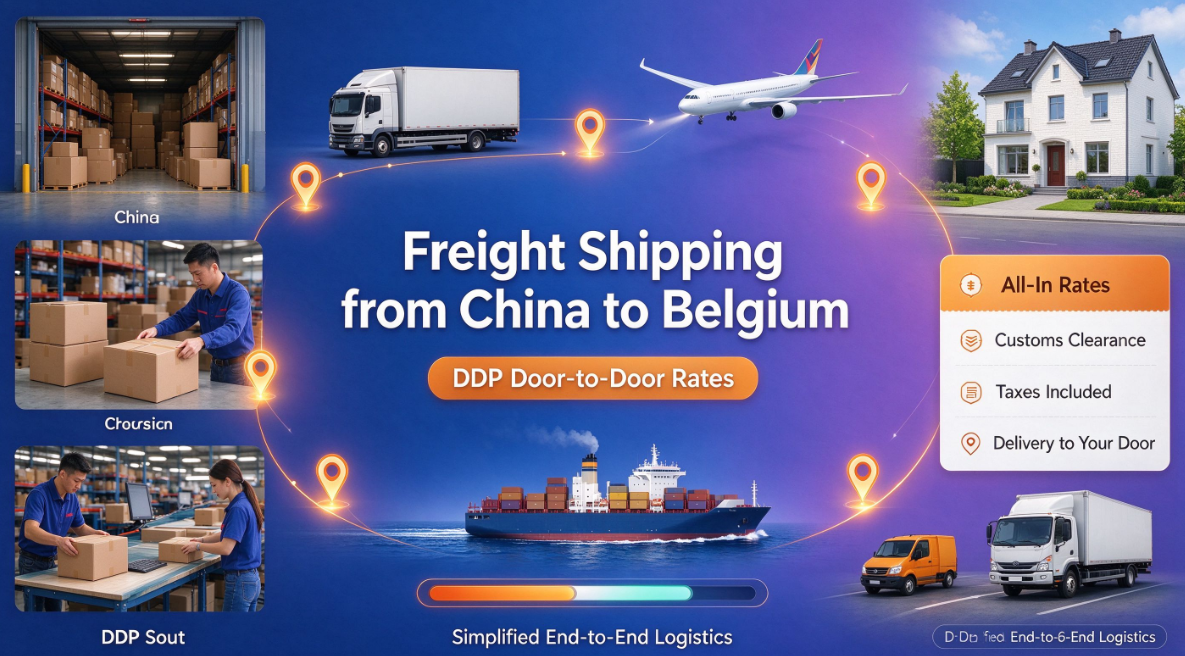
Freight Shipping from China to Belgium requires the right balance between transportation costs, transit time, customs compliance, and final delivery arrangements. Whether you are importing a few cartons, several pallets, or full containers, choosing the right shipping method can significantly affect your total landed cost. Sea freight is generally the most economical solution for bulk cargo, air freight offers faster delivery for urgent shipments, and DDP shipping provides a convenient door-to-door option with import duties and taxes handled under an agreed arrangement. In this guide, we compare shipping rates from China to Belgium, explain FCL and LCL sea freight, air cargo costs, transit times, DDP services, Belgian customs procedures, and EU import VAT. We also cover major shipping gateways such as Antwerp, Zeebrugge, Brussels Airport, and Liège Airport, helping importers understand how to move goods from Chinese suppliers to Belgian warehouses and businesses efficiently.
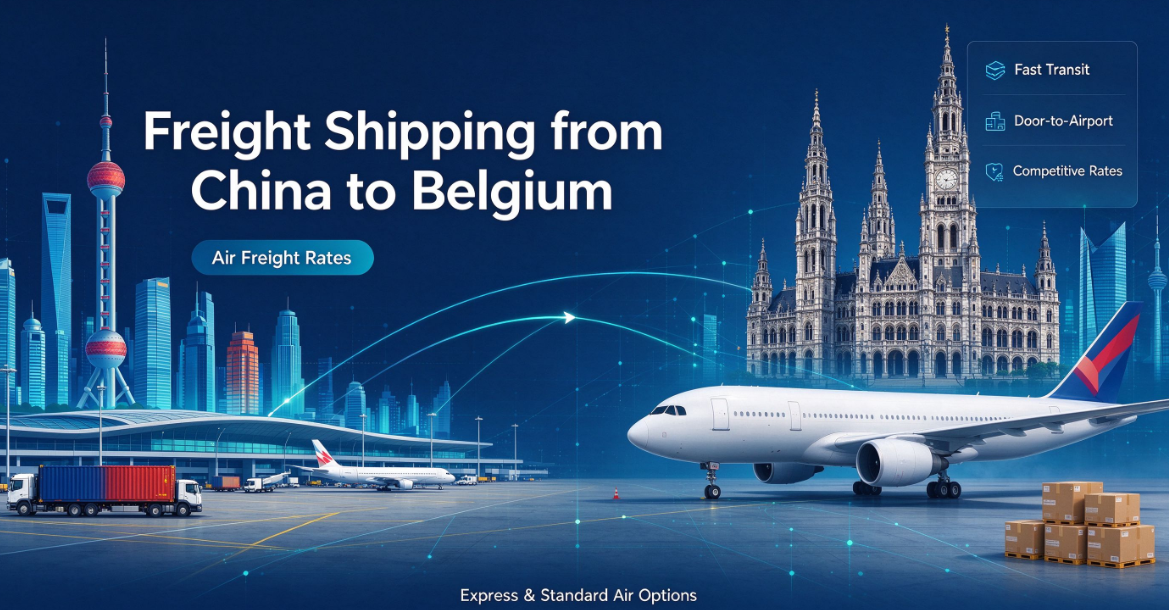
Freight Shipping from China to Belgium – Costs, Transit Times, Customs & DDP
Updated: November 2026 | China → Belgium Freight Guide
Shipping goods from China to Belgium is a common requirement for European wholesalers, manufacturers, distributors, and e-commerce businesses. Belgium's strategic location in Western Europe, combined with the Port of Antwerp-Bruges and its extensive road, rail, and air cargo infrastructure, makes it an important distribution gateway for imported products.
Shibida Logistics(Top China freight forwarders)Cross-Border Logistics Line
Services: Sea Freight, Air Freight, DDP, FCL, LCL, Amazon FBA First Mile
Shibida Logistics(Top China freight forwarders) specializes in door-to-door one-stop shipping to the US, Europe, the Middle East and Southeast Asia. We deliver reliably with high on-time rates, own container pickup & trailer fleet, 18 years of experience, and have served over 30,000 enterprises.
View Logistics Solutions Get Detailed Quotation
Contact Us
📞 Phone: +86 15813899064
📧 Email: 732175850@qq.com
💬 WeChat ID: 15813899064
Scan WeChat QR Code

However, the cheapest freight rate is not always the cheapest shipping solution. A shipment quoted at a low ocean freight rate may incur additional destination handling, customs brokerage, storage, and trucking expenses. Similarly, an attractive DDP price may not be suitable if the import declaration, VAT treatment, and importer-of-record arrangements are unclear.
For most importers, three decisions determine the success of a China-to-Belgium shipment:
Transportation method: Choose between sea freight, air freight, express courier, and rail-based multimodal solutions according to cargo volume and delivery deadlines.
Import arrangements: Decide whether FOB, CIF, DAP, or DDP provides the right balance of control, cost, and responsibility.
Customs preparation: Confirm HS codes, customs duties, Belgian VAT, EORI requirements, and product compliance before cargo departure.
This guide provides practical cost comparisons, shipping schedules, port information, customs considerations, and real-world planning examples for businesses importing from China to Belgium.
China to Belgium Shipping at a Glance
| CHINA | BELGIUM | ||
| Main Origin Ports | Shanghai, Ningbo, Shenzhen, Guangzhou, Qingdao | Main Seaport | Antwerp, Zeebrugge |
| Air Cargo Gateways | PVG, CAN, SZX, HKG | Air Cargo Airports | BRU, LGG |
| Sea Freight | FCL & LCL | Air Freight | Airport-to-airport & door-to-door |
| Sea Freight | Air Freight | Sea Transit | Air Transit |
|---|---|---|---|
| $1,800–$2,800 20GP | $4–$8/kg General cargo | 28–40 days | 5–10 days |
All prices and transit times are indicative planning estimates, not live carrier quotations. Actual rates depend on cargo specifications, origin, destination, booking date, shipping route, and service scope.
In This Guide
Shipping Rates from China to Belgium
Sea vs Air vs Express vs Rail Shipping
Incoterms: FOB, CIF, DAP and DDP
Sea Freight Services: FCL and LCL
Air Freight and Express Services
DDP Shipping to Belgium
Belgian Customs, Import Duties and VAT
Shipping Documents and Product Compliance
Shipping Routes, Ports and Cut-off Planning
Pallets, Packaging and Cargo Insurance
Practical Shipping Cost Examples
How to Choose a Freight Forwarder
Frequently Asked Questions
01. Shipping Rates from China to Belgium
How much does it cost to ship from China to Belgium? The answer depends primarily on the shipping method, shipment size, cargo weight, and delivery location.
For full container shipments, ocean freight is generally quoted per container. LCL shipping is calculated by chargeable cubic meter or weight, depending on the applicable tariff. Air freight is calculated using chargeable weight, while express services generally use their own dimensional-weight rules.
Current Indicative Shipping Rates
The following figures provide a starting point for calculating your import budget. They are reference ranges for standard commercial cargo and should be confirmed before booking.
| Shipping Method | Estimated Rate (USD) | Transit Time | Best For |
|---|---|---|---|
| Sea Freight 20GP | $1,800–$2,800 | 28–40 days | Full container shipments |
| Sea Freight 40GP | $2,800–$4,000 | 28–40 days | Large-volume cargo |
| Sea Freight 40HQ | $3,000–$4,300 | 28–40 days | Bulky, lightweight cargo |
| Sea Freight LCL | $60–$120/CBM | 30–45 days | Small and medium shipments |
| Air Freight 100–300 KG | $5–$8/KG | 5–9 days | Commercial air cargo |
| Air Freight 300–1,000 KG | $4–$7/KG | 5–9 days | Medium and large air shipments |
| Express Courier | $8–$15/KG | 3–7 days | Samples and small parcels |
| Air DDP | $6–$11/KG | 7–12 days | Urgent door-to-door shipments |
| Sea DDP | $1.8–$4/KG | 35–50 days | Large commercial shipments |
Important: Ocean freight rates in the table are not equivalent to total landed shipping costs. LCL origin and destination charges, container handling, customs clearance, import duties, VAT, and inland delivery may be additional. DDP estimates must be checked against the actual HS code, customs value, and tax arrangements.
What Affects Freight Rates?
Shipment dimensions: Larger cargo occupies more container or aircraft space.
Gross weight: Heavy cargo may incur additional handling or weight-related charges.
Origin location: Factory distance from Shanghai, Ningbo, Shenzhen, or Guangzhou affects pickup and inland transportation expenses.
Destination: Delivery to Antwerp, Brussels, Ghent, or Liège involves different inland transportation costs.
Commodity: Batteries, dangerous goods, oversized equipment, and temperature-sensitive cargo may require special arrangements.
Seasonality: Peak shipping demand, carrier capacity, fuel surcharges, and route disruptions can change freight prices.
Quick Shipping Cost Examples
To understand how the transportation method affects your budget, consider the following simplified examples.
| Example Shipment | Calculation | Estimated Freight Cost |
|---|---|---|
| 3 CBM LCL | 3 × $90 | $270 |
| 20GP Container | One container | $1,800–$2,800 |
| 200 KG Air Freight | 200 × $6 | $1,200 |
| 500 KG Air Freight | 500 × $5 | $2,500 |
These calculations illustrate the freight component only. They do not represent a complete door-to-door or customs-cleared price.
Market Planning: What Importers Should Watch
Ocean freight: Container availability, vessel schedules, port congestion, and seasonal demand are the main factors to monitor. When shipping to Antwerp, check whether the selected service is direct or requires transshipment.
Air freight: Capacity from major Chinese export airports can fluctuate significantly during peak shopping seasons. Confirm flight availability and cargo acceptance requirements before arranging pickup.
DDP services: A low DDP quotation is not necessarily the most economical option. Verify whether the price includes import duty, VAT, customs clearance, and final delivery, and whether the customs declaration can be properly documented.
02. Sea vs Air vs Express vs Rail Freight: Which Is Best for Belgium?
Choosing the right transportation method is usually the most important cost decision when importing from China. Sea freight provides the lowest cost for large shipments, air freight is faster, and express courier services offer convenience for small packages.
Rail freight can also be considered for certain China-Europe shipments, usually through European rail terminals followed by road delivery to Belgium. However, its availability, transit time, and total cost depend on the specific corridor and current operating arrangements.
Cost and Speed Comparison
| Mode | Typical Shipment | Cost Reference | Transit | Main Consideration |
|---|---|---|---|---|
| Sea FCL | Full container | $1,800–$4,300/container | 28–40 days | Best for bulk cargo |
| Sea LCL | 1–15 CBM | $60–$120/CBM | 30–45 days | Additional CFS charges |
| Air Freight | 100–1,000 KG | $4–$8/KG | 5–10 days | Chargeable weight |
| Express | Small parcels | $8–$15/KG | 3–7 days | Higher cost per KG |
| Rail + Truck | Medium-sized cargo | Route-specific quotation | Approximately 18–25 days | Terminal and border handling |
Sea Freight: Best for Cost Efficiency
Sea freight is generally the preferred option for shipments above approximately 2–3 CBM when the delivery schedule is flexible. For larger volumes, FCL transportation can reduce the freight cost per unit.
Typical cargo includes:
Furniture and home decoration products.
Construction materials and industrial components.
Machinery and manufacturing equipment.
Textiles, clothing, and footwear.
Household goods and wholesale inventory.
Sea freight requires more planning than air transportation. Cargo must be collected, delivered to the port, cleared for export, loaded onto a vessel, discharged at destination, and released through import customs.
Our recommendation: For shipments above approximately 10–15 CBM, compare the complete LCL cost with a 20GP FCL quotation. The break-even point depends on origin charges, destination handling, and container trucking costs.
Air Freight: Best for Urgent Cargo
Air freight is a practical choice when inventory is urgently needed or when the cargo value is high relative to its weight.
Typical applications include electronic components, industrial spare parts, product samples, high-value consumer products, and urgent e-commerce replenishment.
One important consideration is that air freight charges are based on chargeable weight, not necessarily actual weight.
Air volumetric weight formula:
Length × Width × Height (CM) ÷ 6,000 = Volumetric Weight (KG).
The greater of actual weight and volumetric weight is generally used as chargeable weight, subject to the carrier's tariff.
For example, a shipment of 10 cartons measuring 60 × 50 × 40 cm and weighing 15 kg each has:
Actual weight: 150 KG.
Total volume: 1.2 CBM.
Volumetric weight: 200 KG.
Chargeable weight: 200 KG.
In this situation, the shipment may be charged as 200 KG rather than 150 KG.
Rail Freight: A Middle-Ground Option
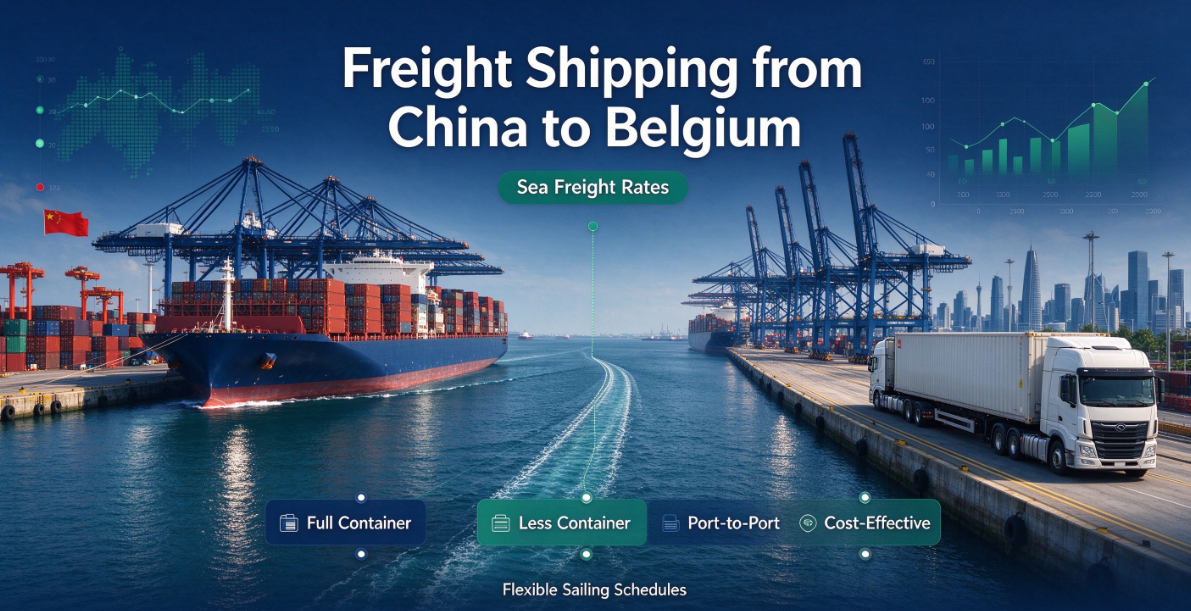
Rail transportation can offer an alternative between sea and air for certain China-Europe shipments. Cargo generally moves through established Eurasian rail corridors before reaching European terminals, where onward road transportation can deliver the goods to Belgium.
Rail may be suitable for:
Medium-volume machinery shipments.
Industrial components.
Electronics and general commercial goods.
Inventory that needs to arrive faster than standard sea freight.
However, rail service is route-dependent. Importers should confirm the actual European arrival terminal, border procedures, handling arrangements, cargo restrictions, and whether the quotation includes delivery to the Belgian address.
Which Method Should You Choose?
| Your Situation | Recommended Method |
|---|---|
| Small samples below 50 KG | Express courier |
| Urgent cargo of 100–500 KG | Air freight |
| Small commercial orders of 1–10 CBM | LCL sea freight |
| Large orders above 15 CBM | Compare LCL and FCL |
| Full container imports | FCL sea freight |
| Medium-sized cargo with a tighter schedule | Compare rail and air freight |
| Importer seeking coordinated customs and delivery | DDP or a suitable DAP arrangement |
03. Incoterms for China-to-Belgium Shipping: FOB, CIF, DAP & DDP
Incoterms determine how transportation costs, risks, export formalities, import customs clearance, and delivery responsibilities are divided between the seller and buyer.
Choosing the correct Incoterm is particularly important when buying from Chinese manufacturers. A supplier may offer a low FOB price, while another provides CIF or DDP delivery. These prices cannot be compared directly without understanding what each one includes.
Who Is Responsible for What?
| Responsibility | EXW | FOB | CIF | DAP | DDP |
|---|---|---|---|---|---|
| Export Clearance | Buyer | Seller | Seller | Seller | Seller |
| Main Freight | Buyer | Buyer | Seller | Seller | Seller |
| Import Clearance | Buyer | Buyer | Buyer | Buyer | Seller |
| Import Duty | Buyer | Buyer | Buyer | Buyer | Seller |
| Import VAT | Buyer | Buyer | Buyer | Buyer | Seller |
| Final Delivery | Buyer | Buyer | Buyer | Seller | Seller |
Responsibility summary for typical transactions. Exact obligations depend on the selected Incoterms 2020 rule and named place or port. Under DDP, the seller is responsible for import clearance and applicable duties and taxes. Under DAP, the buyer handles import clearance and import taxes.
FOB: A Popular Option for Experienced Importers
FOB (Free On Board) is widely used for commercial sea freight shipments. The Chinese supplier arranges export clearance and delivers the goods on board the vessel at the agreed port of shipment.
The Belgian buyer then arranges the main ocean freight, insurance if required, import customs clearance, duties, VAT, and inland delivery.
FOB is suitable for businesses that want control over freight selection and destination customs arrangements.
CIF: Freight and Insurance Arranged by the Seller
CIF (Cost, Insurance and Freight) means that the seller pays for the ocean freight and minimum required insurance to the named destination port.
However, the buyer remains responsible for import customs clearance, duties, VAT, and destination arrangements.
One important detail: Under CIF, the risk transfers to the buyer when the goods are loaded on board the vessel at the origin port, even though the seller pays for freight and insurance to the destination port.
DAP: Door Delivery Without Import Taxes Paid by the Seller
DAP (Delivered at Place) is suitable for buyers who want the seller to organize transportation to a Belgian warehouse or business address but prefer to handle import customs clearance themselves.
The buyer is responsible for import duties, VAT, and customs formalities. The seller generally delivers the cargo ready for unloading at the agreed destination.
DDP: Delivered Duty Paid
DDP is often selected by importers who want a coordinated door-to-door service. The seller assumes responsibility for transportation, import clearance, and applicable import duties and taxes under the agreement.
However, DDP requires proper arrangements for the importer of record, customs representation, and VAT compliance. A non-EU seller should not assume that it can automatically act as the importer in Belgium without meeting the applicable legal requirements.
Which Incoterm Is Best for Belgian Importers?
Regular B2B importers: FOB is often a practical choice when the buyer has an established customs broker and freight forwarder.
Buyers wanting seller-arranged freight: CIF may be suitable for ocean shipments, provided destination charges are understood.
Businesses with their own import arrangements: DAP can simplify transportation while retaining control over customs clearance.
New importers and e-commerce sellers: DDP can simplify operations when the legal and tax arrangements are properly established.
04. Sea Freight from China to Belgium: FCL & LCL Services
Sea freight is one of the most cost-effective methods for moving commercial cargo from China to Belgium. Most containerized shipments use the Port of Antwerp-Bruges as their main maritime gateway.
FCL Shipping: Full Container Load
FCL means that the shipper books an entire container for their cargo. The container is loaded and sealed at the origin, transported to the destination port, and released for delivery.
Common container options include:
| Container | Approx. Internal Volume | Typical Application |
|---|---|---|
| 20GP | 28 CBM | Heavy machinery, dense products |
| 40GP | 58 CBM | General commercial cargo |
| 40HQ | 68 CBM | Furniture, bulky lightweight goods |
These are approximate usable planning volumes. Actual loading capacity depends on cargo dimensions, packaging, weight distribution, container specifications, and applicable road weight limits.
Why choose FCL?
More predictable container space allocation.
Reduced handling compared with consolidated LCL shipments.
Suitable for large orders and regular imports.
Greater control over loading and cargo security.
Potentially lower unit freight costs for larger volumes.
LCL Shipping: Less than Container Load
LCL allows several importers to share one container. Each shipper pays for the cargo space used rather than booking an entire container.
For example, if a Belgian wholesaler imports 5 CBM of furniture accessories from Guangzhou, LCL can be more economical than paying for a dedicated 20GP container.
LCL is particularly suitable for:
Small and medium-sized orders.
Product samples and test orders.
Multi-supplier purchasing.
Regular inventory replenishment.
Businesses without enough cargo to fill a container.
However, LCL shipments involve consolidation at the origin and deconsolidation at the destination. Additional warehouse handling and destination CFS charges should be included in your cost calculation.
Sea Freight Transit Times
| China Origin | Belgium Destination | Indicative Port-to-Port Transit |
|---|---|---|
| Shanghai | Antwerp | 28–40 days |
| Ningbo | Antwerp | 28–40 days |
| Shenzhen / Yantian | Antwerp | 30–42 days |
| Guangzhou / Nansha | Antwerp | 30–42 days |
| Qingdao | Antwerp | 30–42 days |
| Xiamen | Zeebrugge / Antwerp | 30–45 days |
Transit times depend on the shipping line, vessel routing, transshipment, port congestion, and operational conditions. LCL door-to-door delivery generally requires additional time for consolidation and destination handling.
Antwerp vs Zeebrugge: Which Port Should You Choose?
Antwerp is a major container gateway with extensive inland distribution connections. It is a strong option for general containerized imports, industrial products, and wholesale inventory.
Zeebrugge is another important Belgian maritime gateway, particularly relevant for vehicle logistics, Ro-Ro cargo, container operations, and selected international shipping services.
The right port depends on vessel availability, carrier service, destination charges, and the location of your final warehouse.
05. Air Freight from China to Belgium
Air freight is the preferred solution when delivery speed is more important than transportation cost. It allows importers to move cargo from China to Belgium within a much shorter period than standard sea freight.
Air Freight Rates by Weight
| Chargeable Weight | Indicative Air Rate | Estimated Transit |
|---|---|---|
| 45–100 KG | $6–$9/KG | 5–10 days |
| 100–300 KG | $5–$8/KG | 5–9 days |
| 300–500 KG | $4.5–$7/KG | 5–9 days |
| 500–1,000 KG | $4–$6.5/KG | 5–8 days |
| Above 1,000 KG | $4–$6/KG | 5–8 days |
These are general cargo reference rates. Special cargo, dangerous goods, battery shipments, and oversized packages require individual quotations.
Main Chinese Airports
Shanghai Pudong (PVG): International cargo services for industrial goods, electronics, and commercial shipments.
Guangzhou Baiyun (CAN): Convenient for manufacturers in Guangdong and southern China.
Shenzhen Bao'an (SZX): Suitable for electronics, technology accessories, and consumer products.
Hong Kong International (HKG): A major international cargo gateway with extensive airline connections.
Beijing Capital (PEK): An additional option for cargo originating in northern China.
Brussels Airport vs Liège Airport
Brussels Airport (BRU) is Belgium's principal international airport and an important air cargo gateway. It serves a wide range of international transportation and distribution requirements.
Liège Airport (LGG) is a major cargo-focused airport with extensive freight and express logistics operations. It can be a suitable arrival point for shipments requiring dedicated cargo handling and onward distribution.
When requesting a quotation, ask the forwarder to confirm the actual arrival airport, customs clearance location, and final delivery arrangement.
Air Freight vs Express Courier
| Comparison | Air Freight | Express Courier |
|---|---|---|
| Typical Weight | 45 KG and above | Small parcels to commercial packages |
| Transit | 5–10 days | 3–7 days |
| Pricing | Chargeable KG | Courier dimensional weight |
| Delivery | Airport or door-to-door | Usually door-to-door |
| Best For | Commercial cargo | Samples and urgent parcels |
For shipments of several hundred kilograms, standard air cargo is often worth comparing with express courier services because courier rates can be significantly higher.
06. DDP Shipping from China to Belgium
DDP (Delivered Duty Paid) is a delivery arrangement under which the seller assumes responsibility for arranging transportation, import clearance, and applicable import duties and taxes up to the named destination.
For Belgian businesses importing from China, DDP can reduce the administrative work involved in coordinating international freight and customs procedures.
Air DDP vs Sea DDP
| Service | Indicative Rate | Transit Time | Suitable Cargo |
|---|---|---|---|
| Air DDP | $6–$11/KG | 7–12 days | Urgent and medium-sized cargo |
| Sea DDP | $1.8–$4/KG | 35–50 days | Large and bulky shipments |
DDP rates depend on commodity classification, declared value, applicable duties, VAT, shipment dimensions, delivery postcode, and the party responsible for import clearance. The above figures should not be treated as guaranteed tax-inclusive rates.
What Is Included in DDP Shipping?
Pickup from the Chinese supplier.
Export customs clearance in China.
International air or sea freight.
Import customs declaration through the appropriate arrangement.
Applicable import duties and VAT handled by the responsible party.
Final delivery to the agreed Belgian address.
DDP Shipping Process
Quotation: The importer provides cargo details, product value, HS code, and delivery address.
Pickup: Cargo is collected from the supplier's factory or warehouse.
Export clearance: Export documentation and customs procedures are completed in China.
International transport: Goods travel by the agreed air or sea service.
Import clearance: Customs declarations and applicable tax obligations are handled by the responsible party.
Final delivery: Goods are delivered to the named destination in Belgium.
Belgium-specific DDP consideration: Before booking, confirm who acts as importer of record, where import clearance takes place, which EORI number is used, how import VAT is treated, and whether customs declaration evidence is available. DDP is not a customs exemption and does not remove the need to comply with EU import regulations.
07. Belgium Customs Clearance, Import Duties and VAT
Belgium follows the European Union's common customs framework. Goods imported from China must meet applicable EU customs requirements, and Belgian import VAT must be considered when calculating the total landed cost.
Belgium Import VAT
The standard VAT rate in Belgium is 21%. Certain categories of goods may qualify for reduced rates or specific tax treatment.
Import VAT is generally calculated on a taxable amount that includes the customs value, import duties, and certain incidental expenses according to EU VAT rules.
Example: Import Duty and VAT Calculation
Consider a shipment of commercial products imported into Belgium with the following values:
| Customs Value | EUR 10,000 |
| Freight and Insurance Included in Customs Value | EUR 1,000 |
| Customs Value Total | EUR 11,000 |
| Illustrative Customs Duty Rate | 4% |
| Customs Duty | EUR 440 |
| Illustrative VAT Taxable Amount | EUR 11,440 |
| Import VAT at 21% | EUR 2,402.40 |
| Total Duty + VAT | EUR 2,842.40 |
This is a simplified example. Actual VAT calculations may include additional relevant incidental expenses, and the applicable customs duty rate must be checked against the correct tariff classification and origin.
How Are Customs Duties Determined?
Customs duty rates are based on the EU Common Customs Tariff and depend on several factors:
HS or CN product classification.
Customs value of the imported goods.
Country of origin.
Applicable trade measures and additional duties.
Product-specific exemptions or tariff arrangements.
Some goods originating in China may be subject to additional anti-dumping or other trade measures. Importers should check the tariff treatment before confirming a purchase order.
EORI Number Requirements
An EORI number is used to identify economic operators involved in customs operations within the European Union.
Businesses established in Belgium generally need an appropriate EORI registration for commercial customs activities. Non-EU businesses may also require an EORI number depending on their import arrangements and customs representation.
Remember that an EORI number and a VAT registration number serve different purposes. One does not automatically replace the other.
Customs Clearance Time
| Shipment Type | Indicative Clearance Planning |
|---|---|
| Air Freight | 1–3 working days, depending on documentation and inspection |
| Sea FCL | 1–3 working days or longer if additional checks are required |
| Sea LCL | 1–3 working days after relevant cargo availability and documentation |
| Express Courier | Often 1–2 working days, subject to customs review |
These are planning estimates, not official customs service guarantees. Physical inspection, missing documentation, product compliance issues, or customs valuation questions can extend the process.
08. Required Shipping Documents and EU Product Compliance
Correct documentation is essential for successful customs clearance. Incomplete or inconsistent documents can result in additional customs queries, inspection, storage, and delivery delays.
Common Shipping Documents
| Document | Purpose |
|---|---|
| Commercial Invoice | Declares seller, buyer, product description, quantities, and transaction value. |
| Packing List | Shows cartons, dimensions, gross weight, and net weight. |
| Bill of Lading | Sea freight transport document. |
| Air Waybill | Air cargo transport document. |
| EORI Number | Identifies the relevant economic operator for customs. |
| Certificate of Origin | Supports origin verification where required. |
| Product Compliance Documents | Demonstrate compliance with applicable EU regulations. |
| Import Permits | Required for certain regulated products. |
CE Marking and Other Compliance Requirements
Not all imported products require CE marking. However, products covered by specific EU harmonization legislation must meet the applicable requirements before being placed on the European market.
Depending on the product category, relevant requirements may include:
CE marking: Applicable to products covered by relevant EU legislation, such as certain electrical equipment, machinery, and toys.
RoHS: Restrictions on certain hazardous substances in electrical and electronic equipment.
REACH: Chemical substance registration, evaluation, authorization, and restriction requirements where applicable.
Battery regulations: Requirements relating to battery safety, labeling, documentation, and environmental obligations.
Packaging regulations: Applicable packaging and environmental obligations for products placed on the EU market.
Practical advice: Ask your Chinese supplier for the relevant test reports, declarations, and technical documentation before shipment. A freight forwarder can help coordinate transportation and documentation, but cannot replace the manufacturer's or importer's legal responsibility for product compliance.
09. China-to-Belgium Shipping Routes, Ports and Cut-off Planning
Choosing the right origin gateway can reduce inland transportation expenses and improve the overall shipping schedule. The best departure port is usually the one that offers a good combination of factory proximity, carrier availability, freight rates, and sailing frequency.
Main Shipping Routes
| Origin | Destination | Mode | Estimated Transit |
|---|---|---|---|
| Shanghai | Antwerp | Sea | 28–40 days |
| Ningbo | Antwerp | Sea | 28–40 days |
| Yantian | Antwerp | Sea | 30–42 days |
| Nansha | Antwerp | Sea | 30–42 days |
| Shanghai Pudong | Brussels / Liège | Air | 5–10 days |
| Guangzhou Baiyun | Brussels / Liège | Air | 5–10 days |
| Hong Kong | Brussels / Liège | Air | 5–10 days |
Understanding Shipping Cut-off Dates
For sea freight, several deadlines must be considered:
SI Cut-off: Deadline for submitting shipping instructions.
VGM Cut-off: Deadline for submitting verified gross mass information where required.
CY Cut-off: Deadline for delivering the container to the terminal.
Customs Cut-off: Deadline for completing relevant export customs procedures before loading.
For air freight, the main considerations include cargo acceptance cut-off, security screening, export documentation, and flight departure schedules.
These deadlines differ between carriers and services. Always obtain the confirmed booking schedule rather than relying on a general weekly sailing timetable.
Typical Shipping Preparation Timeline
| Stage | Typical Planning Period |
|---|---|
| Supplier Cargo Preparation | Depends on production schedule |
| Pickup and Warehouse Receiving | 1–3 days |
| Export Customs and Origin Handling | 1–3 working days or longer |
| International Sea Transportation | 28–40 days |
| Destination Handling and Clearance | 1–5 working days or longer |
| Belgian Final Delivery | 1–3 working days, depending on location |
Production time and international transit time should be planned separately. If you are importing products for a fixed retail deadline, leave enough buffer for customs and final delivery.
10. Pallet Specifications, Packaging and Cargo Insurance
Packaging is often overlooked when calculating shipping costs. However, poor packaging can increase chargeable volume, create cargo damage, and lead to additional handling expenses.
Common Pallet Types for European Delivery
| Pallet Type | Typical Dimensions | Application |
|---|---|---|
| EUR / EPAL Pallet | 120 × 80 cm | Common European warehouse handling |
| Industrial Pallet | 120 × 100 cm | Large commercial cargo |
| Custom Pallet | According to cargo | Oversized or special equipment |
Wooden packaging used in international trade may need to comply with ISPM 15 requirements, including applicable treatment and marking provisions.
Packaging Recommendations
Use strong export cartons suitable for long-distance transportation.
Protect fragile products with foam, corner guards, and internal cushioning.
Use moisture protection for products sensitive to humidity.
Secure palletized cargo with appropriate straps and stretch film.
Mark cartons with shipping marks and handling instructions.
Ensure that package dimensions and gross weights are accurate.
Cargo Insurance
International cargo insurance can protect importers against specified risks during transportation. It is particularly worth considering for expensive electronics, machinery, fragile goods, and high-value commercial shipments.
When arranging insurance, confirm:
Insured value and valuation basis.
Coverage for loading and unloading.
Coverage for sea, air, and inland transportation.
Applicable exclusions and deductibles.
Claims documentation and reporting deadlines.
Carrier liability is generally limited by applicable transport conventions and contractual conditions. It should not be assumed to provide full reimbursement for the commercial value of lost or damaged goods.
11. Practical Shipping Cost Examples: China to Belgium
Understanding how freight costs work in actual shipments is more useful than looking at a single price per kilogram or cubic meter. The following examples illustrate typical logistics decisions made by importers.
Case 1: A Small Importer Shipping 3 CBM of Household Goods
A Belgian retailer purchases household products from a supplier in Guangzhou. The shipment contains 3 CBM of cargo with a total gross weight of 600 KG.
Recommended option: LCL sea freight.
At an illustrative ocean freight rate of USD 90 per CBM:
Chargeable volume: 3 CBM.
Illustrative ocean freight: 3 × USD 90 = USD 270.
Additional charges: Origin handling, destination CFS, customs brokerage, and delivery.
Booking an entire 20GP container would generally be unnecessary for this shipment unless there are special cargo or handling considerations.
Case 2: An Electronics Importer Shipping 500 KG
A Belgian distributor needs 500 KG of electronic components from Shenzhen. The goods are required for a production schedule that cannot wait for a standard sea freight shipment.
Recommended option: Air freight.
Assuming an illustrative chargeable rate of USD 5 per KG:
Chargeable weight: 500 KG.
Estimated air freight: 500 × USD 5 = USD 2,500.
Transit planning: Approximately 5–9 days.
The importer should confirm whether the products contain lithium batteries or other restricted components before booking.
Case 3: A Wholesaler Importing 25 CBM of Furniture
A furniture wholesaler purchases 25 CBM of products from multiple factories in Foshan and Guangzhou.
Recommended option: Compare LCL and FCL.
At 25 CBM, a dedicated 20GP container may become an attractive option, depending on the cargo dimensions and loading arrangement.
Consolidating products at one warehouse in China can also reduce repeated pickup charges and simplify export arrangements.
Case 4: An E-commerce Seller Using DDP
An e-commerce business purchases 800 KG of general merchandise from several Chinese suppliers and wants delivery to a warehouse in Belgium.
Recommended option: Compare consolidated sea DDP and air DDP.
Sea DDP may provide a lower transportation cost if the inventory is not urgent. Air DDP may be more appropriate for products needed to replenish stock quickly.
Before booking, the seller should confirm the importer-of-record arrangements, VAT treatment, customs declaration, product compliance, and warehouse delivery requirements.
12. How to Choose a Reliable Freight Forwarder in China
A freight forwarder plays an important role in coordinating the entire transportation process. Choosing the right provider can help prevent unexpected costs, documentation problems, and communication delays.
What Should You Check Before Booking?
1. Experience with European destinations
Choose a provider familiar with Belgian ports, European customs procedures, and local delivery requirements.
2. Multiple shipping solutions
A reliable forwarder should be able to compare sea freight, air freight, express, and suitable multimodal services.
3. Transparent pricing
Ask for an itemized quotation covering origin charges, international freight, destination charges, customs brokerage, taxes, and final delivery.
4. Customs knowledge
Confirm that the provider understands HS classification, EORI arrangements, import declarations, and Belgian VAT procedures.
5. Warehouse and consolidation capabilities
If you purchase from multiple Chinese suppliers, warehouse receiving, cargo inspection, consolidation, repacking, and labeling services can be valuable.
6. Tracking and communication
You should receive clear shipment updates, including pickup confirmation, departure, arrival, customs status, and delivery information.
7. Clear insurance arrangements
Ask how cargo insurance works and who handles claims if goods are damaged or lost.
Information Required for an Accurate Freight Quote
Prepare the following information before requesting a shipping quotation:
Product name and detailed description.
HS code, if available.
Number of cartons or pallets.
Gross weight and net weight.
Dimensions of each package.
Total volume in CBM.
Supplier pickup address in China.
Final delivery postcode and address in Belgium.
Commercial invoice value.
Preferred transportation method and delivery deadline.
Required Incoterm and customs arrangement.
Providing accurate cargo information allows the forwarder to calculate chargeable weight, estimate destination costs, and identify possible customs or transportation restrictions before shipment.
13. Frequently Asked Questions – Shipping from China to Belgium
How much does it cost to ship a container from China to Belgium?
A 20GP container may cost approximately USD 1,800–2,800 in ocean freight, while a 40GP container may cost around USD 2,800–4,000. Actual rates depend on the origin port, carrier, booking date, and destination charges. These figures are indicative rather than live quotations.
What is the cheapest way to ship from China to Belgium?
Sea freight is generally the most economical option for large and heavy shipments. LCL is suitable for smaller volumes, while FCL may become more economical when cargo volume increases. Compare total landed costs rather than ocean freight alone.
How long does sea freight take from China to Belgium?
Typical port-to-port sea freight takes approximately 28–40 days. LCL shipments may require 30–45 days because of consolidation, deconsolidation, and additional handling.
How long does air freight take from China to Belgium?
Standard air freight generally takes approximately 5–10 days, depending on the airline, departure airport, arrival airport, and customs processing.
What is the difference between Antwerp and Zeebrugge?
Antwerp is a major container and industrial logistics gateway with extensive inland distribution connections. Zeebrugge is another important maritime gateway, particularly for vehicle logistics, Ro-Ro operations, and selected container services. The best port depends on the carrier route and final delivery location.
What is the standard VAT rate in Belgium?
Belgium's standard VAT rate is 21%. Certain goods may qualify for reduced rates or specific tax arrangements. Import VAT is generally calculated on the customs value plus applicable duties and relevant additional expenses.
Do I need an EORI number to import from China?
Businesses conducting commercial customs operations in the EU generally require an EORI number. Belgian-established businesses should arrange their registration with the relevant Belgian customs authority. Non-EU operators may also require EORI registration depending on their customs activities.
Can I ship from China to Belgium using DDP?
Yes. DDP shipping can be arranged for eligible commercial goods, provided the responsible seller or service provider has appropriate import customs and tax arrangements. Always confirm the importer of record, VAT treatment, and availability of customs documentation.
Can I consolidate products from different Chinese suppliers?
Yes. A freight forwarder can receive cargo from multiple suppliers at a warehouse in China, inspect the packages, consolidate them, and arrange one export shipment. This is particularly useful for businesses purchasing different products from Guangzhou, Shenzhen, Foshan, and surrounding cities.
Which airport is best for air freight to Belgium?
Brussels Airport and Liège Airport are important Belgian cargo gateways. The best option depends on airline capacity, cargo type, customs arrangements, and the final delivery location.
Can I ship lithium batteries from China to Belgium?
Yes, subject to applicable dangerous goods regulations and carrier acceptance. Lithium battery shipments may require UN38.3 test documentation, appropriate packaging, labeling, and transport declarations. Confirm the battery type and configuration before booking.
Does DDP include Belgian customs duty and VAT?
Under a properly arranged DDP agreement, the seller is responsible for applicable import duties and taxes. However, you should confirm exactly what is included, who acts as importer of record, and how the import declaration and VAT are documented.
What is the difference between DDP and DAP shipping?
Under DDP, the seller handles import clearance and applicable duties and taxes. Under DAP, the seller arranges delivery to the agreed destination, but the buyer is responsible for import clearance and applicable import duties and taxes.
What documents are needed for customs clearance in Belgium?
Common documents include a commercial invoice, packing list, bill of lading or air waybill, and relevant EORI information. Depending on the product, customs may also require certificates, declarations, licenses, or other compliance documents.
14. Get a Freight Quote from China to Belgium
Whether you are importing a few cartons, several pallets, or full container loads, the right transportation arrangement can make a substantial difference to your total logistics costs.
For bulk cargo, sea freight provides an economical solution. For urgent deliveries, air freight can reduce inventory lead times. For smaller packages, express courier services offer convenient door-to-door transportation. If you prefer a coordinated customs and delivery arrangement, DDP may be suitable when the import and tax responsibilities are properly established.
Before booking, prepare your cargo dimensions, gross weight, commodity description, commercial value, and Belgian delivery address. Compare the complete transportation cost, including destination handling, customs clearance, duties, VAT, and final delivery.
Ready to arrange freight shipping from China to Belgium? Request a quotation based on your actual shipment details and compare sea freight, air freight, and DDP options. A properly planned shipment helps you control costs, avoid unnecessary customs delays, and keep your European supply chain running smoothly.
How to Book
To take advantage of these new routes and services, simply:
- Contact our dedicated 【Freight Shipping from China to Belgium | Air, Sea & DDP Rates】 desk at Contact
- Provide details of your shipment (cargo type, volume, pickup location)
- Receive a customized quote within 24 hours
- Confirm your booking and prepare your goods for shipment
Our team specialists is ready to assist with all aspects of your shipment, from documentation to delivery.
About Shibida Logistics
Shibida Freight Forwarding is a leading private logistics service provider based in China, offering comprehensive export logistics and warehousing services, international freight forwarding, FBA dedicated logistics, US overseas warehouses, and international logistics services from China to the world by land, air, and sea.
With our headquarters in Shenzhen and branch offices/agents covering almost all major cities and seaports in China, we strive to deliver your cargo to any destination worldwide safely, timely, and at reasonable prices.
For more information about our new Australia routes or to request a quote, please contact us today.