Shibida Logistics Team
Logistics Expert
# Freight Forwarder for Shipping from China to Australia: Complete Guide to Sea Freight, Air Freight, Customs and DDP Solutions
Shipping goods from China to Australia requires more than choosing a shipping company. Importers need to consider freight costs, shipping schedules, customs clearance, import duties, GST, biosecurity requirements, cargo packaging and final delivery. Working with an experienced freight forwarder can help coordinate these processes and reduce unnecessary delays and additional costs.
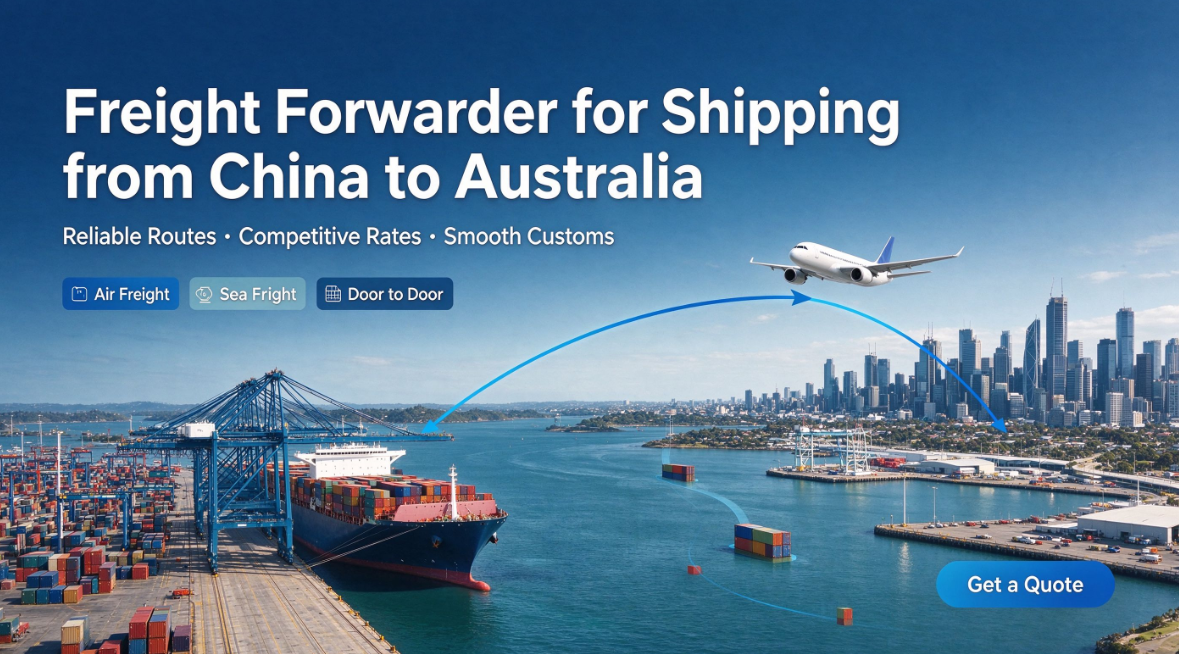
SHIBIDA Freight Forwarder provides international logistics solutions for businesses importing goods from China to Australia. Its services cover ocean freight, air freight, international express delivery, LCL consolidation, FCL container shipping, Amazon FBA replenishment, oversized cargo transportation and door-to-door delivery. Depending on the shipment, customers can choose FOB, CIF, EXW, DDP or DAP arrangements.
Shibida Logistics(Top China freight forwarders)Cross-Border Logistics Line
Services: Sea Freight, Air Freight, DDP, FCL, LCL, Amazon FBA First Mile
Shibida Logistics(Top China freight forwarders) specializes in door-to-door one-stop shipping to the US, Europe, the Middle East and Southeast Asia. We deliver reliably with high on-time rates, own container pickup & trailer fleet, 18 years of experience, and have served over 30,000 enterprises.
View Logistics Solutions Get Detailed Quotation
Contact Us
📞 Phone: +86 15813899064
📧 Email: 732175850@qq.com
💬 WeChat ID: 15813899064
Scan WeChat QR Code

Whether you are shipping a few cartons of samples, 50–3000 KG of commercial cargo, or a full 20GP or 40HQ container, the most suitable solution depends on the cargo's weight, volume, dimensions, value, delivery deadline and customs requirements. This guide explains how to select the right shipping method, estimate transit times, understand Australian import taxes and arrange a practical China-to-Australia shipping plan.
Quick Overview: Shipping from China to Australia
| Shipping Method | Estimated Transit Time | Recommended Cargo |
|---|---|---|
| Sea Freight FCL | 20–35 days | Full container shipments and large-volume cargo |
| Sea Freight LCL | 25–40 days | Small and medium commercial shipments |
| Standard Air Freight | 5–10 days | Time-sensitive and higher-value cargo |
| International Express | 3–7 business days | Samples, documents and small parcels |
| Sea DDP | 25–45 days | Businesses seeking coordinated door-to-door delivery |
| Air DDP | 6–12 days | Urgent commercial shipments |
Import tax reference: Australia's standard GST rate on taxable importations is 10%. Customs duty depends on the applicable tariff classification, origin rules and any available preferential treatment. Eligible Chinese-origin goods may qualify for ChAFTA preferential rates.
Main Australian destinations: Sydney, Melbourne, Brisbane, Perth, Adelaide and other regional destinations.
Transit times are indicative planning estimates, not guaranteed delivery commitments. Actual schedules depend on the origin and destination, carrier, consolidation, customs clearance, biosecurity inspection and local delivery arrangements.
1. Introduction to the China-to-Australia Shipping Route
China and Australia maintain extensive commercial trade connections. Australian importers purchase a wide range of manufactured products, retail goods, construction materials, machinery, electronics and household products from Chinese suppliers. For many Australian businesses, importing from China provides access to a broad manufacturing base, flexible production capacity and competitive sourcing options.
The China-to-Australia freight route connects major manufacturing and export centres in China with Australia's principal commercial ports and airports. The route is used by wholesalers, distributors, manufacturers, online retailers, construction companies, importers and Amazon marketplace sellers.
For an importer, the important question is not simply how quickly a ship or aircraft reaches Australia. The complete transportation process includes supplier coordination, cargo collection, export documentation, Chinese customs procedures, international transportation, Australian import clearance, possible biosecurity inspection and final delivery.
1.1 Major Chinese Export Cities
SHIBIDA can coordinate shipments from major Chinese manufacturing and logistics centres, depending on cargo location and available transportation services.
Shenzhen: A major manufacturing and export centre for electronics, consumer products, accessories, lighting equipment and general merchandise.
Guangzhou: Important for clothing, furniture, household products, machinery, cosmetics and wholesale goods.
Shanghai: A major international shipping gateway for industrial equipment, automotive components, machinery and manufactured products.
Ningbo: An important export port serving Zhejiang and surrounding manufacturing regions, including household goods and industrial products.
Qingdao: A significant northern China shipping gateway for machinery, chemicals, industrial materials and general cargo.
Xiamen: An export centre serving manufacturers of building materials, furniture, textiles and consumer products.
The appropriate departure port is determined by the supplier's factory location, cargo readiness, available sailing schedules and total inland transportation costs. Sending cargo to a distant port simply because its ocean freight quotation appears cheaper does not necessarily reduce the final logistics expense.
1.2 Major Australian Ports and Destinations
Australia has several major container ports that support imports from China. The destination port should be selected according to the consignee's location, delivery requirements and available shipping services.
| Australian Destination | Main Gateway | Common Cargo |
|---|---|---|
| Sydney, NSW | Port Botany / Sydney Airport | Retail goods, electronics, furniture and commercial inventory |
| Melbourne, VIC | Port of Melbourne / Melbourne Airport | Machinery, building products and general merchandise |
| Brisbane, QLD | Port of Brisbane / Brisbane Airport | Construction materials, household products and retail stock |
| Perth, WA | Fremantle Port / Perth Airport | Industrial supplies, furniture and commercial cargo |
| Adelaide, SA | Port Adelaide / Adelaide Airport | Manufactured goods and wholesale inventory |
For deliveries outside major metropolitan areas, additional domestic transportation may be required. A freight forwarder should confirm whether the quoted service includes port-to-door transportation, residential delivery, forklift unloading or tail-lift service.
2. What Types of Goods Can Be Shipped from China to Australia?
Australia imports a wide variety of products from China. However, not every product can be transported using the same shipping procedure. Cargo classification, material composition, value, dimensions and import regulations all affect the available shipping options.
2.1 General Commercial Products
Most ordinary, non-restricted manufactured goods can be considered for standard sea freight, air freight or express transportation, subject to Australian import requirements.
Clothing, shoes, bags and fashion accessories.
Household products, kitchen accessories and storage equipment.
Plastic products, packaging materials and promotional merchandise.
Furniture, office furniture and home decoration products.
Lighting fixtures and non-restricted electrical accessories.
Sports equipment, fitness accessories and outdoor products.
Hardware, tools and general industrial supplies.
Automotive accessories and non-regulated spare parts.
2.2 Electronics and Electrical Products
Electronics are commonly transported from China to Australia by air or sea. The most suitable method depends on product value, battery configuration, dimensions and delivery urgency.
Examples include computer accessories, monitors, networking equipment, electronic components, LED lighting, household appliances and other electrical products.
Importers should check Australian electrical safety, electromagnetic compatibility, product labelling and other applicable compliance requirements before shipment. Products containing lithium batteries require particular attention to dangerous goods classification, packaging, labelling and carrier acceptance rules.
2.3 Machinery and Industrial Equipment
Machinery, production equipment, commercial tools, pumps, industrial components and replacement parts are frequently shipped by sea freight. Large machines may require flat-rack containers, open-top containers or specialised project cargo arrangements.
Before booking, the importer should provide the total weight, external dimensions, centre of gravity where relevant, lifting points and loading requirements. This information allows the forwarder to assess container compatibility, handling equipment and delivery access.
2.4 Furniture and Oversized Goods
Furniture is often better suited to sea freight because it can occupy considerable space even when its actual weight is relatively low.
Examples include sofas, dining tables, cabinets, office desks, mattresses, shelving systems, commercial furniture and flat-packed furniture.
Oversized products need accurate measurements and suitable protective packaging. If a shipment exceeds standard container or road transport dimensions, specialised handling and permits may be necessary.
2.5 Products Requiring Additional Compliance Checks
Some products need additional approval, certification, permits or biosecurity assessment before they can be imported into Australia.
Food, beverages and agricultural products.
Wooden furniture and products containing untreated timber.
Plant products, seeds and products of animal origin.
Cosmetics, chemicals and products containing regulated substances.
Medical devices and certain healthcare products.
Products containing batteries, aerosols or other dangerous goods.
Products subject to electrical, radio communications or other mandatory standards.
Importers should not assume that a product is permitted merely because it can be purchased and exported from China. Australian import conditions should be checked before the supplier completes production or the cargo is collected.
3. Shipping Methods from China to Australia
There are three principal international transportation options: sea freight, air freight and international express courier. Each has different cost structures, transit times, handling procedures and shipment size requirements.
3.1 Sea Freight from China to Australia
Sea freight is commonly selected for medium and large commercial shipments. It is particularly suitable for cargo that is heavy, bulky or not urgently required.
SHIBIDA can assess two main sea freight options: Full Container Load (FCL) and Less than Container Load (LCL).
FCL – Full Container Load
FCL means that a shipper books an entire container for their shipment. The container is allocated to the customer's cargo rather than being shared with unrelated shippers.
Common container options include:
| Container Type | Approximate Internal Volume | Typical Application |
|---|---|---|
| 20GP | Approximately 33 CBM | Heavy machinery and dense cargo |
| 40GP | Approximately 67 CBM | Large-volume commercial goods |
| 40HQ | Approximately 76 CBM | Bulky products and lightweight cargo |
Actual usable volume depends on container specifications, cargo dimensions, loading configuration, door clearance and weight restrictions.
FCL is generally suitable for:
Shipments occupying a substantial portion of a container.
Heavy machinery and industrial equipment.
Large furniture orders and building materials.
Regular wholesale inventory replenishment.
Shipments that require exclusive container loading.
For large shipments, FCL can reduce handling and consolidation risks. However, the importer should compare the total container cost with the cost of LCL before deciding.
LCL – Less than Container Load
LCL allows several shippers to share the same container. Each customer pays according to the chargeable cargo volume or other applicable pricing rules rather than booking an entire container.
It is a practical option for small and medium-sized businesses that purchase goods from one or several Chinese suppliers but do not have enough cargo to fill a container.
LCL is particularly suitable for:
Furniture orders of limited volume.
Small batches of household products.
Commercial samples and product inventory.
50–3000 KG general cargo, depending on its volume and dimensions.
Multiple suppliers' goods consolidated at a Chinese warehouse.
LCL involves consolidation at origin and deconsolidation at destination. Consequently, cargo may require additional warehouse handling compared with FCL. It is important to check minimum charges, destination handling fees, customs clearance charges and delivery costs before booking.
3.2 Air Freight from China to Australia
Air freight provides a balance between transportation speed and shipment capacity. It is suitable for importers who need their products sooner than sea freight allows but whose cargo is too large or heavy for ordinary courier services.
Common air freight routes connect major Chinese airports with Sydney, Melbourne, Brisbane and Perth.
Air freight is often used for:
Electronic components and commercial equipment.
Urgent spare parts and replacement components.
High-value retail products.
Seasonal merchandise requiring timely replenishment.
Business samples and product launches.
Small batches of commercial inventory.
Air freight charges are generally calculated using chargeable weight. This is normally the greater of actual gross weight and volumetric weight, subject to the carrier's applicable calculation method.
A commonly used air cargo volumetric formula is:
Volumetric Weight (KG) = Length × Width × Height (CM) ÷ 6000
For example, a carton measuring 80 × 60 × 50 CM has a volume of 240,000 cubic centimetres. At a divisor of 6000, its volumetric weight is 40 KG. If the actual gross weight is 28 KG, the chargeable weight may therefore be 40 KG.
The divisor and chargeable-weight rules must be confirmed with the selected airline or service provider.
3.3 International Express Shipping
International express courier services are designed for smaller shipments that require fast delivery and individual parcel tracking.
Common courier operators include DHL, UPS, FedEx and other international parcel networks, subject to service availability and cargo eligibility.
Express delivery is appropriate for:
Documents and business samples.
Small parcels and lightweight products.
Urgent replacement parts.
Product testing samples.
Small online retail orders.
Express courier services usually offer convenient pickup, international transportation, customs processing and final delivery. However, dimensional weight, remote-area charges, fuel surcharges, customs fees and restrictions on batteries or other regulated goods may affect the total price.
3.4 Sea Freight vs Air Freight vs Express
| Comparison | Sea Freight | Air Freight | Express |
|---|---|---|---|
| Speed | Slowest | Medium | Fastest |
| Cost per KG | Generally lowest for bulky cargo | Higher | Often highest for small parcels |
| Shipment Size | Small to very large | Small to large, subject to limits | Usually small parcels |
| Best For | Furniture, machinery and wholesale stock | Urgent commercial cargo | Samples and urgent packages |
4. How Long Does Shipping from China to Australia Take?
Transit time is one of the most important factors when choosing a freight forwarder. However, the actual delivery period is not determined solely by the sailing or flight duration.
For a realistic shipping schedule, importers should consider supplier pickup, warehouse handling, export clearance, international transportation, Australian customs, biosecurity inspection and final delivery.
4.1 Estimated Shipping Time by Method
| Method | Estimated Time | Time Considerations |
|---|---|---|
| FCL Sea Freight | 20–35 days | Sailing schedule and destination port |
| LCL Sea Freight | 25–40 days | Consolidation and deconsolidation |
| Air Freight | 5–10 days | Flight availability and handling |
| Express Courier | 3–7 business days | Courier network and customs |
4.2 Why Can the Same Route Have Different Transit Times?
Several factors can change the expected delivery date:
Origin location: Cargo collected from inland factories may require additional transportation before export.
Destination location: Sydney and Melbourne may have different service options from regional Australian locations.
Shipping schedule: Vessel departure frequency, transshipment and space availability affect the departure date.
Peak season: Major shopping seasons, pre-holiday inventory replenishment and Chinese New Year can affect capacity.
Customs clearance: Incomplete documentation or incorrect cargo descriptions can delay release.
Biosecurity intervention: Australian authorities may inspect cargo, packaging or timber materials.
Final delivery: Residential delivery, remote destinations and warehouse appointment requirements may add time.
SHIBIDA recommends allowing additional time for customs processing and local delivery rather than planning stock replenishment around the fastest advertised transportation estimate.
5. SHIBIDA Freight Forwarder: Shipping Solutions for Different Cargo Weights
There is no single transportation method that works best for every shipment. A 100 KG shipment of electronic components has different requirements from 100 KG of furniture, while a 2,000 KG shipment of dense machinery may be more economical by sea.
SHIBIDA evaluates each shipment according to actual weight, volume, cargo type, destination, delivery deadline and service requirements.
5.1 Small Shipments: Below 50 KG
For small shipments, international express or consolidated air transportation may be appropriate.
Typical examples include:
Product samples for Australian customers.
Small electronic accessories.
Replacement parts for machinery.
Lightweight retail products.
Documents and commercial samples.
Recommended solution: Express courier for urgent shipments or air consolidation when the cargo is eligible and the overall quotation is more economical.
Before dispatch, customers should confirm carton dimensions, gross weight, product value and whether the goods contain batteries or other restricted materials.
5.2 Shipments from 50 KG to 300 KG
This weight range is common among small importers, online retailers and businesses purchasing products from several Chinese factories.
Depending on volume, cargo characteristics and urgency, customers can compare air freight and LCL sea freight.
Air freight is worth considering when:
Products are urgently required.
The cargo has a relatively high value-to-weight ratio.
Inventory shortages would interrupt business operations.
LCL is worth considering when:
The products are bulky and not urgently required.
The shipment contains furniture or general merchandise.
The customer wants to reduce international transportation costs.
For example, a 180 KG shipment of small electronic accessories may be considered for air freight, while 180 KG of bulky plastic storage products may be better evaluated for sea consolidation. The final choice should be based on chargeable weight, volume and total landed cost.
5.3 Shipments from 300 KG to 1000 KG
For shipments between 300 KG and 1000 KG, both air freight and sea freight may be practical depending on the cargo's density and delivery requirements.
SHIBIDA can compare:
Standard air cargo for urgent inventory.
LCL sea freight for cost-sensitive products.
Consolidated shipping for multiple suppliers.
Door-to-door delivery for importers without local logistics resources.
At this stage, customers should avoid comparing freight prices alone. Origin warehouse fees, export documentation, destination charges, customs brokerage, taxes and local transportation can significantly change the final cost.
5.4 Shipments from 1000 KG to 3000 KG
For shipments weighing 1000–3000 KG, sea freight often becomes an attractive option, especially when the goods occupy several cubic metres.
However, high-density cargo may reach a container's weight limitations before using its full volume. In this case, LCL may still be more practical than FCL.
SHIBIDA can assess:
LCL shipping for medium-volume cargo.
FCL shipping if the cargo volume and operational requirements justify a dedicated container.
Air freight for urgent, high-value or production-critical cargo.
Consolidation and repacking for goods collected from multiple suppliers.
5.5 Full Container Shipments
Businesses importing large quantities of furniture, machinery, construction materials or retail inventory may benefit from FCL shipping.
SHIBIDA can coordinate the shipment process, including supplier communication, container booking, cargo loading arrangements, export documentation, ocean transportation, destination coordination and final delivery according to the agreed service scope.
For heavy or oversized cargo, customers should provide loading photographs, dimensions, total weight, pallet details and unloading requirements before the booking is confirmed.
5.6 Shipment Recommendation Table
| Cargo Weight / Size | Potential Shipping Method | Main Consideration |
|---|---|---|
| Below 50 KG | Express / Air | Speed and dimensional weight |
| 50–300 KG | Air / LCL | Volume and urgency |
| 300–1000 KG | Air / LCL | Total landed cost |
| 1000–3000 KG | LCL / FCL / Air | Density and container utilisation |
| Several CBM or more | LCL / FCL | Compare consolidation and container costs |
Important: These are planning categories, not fixed weight-based service rules. Cargo dimensions, product restrictions, density and destination requirements can change the recommendation.
6. Shipping from China to Australia Under Different Trade Terms
International shipping arrangements are commonly based on Incoterms. These rules define the responsibilities of buyers and sellers for transportation, risk transfer and certain costs. Selecting the correct trade term helps avoid misunderstandings between the Chinese supplier, Australian importer and freight forwarder.
6.1 EXW – Ex Works
Under EXW, the seller makes the goods available at an agreed location, usually the factory or warehouse. The buyer generally arranges collection and the subsequent transportation process.
EXW may be suitable for Australian importers purchasing from multiple Chinese suppliers who want to consolidate their products at a single warehouse.
However, export clearance arrangements should be confirmed in advance because the seller's obligations under EXW are limited. The buyer and forwarder need to establish who will handle export formalities in practice.
6.2 FOB – Free on Board
Under FOB, the seller generally handles the export process and delivers the goods on board the nominated vessel at the named port of shipment. The buyer arranges the main ocean freight and subsequent transportation.
FOB is widely used by Australian importers who work with their own freight forwarder and want control over the international shipping arrangements.
FOB is intended for sea and inland waterway transport. For containerised cargo delivered to a terminal before loading, FCA may be more appropriate depending on the actual transaction.
6.3 CIF – Cost, Insurance and Freight
Under CIF, the seller arranges and pays for the cost of transportation and insurance to the named destination port. However, the risk transfers to the buyer when the goods are loaded on board the vessel at the port of shipment.
Australian buyers should carefully review the insurance coverage, destination charges and local customs responsibilities before accepting a CIF quotation.
6.4 DAP – Delivered at Place
DAP means that the seller arranges transportation to the agreed destination, making the goods available to the buyer ready for unloading. The buyer generally handles import clearance and applicable import duties and taxes.
DAP can be appropriate for businesses that have their own Australian customs broker or established import arrangements.
6.5 DDP – Delivered Duty Paid
DDP is a door-to-door delivery arrangement under which the seller assumes extensive transportation and import-clearance responsibilities, including applicable import duties and taxes, subject to the contract and local legal requirements.
For Australian customers who do not have a local logistics team, DDP may provide a more coordinated shipping experience.
SHIBIDA can assess DDP options for eligible shipments and clarify the scope of the quotation before booking. Customers should confirm who acts as importer of record, how customs declarations are made, how GST and duty are handled, and whether the service includes final delivery.
6.6 Comparison of Common Trade Terms
| Trade Term | Main Transportation Responsibility | Import Clearance |
|---|---|---|
| EXW | Primarily buyer | Buyer |
| FOB | Seller to onboard; buyer thereafter | Buyer |
| CIF | Seller pays freight and insurance to named port | Buyer |
| DAP | Seller arranges delivery to named place | Buyer |
| DDP | Seller arranges delivery and assumes agreed import obligations | Seller, subject to lawful arrangements |
Incoterms do not replace a complete sales contract. The named place, applicable Incoterms edition, insurance arrangements, customs responsibilities and delivery conditions should be clearly written into the agreement.
7. Australian Import Duties, GST and Taxes
Understanding Australian import taxes is essential when calculating the total cost of shipping from China. The amount payable depends on the tariff classification, customs value, country of origin, available trade preferences and the type of product.
7.1 Australian GST: 10%
Australia generally applies a 10% Goods and Services Tax (GST) to taxable importations.
For customs purposes, the Value of the Taxable Importation (VoTI) generally includes:
The customs value of the imported goods.
Applicable customs duty.
International transportation and insurance costs to the place of consignment, to the extent not already included.
Wine Equalisation Tax, where applicable.
The general calculation is:
GST = 10% × Value of Taxable Importation
For example, assume an imported shipment has the following illustrative values:
| Customs value | AUD 10,000 |
| International freight and insurance | AUD 1,000 |
| Assumed customs duty | AUD 500 |
| Illustrative taxable importation value | AUD 11,500 |
| GST at 10% | AUD 1,150 |
This is a simplified example. The actual calculation must follow the applicable customs valuation and tax rules. Other charges, including import processing charges, brokerage and inspection costs, may also apply.
7.2 How Much Customs Duty Does Australia Charge?
There is no single customs duty rate for all products imported from China. The applicable rate depends on the Australian tariff classification and any available preferential tariff treatment.
Some products may have a general duty rate of 5%, while others may have a different rate or a free rate. Eligible Chinese-origin goods may qualify for preferential treatment under the China–Australia Free Trade Agreement (ChAFTA).
ChAFTA entered into force on 20 December 2015. However, preferential treatment is not granted simply because goods are shipped from China. The goods must satisfy the relevant rules of origin and documentary requirements.
7.3 Reference Table for Different Product Categories
The following table is a preliminary planning reference, not a tariff quotation. The indicative duty column illustrates why HS classification and origin verification are necessary; it must not be used as the final payable rate for a product.
| Product Category | Duty Planning Reference | GST Reference | Additional Considerations |
|---|---|---|---|
| Clothing and textiles | May be free or subject to a tariff, depending on classification | Generally 10% | Material, construction and tariff classification |
| Furniture | May be free or subject to a tariff | Generally 10% | Material, composition and timber packaging |
| Electronics | Classification-specific; some products are duty-free | Generally 10% | Electrical and product compliance |
| Machinery and equipment | Classification-specific; ChAFTA may apply | Generally 10% | Technical specifications and possible permits |
| Plastic and household products | Classification-specific; some lines may be free | Generally 10% | Material and product description |
| Footwear and bags | Classification-specific | Generally 10% | Upper, sole and material composition |
| Food and agricultural products | Classification-specific | Depends on the product and tax treatment | Biosecurity, permits and food requirements |
7.4 ChAFTA: Preferential Tariffs for Eligible Chinese Goods
The China–Australia Free Trade Agreement provides preferential tariff arrangements for qualifying goods originating in China.
To assess eligibility, importers should:
Identify the correct Australian HS tariff classification.
Check the applicable general and preferential tariff rates.
Confirm whether the goods meet the relevant ChAFTA rules of origin.
Obtain the required Certificate of Origin or other acceptable origin documentation.
Ensure the customs declaration correctly claims the applicable preference.
Not every Chinese-made product automatically qualifies. Rules of origin can depend on whether goods are wholly obtained, produced from originating materials or meet product-specific processing requirements.
7.5 Import Processing Charges and Other Costs
Besides duty and GST, importers should budget for other possible charges, including:
Customs brokerage and declaration fees.
Australian import processing charges.
Port and terminal handling fees.
Container unpacking and warehouse handling.
Biosecurity inspection and treatment charges.
Storage, demurrage and detention, where applicable.
Domestic transportation and special delivery services.
A professional freight quotation should explain which charges are included, which are excluded and which may arise only if customs or biosecurity authorities require additional action.
8. Australian Customs Clearance and Biosecurity Requirements
Australian customs and biosecurity procedures are important parts of the China-to-Australia shipping process. Importers must provide accurate documentation and ensure that their products comply with relevant Australian laws.
8.1 Common Import Documents
Depending on the shipment and customs entry, the following documents may be required:
Commercial Invoice: Identifies the seller, buyer, product description, quantity, unit price and total value.
Packing List: Shows carton numbers, packaging types, dimensions, net weight and gross weight.
Bill of Lading: The main transport document for sea freight.
Air Waybill: The main transport document for air freight.
Certificate of Origin: Supports a preferential tariff claim where applicable.
Import permits or certificates: Required for certain regulated products.
Insurance documents: Relevant where insurance is arranged or required.
For consignments valued above AUD 1,000 that are entered for home consumption, an Australian Import Declaration (N10) is generally required. The importer or their authorised customs broker must ensure the declaration accurately identifies the goods, importer, customs value and tariff classification.
8.2 Australian Biosecurity Inspection
Australia has strict biosecurity controls designed to reduce the risk of introducing harmful pests, diseases and contaminants.
Cargo may be selected for inspection based on its product category, country of origin, packaging, documentation, risk profile and other regulatory factors.
Particular attention should be paid to:
Wooden pallets and solid timber packaging.
Soil, plant material and agricultural residues.
Food and animal-origin products.
Used machinery or equipment that may contain soil or organic material.
Packaging that is dirty, damaged or contaminated.
Solid wood packaging and dunnage entering Australia must meet applicable biosecurity conditions. ISPM 15 treatment and marking requirements are particularly important. Non-compliant packaging may require treatment, export or disposal at the importer's expense.
8.3 How to Reduce the Risk of Customs Delays
SHIBIDA recommends completing the following checks before cargo departure:
Provide a precise product description rather than vague terms such as general goods or accessories.
Confirm the declared commercial value and transaction details.
Check that invoice and packing list quantities match the actual shipment.
Identify products containing batteries, chemicals or regulated components.
Verify that any required permits and certificates are available.
Use compliant timber pallets and packaging.
Confirm the HS classification and origin documentation before the import declaration is lodged.
9. What Happens If Australian Customs Selects a Shipment for Inspection?
Customs or biosecurity inspection is a normal possibility in international freight transportation. Being selected for inspection does not automatically mean that the shipment has violated any regulation.
However, inspections may result in additional handling, storage, treatment or transportation costs, as well as a longer delivery period.
9.1 Common Reasons for Inspection
Random or risk-based customs selection.
Unclear product descriptions or inconsistent declarations.
Unusual customs values or discrepancies between documents.
Products subject to special import controls.
Wooden packaging or potential biosecurity contamination.
Requests for additional certificates or supporting documents.
9.2 How SHIBIDA Handles an Inspection
When a shipment arranged through SHIBIDA is selected for inspection, the logistics team can coordinate the relevant communication and operational follow-up according to the agreed service scope.
The process generally involves:
Confirming the inspection status: Establish whether the shipment is undergoing customs examination, document review or biosecurity inspection.
Identifying the outstanding requirements: Determine whether authorities require additional documents, clarification, treatment or physical examination.
Communicating with the relevant parties: Coordinate with the customs broker, destination agent, warehouse and consignee.
Providing document assistance: Help obtain available invoices, packing lists, product specifications and origin documents from the supplier.
Coordinating the next step: Arrange release, treatment, re-inspection or another action according to the official instructions.
Updating the customer: Explain the status, expected next steps and any additional charges that have been identified.
SHIBIDA's service commitment
SHIBIDA aims to provide timely shipment updates, coordinate documentation and communicate clearly when customs or biosecurity issues arise. The team can assist with logistics coordination and follow-up, but cannot override an Australian government inspection decision, guarantee customs release or promise that inspection-related charges will never occur.
For importers, transparent communication and accurate documentation are more valuable than unrealistic promises that customs inspection will never happen.
10. SHIBIDA Freight Forwarder: Door-to-Door Shipping Solutions
For many Australian importers, coordinating several independent logistics providers can be time-consuming. They may need to contact the factory, arrange collection, manage export documents, book international freight, appoint a customs broker and organise domestic delivery.
SHIBIDA aims to simplify this process by providing coordinated logistics services from China to the final destination in Australia.
10.1 Supplier Pickup and Cargo Consolidation
Customers purchasing from multiple suppliers may arrange to send their products to a designated Chinese warehouse. After receiving the cargo, the logistics team can assist with checking shipment details, recording package information and arranging consolidation where suitable.
This can help reduce the need for each supplier to arrange an independent international shipment.
10.2 Cargo Inspection and Packaging Coordination
Before shipment, customers may request package checks, carton measurements, weight confirmation and photographs, subject to the agreed warehouse service.
For fragile, valuable or oversized cargo, additional protective packaging can be considered. However, packaging checks are not equivalent to a full product quality inspection unless that service is specifically arranged.
10.3 Customs and Transportation Coordination
SHIBIDA can help customers select an appropriate transportation arrangement and coordinate the relevant shipping documents and customs brokerage services through the agreed service providers.
Depending on the selected service, transportation may include origin pickup, export handling, international freight, Australian customs coordination and domestic delivery.
10.4 Delivery to Business and Residential Addresses
Different customers have different delivery requirements. SHIBIDA can assess transportation options for:
Commercial warehouses and distribution centres.
Retail stores and wholesale premises.
Residential addresses, where the carrier accepts the shipment.
Third-party logistics warehouses.
Amazon fulfilment centres, subject to booking and receiving requirements.
Construction sites and other commercial locations, subject to access arrangements.
Customers should confirm whether their destination has a loading dock, forklift, unloading staff, suitable truck access or other special delivery requirements.
11. Shipping to Amazon Australia and E-commerce Warehouses
Australian e-commerce sellers often import goods from Chinese manufacturers and arrange delivery to Amazon fulfilment centres or independent third-party warehouses.
These shipments require more planning than ordinary warehouse deliveries because the receiving facility may have specific labelling, packaging, carton, pallet and appointment requirements.
11.1 Amazon FBA Shipping Considerations
Before shipping to an Amazon fulfilment centre, sellers should:
Confirm the correct destination warehouse address and shipment plan.
Prepare carton labels and product labels according to current Amazon requirements.
Check pallet specifications and wrapping requirements.
Confirm whether the delivery needs an appointment.
Ensure that the cargo has been correctly customs-cleared.
Check the receiving centre's current shipment and delivery rules.
Amazon's warehouse address and receiving instructions may change. Importers should not rely on an old warehouse address or previous delivery labels.
11.2 FBA Delivery by Sea or Air
Sea freight is generally worth considering for planned stock replenishment and larger volumes. Air freight may be appropriate for urgent inventory shortages or products with short sales windows.
The right choice should take into account warehouse receiving dates, inventory turnover, product margins and the cost of running out of stock.
12. Packaging Recommendations for Shipping from China to Australia
Packaging affects cargo safety, freight charges and the likelihood of handling problems. Poorly packed goods can be damaged during loading, consolidation, ocean transportation or final delivery.
12.1 Carton Packaging
Standard export cartons should be selected according to product weight, shape and fragility.
Use strong corrugated cartons for commercial shipments.
Do not leave excessive empty space inside cartons.
Use suitable cushioning for fragile products.
Seal cartons securely with appropriate packing tape.
Keep carton labels clear and consistent with the packing list.
Avoid oversized cartons when the cargo can be packed more efficiently.
12.2 Pallet Packaging
For palletised cargo, ensure that the pallets are stable, properly secured and suitable for the handling equipment used at both ends.
Australian standard pallet dimensions commonly include 1165 × 1165 MM, but the appropriate pallet size depends on the receiving warehouse and transportation method.
Solid wood packaging must meet applicable Australian biosecurity requirements, including ISPM 15 where required. Manufactured wood products such as plywood may be subject to different treatment conditions, so the exact material should be identified correctly.
12.3 Packaging for Fragile Products
Glass products, ceramics, monitors, lighting equipment and other fragile goods require additional protection.
Recommended measures include:
Individual product protection.
Foam inserts or suitable cushioning materials.
Double-wall cartons where appropriate.
Internal separation between individual products.
Reinforced corners and external protection for vulnerable edges.
Suitable palletisation for heavy or large packages.
12.4 Oversized Cargo Packaging
Large machinery, furniture and irregularly shaped products should be measured at their maximum external dimensions, including any protruding parts or packaging.
Customers should provide photographs and lifting information when requesting a quotation. If the cargo cannot fit into a standard container or requires specialised unloading, the transportation plan should be confirmed before the goods are collected.
12.5 How Packaging Affects Freight Costs
Air freight and express charges are influenced by dimensional weight. A lightweight product packed in a very large carton can cost significantly more to transport than the product's actual weight suggests.
For example:
| Measurement | Example A | Example B |
|---|---|---|
| Carton Size | 60 × 50 × 40 CM | 80 × 60 × 50 CM |
| Actual Weight | 25 KG | 25 KG |
| Volumetric Weight at ÷6000 | 20 KG | 40 KG |
| Potential Chargeable Weight | 25 KG | 40 KG |
In this example, the second carton may be charged at a higher weight despite having the same actual weight. Efficient packaging can therefore reduce transportation expenses.
13. Why Choose SHIBIDA Freight Forwarder for Shipping from China to Australia?
Selecting a freight forwarder is an important decision for importers. A low freight quotation alone does not necessarily indicate a good logistics solution. Customers should consider service scope, communication, shipment visibility, customs coordination and the provider's ability to handle different cargo requirements.
13.1 Multiple Shipping Options
SHIBIDA offers access to sea freight, air freight and courier shipping arrangements. This allows customers to compare different transportation options instead of relying on one method for every shipment.
13.2 Solutions for Different Shipment Sizes
From small commercial parcels to 3000 KG shipments and full containers, SHIBIDA can assess transportation options according to the actual cargo specifications.
13.3 Consolidation for Multiple Suppliers
For customers purchasing from several Chinese factories, warehouse consolidation can simplify shipment management and help reduce the number of separate international shipments.
13.4 DDP and DAP Options
Customers who prefer a more coordinated delivery arrangement can discuss DDP or DAP solutions. The precise scope, customs arrangements, taxes and importer responsibilities should be confirmed before booking.
13.5 Oversized Cargo and Commercial Deliveries
SHIBIDA can assess shipments involving bulky products, commercial machinery, furniture and other cargo that may require special handling or delivery arrangements.
13.6 Communication and Shipment Updates
International transportation involves multiple parties. Timely communication can help importers understand cargo status, document requirements and potential delays.
SHIBIDA aims to maintain communication throughout the agreed shipping process and provide operational updates when important milestones or issues arise.
14. Feedback from Australian Customers
For Australian importers, practical service experience is often more useful than promotional statements. Important factors include whether the shipment arrives within the communicated schedule, whether the charges are explained clearly and whether the logistics provider responds when problems occur.
When evaluating SHIBIDA, customers can consider the following service dimensions:
Communication: Are shipment milestones and changes explained clearly?
Cost transparency: Are origin, freight, customs and destination charges identified before booking?
Shipment handling: Are cargo measurements, packaging and loading requirements checked?
Customs coordination: Is the customer informed when additional documentation or inspection is required?
Delivery coordination: Are address restrictions, appointments and unloading requirements confirmed?
14.1 Suggested Customer Review Display Format
For a business website, genuine customer testimonials can be displayed using a format such as the following. The examples below are editorial templates, not verified customer quotations, and should only be replaced with actual feedback after obtaining customer permission.
★★★★★
Commercial Importer – Sydney
Suggested review topic: Clear communication and coordinated delivery of commercial inventory from China.
★★★★★
Online Retailer – Melbourne
Suggested review topic: Comparing air and sea options for different inventory replenishment requirements.
★★★★★
Wholesale Buyer – Brisbane
Suggested review topic: Consolidating goods purchased from multiple Chinese suppliers.
To strengthen credibility, publish reviews with genuine customer consent and, where possible, include the actual service type, shipment period and destination. Do not present illustrative examples as real customer experiences or independently verified ratings.
15. Practical Shipping Advice from SHIBIDA Freight Forwarder
Good shipping decisions begin before cargo leaves the factory. Customers who prepare accurate shipment information can receive more useful quotations and avoid many common transportation problems.
15.1 Choose the Shipping Method According to Cargo Characteristics
For small and urgent shipments, express courier may be the most convenient option. For commercial shipments weighing several hundred kilograms, compare air freight and LCL. For bulky goods and large orders, sea freight is usually worth evaluating first.
Do not select a shipping method solely because its advertised price per kilogram is lower. Compare the complete door-to-door cost and expected delivery time.
15.2 Provide Accurate Cargo Information
When requesting a quotation, provide:
Product name and detailed description.
Number of cartons or pallets.
Total gross weight and net weight, if available.
Length, width and height of every package or package type.
Product value and country of origin information.
Supplier pickup address in China.
Final delivery address in Australia.
Preferred delivery date and shipping method.
Whether the cargo contains batteries, liquids, chemicals or regulated materials.
15.3 Consider the Full Landed Cost
The total cost of importing goods is not just the international freight charge. Importers should calculate:
Total Landed Cost = Product Cost + Origin Charges + International Freight + Insurance + Customs Duty + GST + Destination Charges + Domestic Delivery
This formula is a planning framework rather than a formal customs valuation formula. Some cost components may be included in other charges or treated differently for tax purposes.
15.4 Check Australian Import Requirements Before Production
If a product needs a permit, certification or special biosecurity treatment, discovering the requirement after the cargo reaches Australia can be expensive.
Importers should check product compliance before confirming the purchase order, especially for food, agricultural goods, chemicals, timber products, electrical equipment and battery-powered products.
15.5 Plan for Seasonal Delays
Importers should allow sufficient lead time during major retail periods and Chinese public holidays. Booking cargo at the last minute may result in limited shipping space, higher transportation charges or missed inventory deadlines.
15.6 Confirm Final Delivery Conditions
Before booking door-to-door transportation, check whether the receiving location can accept the proposed vehicle and cargo size.
For example, a residential address may not have a loading dock or forklift. A large commercial shipment may require a tail-lift truck, pallet jack or scheduled delivery appointment.
16. How to Arrange Shipping from China to Australia with SHIBIDA
Customers can follow a straightforward process to arrange an international shipment.
Step 1 – Submit shipment details: Provide product information, cargo weight, dimensions, collection address and Australian delivery address.
Step 2 – Compare transportation options: SHIBIDA assesses suitable sea, air or express options based on the shipment requirements.
Step 3 – Confirm the quotation: Review the service scope, estimated transit time, included charges, exclusions and customs arrangements.
Step 4 – Arrange cargo collection: Coordinate supplier delivery or warehouse pickup in China.
Step 5 – Complete export preparation: Check shipping documents, cargo measurements, packaging and applicable export procedures.
Step 6 – International transportation: Arrange the selected shipping service and provide available shipment updates.
Step 7 – Australian customs clearance: Coordinate the required import declaration, customs processing and any additional regulatory procedures.
Step 8 – Final delivery: Arrange delivery to the agreed commercial, residential or warehouse address according to the selected service.
Customers should retain their commercial invoices, packing lists, transport documents and customs records for business and compliance purposes.
17. Frequently Asked Questions About Shipping from China to Australia
Q1. What is the cheapest way to ship from China to Australia?
For large-volume shipments, sea freight is generally the most economical option on a per-unit basis. FCL is suitable when the shipment justifies booking an entire container, while LCL is useful for smaller volumes. The cheapest option depends on cargo dimensions, weight, origin, destination and total local charges. For very small shipments, express or consolidated air services may sometimes be more practical.
Q2. How long does shipping from China to Australia take?
As a general planning estimate, FCL sea freight takes approximately 20–35 days, LCL takes 25–40 days, air freight takes 5–10 days and express courier takes 3–7 business days. These estimates depend on the route and whether they include customs clearance and final delivery. Inspection, peak season and remote-area delivery can extend the schedule.
Q3. How much is the import tax when shipping from China to Australia?
Australia generally applies 10% GST to taxable importations. Customs duty depends on the HS code and applicable tariff treatment. Eligible Chinese-origin goods may qualify for preferential duty rates under ChAFTA if the rules of origin and documentation requirements are met. A precise tax estimate requires the product description, HS code, customs value and shipment details.
Q4. Can SHIBIDA arrange door-to-door shipping from China to Australia?
SHIBIDA can assess door-to-door shipping options using sea freight, air freight or express transportation. Depending on the agreed service, the arrangement may include supplier pickup, export handling, international freight, customs coordination and final delivery. Customers should confirm whether duties, GST, brokerage, inspection costs and special delivery charges are included.
Q5. Can I ship 50 KG to 3000 KG of goods from China to Australia?
Yes, this cargo range can be considered for air freight or LCL sea freight, depending on its dimensions, density and urgency. For shipments approaching or exceeding several tonnes, FCL may also be worth evaluating. SHIBIDA can compare the available options after receiving the actual cargo measurements and destination details.
Q6. What happens if Australian customs inspects my shipment?
Customs or biosecurity authorities may select shipments for document review, physical examination or additional treatment. SHIBIDA can help coordinate communication, provide available shipping documents and arrange operational follow-up according to the agreed service. Any official inspection decision, release approval, treatment requirement or associated government charge remains subject to the relevant Australian authorities.
18. Get a Shipping Quote from SHIBIDA Freight Forwarder
Whether you are importing a small parcel, several pallets of commercial goods, 3000 KG of cargo or a full container, selecting the right transportation plan can make a significant difference to your overall logistics costs and delivery schedule.
SHIBIDA Freight Forwarder provides China-based logistics solutions for shipments to Australia, including sea freight, air freight, express delivery, LCL consolidation, FCL transportation, DDP and DAP arrangements, Amazon FBA replenishment and commercial or residential deliveries.
To receive a more accurate quotation, prepare the following information:
Product name and description.
Total gross weight and number of packages.
Dimensions of each carton or total cargo volume.
Pickup city or supplier address in China.
Destination city and postcode in Australia.
Preferred shipping method or delivery deadline.
Whether you require customs clearance and DDP service.
Ship from China to Australia with SHIBIDA
Looking for a suitable freight solution for your next Australian import shipment?
Share your cargo details with SHIBIDA and compare transportation options based on your budget, shipment size and delivery requirements.
Sea Freight | Air Freight | Express | FCL | LCL | DDP | Amazon FBA
Contact SHIBIDA Freight Forwarder for a shipment assessment and quotation.
Conclusion
Shipping from China to Australia involves several interconnected processes, including supplier coordination, transportation selection, export documentation, customs clearance, import taxes, biosecurity compliance and final delivery. Choosing a freight forwarder who can assess these requirements before shipment helps importers make better decisions and manage unexpected costs.
Sea freight is generally suitable for large and bulky cargo, air freight is useful for time-sensitive commercial shipments, and express courier is convenient for small parcels and urgent samples. For shipments between 50 KG and 3000 KG, the most appropriate option should be determined by comparing actual weight, volumetric weight, cargo type, delivery deadline and total landed cost.
With its China-based logistics services and transportation options, SHIBIDA Freight Forwarder aims to help Australian importers coordinate shipments from Chinese suppliers to their final destinations. By preparing accurate cargo information, checking import requirements and selecting the right delivery arrangement, businesses can build a more predictable and efficient China-to-Australia supply chain.
How to Book
To take advantage of these new routes and services, simply:
- Contact our dedicated 【Freight forwarder for shipping from China to Australia】 desk at Contact
- Provide details of your shipment (cargo type, volume, pickup location)
- Receive a customized quote within 24 hours
- Confirm your booking and prepare your goods for shipment
Our team specialists is ready to assist with all aspects of your shipment, from documentation to delivery.
About Shibida Logistics
Shibida Freight Forwarding is a leading private logistics service provider based in China, offering comprehensive export logistics and warehousing services, international freight forwarding, FBA dedicated logistics, US overseas warehouses, and international logistics services from China to the world by land, air, and sea.
With our headquarters in Shenzhen and branch offices/agents covering almost all major cities and seaports in China, we strive to deliver your cargo to any destination worldwide safely, timely, and at reasonable prices.
For more information about our new Australia routes or to request a quote, please contact us today.