
Shibida Logistics Team
Logistics Expert
Executive Summary: In today's hyper-complex global supply chain, real-time visibility is no longer a luxury for shippers—it is a core operational requirement. Modern Real-Time Transportation Visibility Platforms (RTTVPs) go far beyond static GPS plot points. They combine IoT sensor telemetry, direct ELD/API integrations, predictive ETA modeling, and automated exception management to mitigate delays, prevent detention fees, and lower total logistics costs. This comprehensive guide analyzes the top 10 real-time cargo tracking technical platforms for shippers, comparing their core operational strengths, tracking hardware/software mechanisms, best-fit industries, and key technical capabilities. Written from the perspective of an experienced supply chain logistics director, this article delivers real-world implementation insights, critical deployment pitfalls, and practical integration advice for optimizing end-to-end freight execution.
1. Introduction: The Evolution of Freight Visibility in Modern Logistics
For decades, shipper "tracking" meant a manual, fragmented loop: phone calls to dispatchers, delayed check-calls with truck drivers, and static carrier portals that updated hours after an event occurred. When a trailer was delayed at a port or stuck in highway congestion, shippers often discovered the issue only after a critical delivery window was missed.
Today, advanced real-time transportation visibility platforms (RTTVPs) have re-engineered freight visibility. By pulling data directly from Telematics / Electronic Logging Devices (ELD), GPS cellular sensors, AIS maritime satellite feeds, and Carrier APIs, these technical solutions provide continuous, granular oversight of freight across road, ocean, air, and rail.
Beyond geographical coordinates, modern platforms track environmental parameters (such as cargo temperature, humidity, light exposure, and physical shock) while utilizing machine learning algorithms to calculate high-accuracy dynamic ETAs. For shipping managers, enterprise logistics planners, and supply chain executives, deploying the right tracking ecosystem means moving from reactive firefighting to proactive, automated logistics orchestration.
Shibida Logistics(Top China freight forwarders)Cross-Border Logistics Line
Services: Sea Freight, Air Freight, DDP, FCL, LCL, Amazon FBA First Mile
Shibida Logistics(Top China freight forwarders) specializes in door-to-door one-stop shipping to the US, Europe, the Middle East and Southeast Asia. We deliver reliably with high on-time rates, own container pickup & trailer fleet, 18 years of experience, and have served over 30,000 enterprises.
View Logistics Solutions Get Detailed Quotation
Contact Us
📞 Phone: +86 15813899064
📧 Email: 732175850@qq.com
💬 WeChat ID: 15813899064
Scan WeChat QR Code

2. Top 10 Technical Cargo Tracking Platforms: Comprehensive Analysis
1. Project44
Core Overview & Technical Architecture: Project44 is widely recognized as an enterprise-grade RTTVP powerhouse. Operating via a vast network of direct carrier integrations, Project44 connects directly with global TMS, ERP (such as SAP and Oracle), and WMS systems. It relies primarily on a software-first architecture, ingesting telematics, carrier APIs, and ELD data stream feeds without forcing carriers to install proprietary hardware.
Key Operational Features:
High-Precision Dynamic ETAs: Machine-learning models evaluate historical transit times, traffic patterns, weather events, and border crossing bottlenecks.
Multi-Modal Native Support: Seamless coverage spanning Truckload (TL), Less-than-Truckload (LTL), Ocean, Air, Rail, and Parcel.
Workflow Automation & Notification: Triggers dynamic Webhooks and alerts when a shipment strays from its target geofence or transit corridor.
Best Used For: Global enterprise shippers, Fortune 500 manufacturers, and high-volume retail supply chains requiring unified visibility across complex multi-carrier networks.
Practical Deployment Insight: "The key with Project44 is carrier onboarding compliance. While its API architecture is top-tier, ensure your logistics team allocates dedicated carrier-enablement resources during week 1–4 to hit high tracking-compliance thresholds across long-tail LTL carriers."
2. FourKites
Core Overview & Technical Architecture: FourKites is another primary leader in enterprise real-time visibility, known for its deep predictive analytics, yard management capabilities, and automated workflow triggers. It aggregates data from over 500+ telematics providers, ELDs, and ocean carrier systems.
Key Operational Features:
Financially Guarded Dynamic ETAs: Accurately predicts arrival times down to a 15-minute window, significantly reducing loading dock dwell time.
Facility Manager & Yard Visibility: Extends tracking from in-transit roads directly into facility gates and staging yards.
Sustainability & Carbon Tracking: Provides granular scope 3 emissions reporting per shipment lane and modal type.
Best Used For: Consumer packaged goods (CPG), food and beverage, manufacturing, and pharmaceuticals where tight appointment windows at distribution centers are paramount.
Practical Deployment Insight: "FourKites shines when integrated with dock scheduling systems. Connecting FourKites’ dynamic ETA directly to your WMS dock door allocation can immediately trim warehouse dwell time by 20% to 35%."
3. Tive
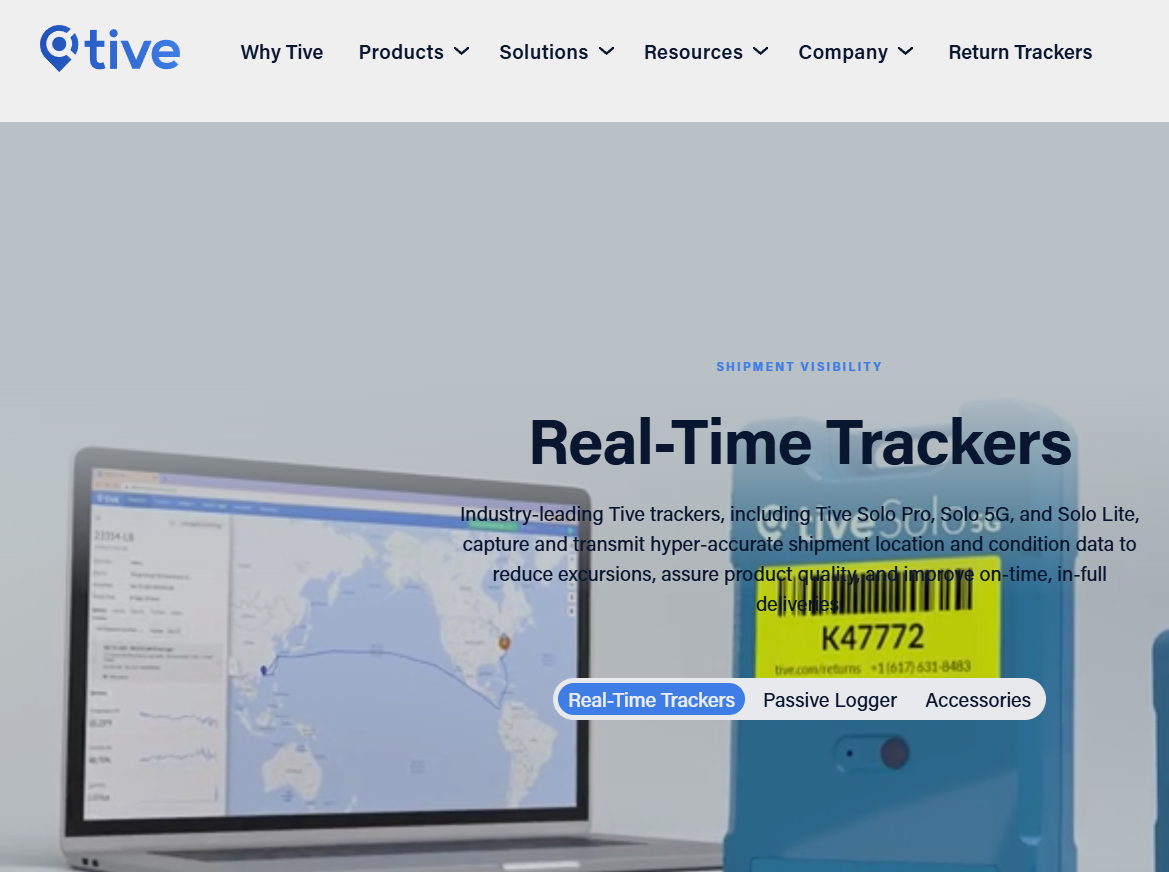
Core Overview & Technical Architecture: Unlike software-only aggregator platforms, Tive differentiates itself through an integrated hardware-plus-software sensing architecture. Tive utilizes hyper-thin, multi-sensor cellular trackers (including Solo 5G and single-use eco-friendly labels) that transmit continuous in-transit data directly to the Tive Cloud platform.
Key Operational Features:
Full Condition Monitoring: Real-time tracking of Temperature, Humidity, Shock/Impact, Tilt, and Light Exposure (detecting unauthorized package opening).
Global 5G/Cellular & Wi-Fi Location Triangulation: Ensures location transmission even inside cargo holds or urban canyons where direct GPS signals drop.
24/7 Live Monitoring Support: Optional Live Monitoring Team that intervenes directly with carriers when excursions occur.
Best Used For: High-value electronics, cold-chain pharma, perishable food items, and sensitive industrial equipment requiring active environmental safeguarding.
Practical Deployment Insight: "For temperature-sensitive shipments, stick a tracker inside the core pallet rather than on the trailer wall. Tive’s real-time light sensor will immediately alert you if a box is opened during unauthorized cross-docking."
4. Descartes MacroPoint
Core Overview & Technical Architecture: Descartes MacroPoint is a foundational visibility platform with deep penetration across North American freight brokers, 3PLs, and direct shippers. It leverages driver mobile application location tracking, cellular tower triangulation, and direct ELD telematics integrations.
Key Operational Features:
Extensive Broker & Carrier Coverage: Direct connectivity to hundreds of thousands of drivers and carrier fleets across North America.
Automated Exception Alerting: Flags late departures, extended delays, and potential appointment misses automatically.
Driver App & Cell Tower Fallback: Enables tracking even for small, spot-market carriers without formal ELD API connections.
Best Used For: Middle-market shippers and freight brokerages heavily utilizing spot-market drivers or mixed-fleet regional carriers.
Practical Deployment Insight: "When dealing with owner-operators on spot loads, automated SMS-based tracking consent links via MacroPoint achieve far higher compliance than requiring manual app store downloads."
5. Samsara
Core Overview & Technical Architecture: Samsara is an industry giant in connected operations and asset tracking. While widely known as a fleet management telematics solution, Samsara’s Connected Operations Cloud provides enterprise shippers operating private or dedicated fleets with real-time visibility, smart dashcams, and trailer asset tracking.
Key Operational Features:
Unified Hardware Ecosystem: GPS dashcams, wireless door sensors, engine diagnostics gateways, and reefer temperature probes.
AI Driver Safety & Diagnostics: Real-time monitoring of driving behaviors, harsh braking, fuel consumption, and vehicle health.
Reefer Integration: Direct controls to adjust reefer set-points remotely from the centralized dispatch console.
Best Used For: Shippers that manage their own private delivery fleets, dedicated private contract carriers, or distributor networks.
Practical Deployment Insight: "Samsara’s open API allows you to pull trailer battery health and tire pressure data directly into your dispatch routine, preventing breakdowns before a truck hits the highway."
6. FarEye
Core Overview & Technical Architecture: FarEye is a modular, cloud-based last-mile delivery and shipment visibility software tailored to orchestrate complex distribution networks. It specializes in connecting first-mile, middle-mile, and critical last-mile operations into a single operational view.
Key Operational Features:
Last-Mile Precision Tracking: Dynamic route optimization, real-time driver dispatching, and branded live customer tracking portals.
Digital Proof of Delivery (ePOD): Captures customer electronic signatures, barcode scans, photo verification, and geo-stamps upon package drop-off.
Carrier Allocation Engine: Automatically routes shipments to optimal last-mile parcel or courier providers based on cost and SLA targets.
Best Used For: E-commerce brands, retail distribution, furniture/appliance white-glove deliveries, and direct-to-consumer shippers.
Practical Deployment Insight: "Leverage FarEye’s self-service delivery rescheduling portal for end customers—it dramatically lowers inbound call center volume regarding 'Where is my order?' (WISMO) queries."
7. Shippeo
Core Overview & Technical Architecture: Shippeo is Europe’s premier real-time transportation visibility provider, now rapidly expanding globally. It features an advanced proprietary ETA algorithm that processes over 200 data parameters, achieving unmatched ETA precision across road, rail, and maritime transport.
Key Operational Features:
Unrivaled European Carrier Network: Direct integrations with regional carrier systems, telematics, and European road transport networks.
Multi-Modal Ocean & Rail Tracking: Real-time container status via direct port terminal integrations, AIS vessel tracking, and railway operator data.
GDPR-Compliant Driver Privacy Controls: Built-in privacy features that safeguard driver personal data, simplifying European transport union compliance.
Best Used For: Multinational shippers with major manufacturing or distribution footprints in Europe, cross-border EMEA freight, and global intermodal supply chains.
Practical Deployment Insight: "If your supply chain crosses European borders, driver data privacy laws (GDPR) can halt software adoption. Shippeo’s automated privacy toggles resolve driver union objections out-of-the-box."
8. Overhaul
Core Overview & Technical Architecture: Overhaul takes a risk-management-first approach to real-time cargo tracking. Combining software-driven data aggregation with real-time IoT tracking hardware, Overhaul focuses on active risk mitigation, freight integrity, and theft prevention.
Key Operational Features:
Proactive Security Rules Engine: Automatically detects unauthorized stops, route deviations, geofence breaches, or door openings in high-risk zones.
Law Enforcement Escapes & Emergency Response: Direct integration with global law enforcement agencies for immediate recovery of stolen cargo.
Temperature & Quality Compliance: Maintains strict audit logs for regulatory standards like FDA FSMA and GDP pharmaceutical guidelines.
Best Used For: High-risk, high-value, and regulated shippers (pharmaceuticals, consumer electronics, luxury retail, alcohol, and tobacco).
Practical Deployment Insight: "Set Overhaul's rules engine to auto-trigger an emergency audio alarm on driver devices if a vehicle stops in a known cargo theft hotspot for more than 10 minutes."
9. GoComet
Core Overview & Technical Architecture: GoComet is an AI-powered logistics platform designed to combine end-to-end freight visibility with automated freight procurement and invoice auditing. It relies on automated data extraction from ocean lines, airlines, and land carriers.
Key Operational Features:
Automated Container Tracking: Tracking across major ocean shipping lines using shipping line APIs, AIS satellite data, and container port EDI feeds.
Freight Audit & Reconciliation: Matches live tracking milestones against invoice line items to automatically flag fraudulent demurrage or detention charges.
Predictive Port Congestion Analytics: Alerts shippers to dwell-time surges at major global port hubs.
Best Used For: Mid-market to large importers, exporters, and international traders looking for ocean/air shipment visibility integrated with cost-control workflows.
Practical Deployment Insight: "GoComet’s automated demurrage calculator allows logistics teams to prioritize container offloading at destination ports based on remaining free-days, saving thousands in daily fees."
10. Ocean Insights (by project44)
Core Overview & Technical Architecture: Originally an independent leader in maritime intelligence, Ocean Insights was acquired by Project44 to serve as its specialized ocean freight visibility arm. It aggregates AIS vessel tracking data, carrier EDI, port terminal data, and customs feeds into an ocean-tracking interface.
Key Operational Features:
Granular Container Event Tracking: Real-time updates for Gate-In, Vessel Load, Transshipment, Vessel Discharge, Gate-Out, and Empty Return.
Vessel AIS & Satellite Mapping: Live ocean vessel location tracking combined with historical carrier schedule reliability scores.
Port Dwell & Congestion Heatmaps: Real-time tracking of vessel queuing times outside major marine terminals worldwide.
Best Used For: Enterprise shippers heavily reliant on global ocean freight, overseas manufacturing sourcing, and high-volume containerized imports.
Practical Deployment Insight: "Use Ocean Insights' schedule reliability rating during quarterly carrier reviews to shift container volumes away from chronically delayed shipping lines."
3. Comprehensive Comparison Table of Real-Time Tracking Platforms
The following structured comparison evaluates all 10 technical platforms across key operational parameters:
| Platform Name | Primary Modal Focus | Tracking Mechanism | Condition Sensing Capabilities | Target Shipper Segment |
|---|---|---|---|---|
| Project44 | Full Multi-Modal (Road, Sea, Air, Rail) | Software Aggregator (ELD / API / Telematics) | Basic (via third-party integrations) | Enterprise Global Shippers |
| FourKites | Multi-Modal (Road, Ocean, Yard) | Software Aggregator (ELD / API / Yard Systems) | Moderate (Temperature / Reefer ELD) | Enterprise Manufacturing & CPG |
| Tive | Multi-Modal / Parcel / Cargo | IoT Cellular Hardware Tracker + Sensor Cloud | Full (Temp, Humidity, Shock, Light, Tilt) | Pharma, Cold Chain, High-Value Goods |
| Descartes MacroPoint | Road Freight (TL / LTL) | ELD, Driver App, Cell Tower Triangulation | Limited (Driver Reported / ELD) | Mid-Market Shippers & 3PL Brokers |
| Samsara | Road Fleet / Assets | Proprietary Telematics / GPS Hardware / Dashcams | High (Reefer Temperature, Door Sensors) | Private Fleets & Dedicated Transport |
| FarEye | Last-Mile / Courier / Parcel | Driver App, Courier API Integration | Limited (Focus on Delivery Milestones) | E-Commerce, Retail, Courier Networks |
| Shippeo | Multi-Modal (European Road, Sea, Rail) | Telematics, ELD, Port & Rail APIs | Moderate (Reefer Telematics) | EMEA & Global Industrial Shippers |
| Overhaul | Road & Air High-Value Freight | Multi-Source Data + IoT Hardware Sensors | High (Temp, Security, Door Openings) | High-Value, Pharma, Electronics |
| GoComet | Ocean & Air International Freight | Shipping Line APIs, AIS Satellite, EDI | Basic (Focus on Container Milestones) | Importers, Exporters, Global Traders |
| Ocean Insights | Ocean Container Shipping | AIS Satellite Tracking, Terminal EDI, Carrier APIs | None (Container Location & Status Focus) | Global Ocean Freight Enterprise Shippers |
4. Technical Selection Framework: How Shippers Should Evaluate Platforms
Selecting the right real-time tracking platform requires evaluating specific operational variables rather than choosing based solely on brand popularity. Shippers should evaluate vendor platforms against four core criteria:
A. Modal Mix & Freight Profile
If your shippers rely heavily on domestic full truckload (FTL) and LTL across hundreds of third-party carriers, software aggregators like Project44 or Descartes MacroPoint offer the highest carrier compliance rates.
If you move perishable, cold-chain, or sensitive pharmaceuticals, software data alone is insufficient. Platforms with dedicated IoT sensor hardware like Tive or Overhaul are mandatory to record actual product condition in real time.
If you manage an in-house private delivery fleet, telematics platforms like Samsara yield superior fleet health, driver safety, and trailer tracking capabilities.
B. Tracking Mechanism: Software Aggregator vs. IoT Hardware Sensors
Understanding the core technical difference between tracking mechanisms is crucial:
Software Aggregators (API/ELD): Pull location data from the truck driver's ELD or carrier system. Advantage: Zero hardware costs, highly scalable. Limitation: Dependent on carrier participation and ELD uptime; cannot tell you if the cargo inside the trailer was dropped or damaged.
IoT Cellular Hardware Sensors: Small battery-powered devices placed directly inside cargo pallets or shipping containers. Advantage: Independent of carrier compliance; delivers real-time temperature, light, and shock monitoring. Limitation: Per-unit tracker hardware cost and reverse logistics management for multi-use trackers.
C. Data Integration Architecture (API / Webhooks / EDI)
A tracking platform is only as effective as its integration with your primary system of record (ERP, TMS, or WMS). Ensure the platform supports modern RESTful APIs and Webhooks. Webhooks allow your ERP to receive instantaneous event-driven push notifications (e.g., "Shipment_Delayed" or "Temp_Excursion_Alert") rather than continuously polling the tracking server via outdated EDI 214 status messages.
D. Carrier Compliance & Onboarding Network
In freight visibility, data quality hinges on carrier connectivity. Ask prospective vendors for their audited compliance rates in your specific shipping lanes. A platform claiming 98% network carrier coverage may drop to 60% coverage if your network relies on small regional carriers in non-standard lanes.
5. Hands-on Field Experience & Real-World Operational Insights
Implementing a real-time cargo tracking platform is a strategic project that involves operational integration. Below are three real-world field insights gained from deploying enterprise visibility platforms:
A. Eliminating Detention and Demurrage Penalties
One of the most immediate Return on Investment (ROI) drivers for ocean and road tracking platforms is fee avoidance. Ocean containers often incur thousands of dollars in detention and demurrage fees when sitting idle at congested ports past their allotted "free days." By integrating real-time container status feeds from platforms like GoComet or Ocean Insights directly into your drayage dispatch system, teams can set dynamic alerts: "Flag any container with 48 hours remaining of free-time that is not yet scheduled for pickup." This automated priority dispatch routine can reduce port penalty fees by up to 80%.
B. Solving the "Dark Transit" Gap in LTL Shipping
Less-than-Truckload (LTL) shipping is notoriously difficult to track because freight is offloaded and reloaded across multiple cross-dock terminals. Traditional LTL tracking updates only when a terminal worker manually scans the pallet tag. Using disposable IoT trackers (such as Tive’s single-use labels) inside LTL pallets eliminates these "dark transit" gaps. Operations teams maintain true continuous cellular location tracking even when the carrier fails to execute terminal scans.
C. Managing Carrier Onboarding and Driver Resistance
When rolling out tracking platforms that require carrier ELD integration or driver app downloads, logistics teams often encounter driver friction regarding privacy concerns. To streamline carrier compliance:
Include mandatory real-time tracking compliance clauses directly in carrier rate agreements.
Educate carriers that automated tracking eliminates repetitive manual check-calls from dispatchers.
Utilize privacy-first tracking triggers that activate location polling only when the vehicle is inside a geofenced origin loading dock and terminate automatically upon arrival at the destination.
6. Step-by-Step Implementation Strategy for Shippers
To successfully implement a real-time cargo tracking platform without disrupting ongoing logistics, follow this structured execution roadmap:
Phase 1: Logistics Audit & Network Profiling (Weeks 1–2)
Map your total freight modal breakdown (e.g., 60% FTL, 25% LTL, 15% Ocean).
Identify your top 20 core carriers and determine their current ELD/telematics capabilities.
Calculate your current baseline costs for dwell time penalties, detention/demurrage fees, lost cargo, and customer service tracking inquiries.
Phase 2: Platform Selection & API Sandbox Integration (Weeks 3–6)
Select 2–3 platforms that best align with your modal focus.
Run technical API tests to verify how easily tracking data, Webhook alerts, and dynamic ETAs sync into your TMS/ERP.
Phase 3: High-Volume Lane Pilot Testing (Weeks 7–10)
Select 3 to 5 high-volume, critical shipping lanes for pilot testing.
Onboard your core carriers onto the platform and track 100 to 500 live shipments.
Compare the accuracy of predicted ETAs against actual warehouse arrival timestamps.
Phase 4: Full Network Rollout & Automated Workflow Triggering (Weeks 11–16)
Expand carrier onboarding across all secondary and spot-market carriers.
Configure automated customer delivery notifications via Webhooks (e.g., auto-sending branded tracking links to customers when shipments are 2 hours away).
Establish automated exception management dashboards for your logistics team to focus only on delayed or non-compliant shipments.
7. Future Trends: AI-Driven Analytics and IoT Sensing in Freight Tracking
The real-time cargo tracking industry is entering a new phase of technological maturity. Key trends reshaping supply chain visibility over the next three to five years include:
AI-Driven Predictive Risk Analytics: Platforms are moving beyond passive GPS location mapping to active risk prediction. Modern visibility platforms utilize generative AI and machine learning to analyze historical weather patterns, port labor union activity, geopolitical unrest, and driver fatigue to predict supply chain disruptions days before they occur.
Ultra-Low-Cost Printed IoT Tracking Labels: The industry is moving toward ultra-thin, printable cellular and ambient IoT labels. As tracker manufacturing costs decrease, single-use trackable labels will be attached to individual cardboard cartons and low-cost items rather than just high-value pallets.
Automated Autonomous Freight Execution: Tracking platforms are increasingly integrating directly with carrier spot marketplaces and automated dock scheduling systems. In the near future, when a tracking platform detects a 4-hour highway delay, it will automatically reschedule the warehouse receiving dock appointment and notify the warehouse management system without requiring human intervention.
8. Conclusion: Moving from Reactive Tracking to Proactive Supply Chain Control
Implementing a top-tier real-time transportation visibility platform is one of the highest-leverage technology investments a shipper can make. By shifting from manual check-calls and delayed portal updates to automated, continuous tracking, shippers achieve lower operating costs, eliminate unnecessary detention penalties, and build resilient, transparent customer relationships.
Whether your operations require the massive multi-carrier reach of Project44 or FourKites, the deep environmental sensing of Tive, or the last-mile customer focus of FarEye, the key to success lies in choosing a solution that seamlessly integrates into your existing technology stack and carrier network.
Next Action Steps: Evaluate your current freight modal breakdown, assess your top carrier telematics capabilities, and request technical API sandbox demos from the top three platforms that match your specific cargo profile.
How to Book
To take advantage of these new routes and services, simply:
- Contact our dedicated 【Top 10 technical platforms that help shippers track their cargo in real time?】 desk at Contact
- Provide details of your shipment (cargo type, volume, pickup location)
- Receive a customized quote within 24 hours
- Confirm your booking and prepare your goods for shipment
Our team specialists is ready to assist with all aspects of your shipment, from documentation to delivery.
About Shibida Logistics
Shibida Freight Forwarding is a leading private logistics service provider based in China, offering comprehensive export logistics and warehousing services, international freight forwarding, FBA dedicated logistics, US overseas warehouses, and international logistics services from China to the world by land, air, and sea.
With our headquarters in Shenzhen and branch offices/agents covering almost all major cities and seaports in China, we strive to deliver your cargo to any destination worldwide safely, timely, and at reasonable prices.
For more information about our new Australia routes or to request a quote, please contact us today.