Shibida Logistics Team
Logistics Expert
Freight Shipping from China to USA | Air, Sea & DDP Rates (2026 Practical Guide)
Let me be straight with you — I’ve been in the freight game for over a decade, helping hundreds of US importers figure out this exact question: How do I ship from China to the USA without losing my mind (or my profit margin)? Whether you’re an eCommerce seller stocking up for Q4, a startup founder testing a new product line, or an established brand expanding your supply chain, getting this right matters.
The short answer? Your freight shipping from China to the USA cost depends on three things: how fast you need it, how much you’re shipping, and how much hand-holding you want with customs. Let me walk you through what’s actually happening in the market right now and help you make a decision that works for your business.
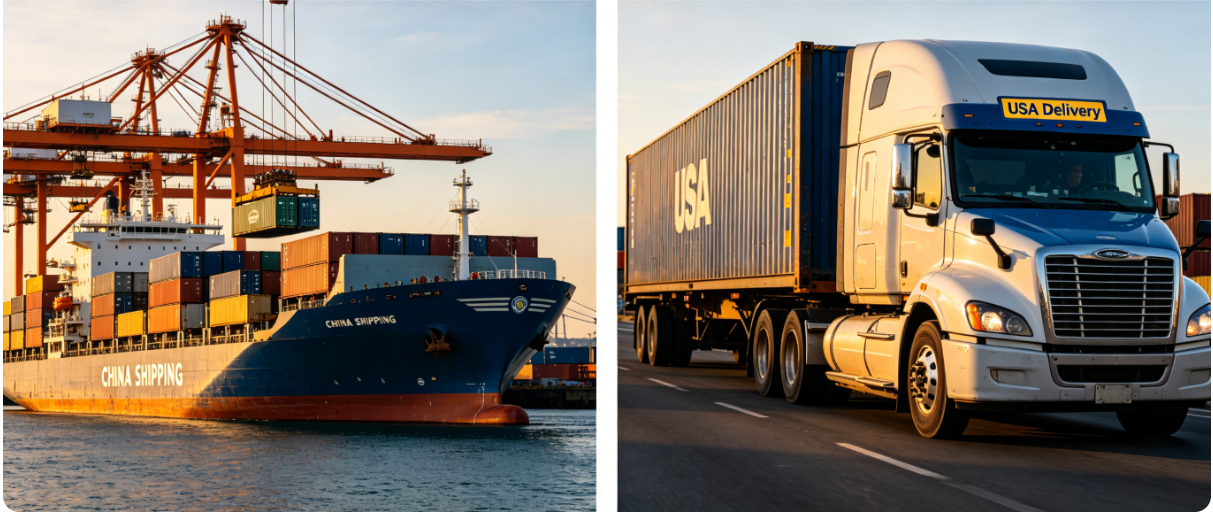
Quick Overview: What You’re Paying in 2026
Here’s what the market looks like as of mid-2026. Rates fluctuate, but this gives you a realistic starting point for budgeting:
| Shipping Method | Typical Transit | Cost Guide (USD) | Best For |
|---|---|---|---|
| ✈️ Air Freight | 3–7 days | 7.50/kg | Urgent commercial cargo, high-value goods |
| 🚢 Sea Freight (LCL) | 18–35 days | 442/CBM | Mid-size shipments, bulky goods |
| 🚢 Sea Freight (FCL 20ft) | 15–35 days | ~3,000+ | Full container loads |
| 📦 Express Courier | 3–7 days | Varies by weight | Samples, parcels under 10kg |
| 🛡️ DDP Air (all-in) | 5–10 days | 8.29/kg | Hassle‑free, door‑to‑door with customs handled |
| 🛡️ DDP Ocean (all-in) | 25–40 days | 3.20/kg | Budget‑friendly, full service |
Prices pulled from en.fbatc.cn and cross-checked with Q2 2026 market data.
⚠️ A quick note on rates: Freight rates can move week‑to‑week. A 40ft container from China to the US West Coast recently ranged between 3,685 depending on the week, while air freight firmed to around $8.06/kg [3†L10-L14]. Don’t treat online rates as final — always get a current quote.
Which Shipping Method Is Right for You?
Not all cargo is created equal, and your choice has real consequences for your bottom line. Let me break down each option like I would for a client sitting across my desk.
✈️ Air Freight from China to USA
The short version: Fastest way to move commercial quantities, but you pay for the speed.
Air freight makes sense when time is money. If you’re shipping 100kg+ of commercial goods and can’t wait weeks for a boat, this is your lane. Typical transit is 3–7 days from pickup to delivery, depending on origin in China and destination in the US.
Best for: Urgent restocks, high‑value electronics, automotive parts, medical supplies, seasonal goods that missed the boat.
Watch out for: Chargeable weight (dimensional weight matters more than you think), fuel surcharges, and the fact that rates to the East Coast are higher than to the West Coast.
🚢 Sea Freight from China to USA
The short version: The backbone of global trade. Slow, steady, and cost‑effective.
For most importers moving anything larger than a few pallets, sea freight is the obvious choice. Transit to the US West Coast runs 18–25 days; add another week or two if you’re shipping to New York, Savannah, or other East Coast ports.
Full Container Load (FCL) vs. Less than Container Load (LCL)
This is where a lot of new importers get tripped up. Here’s the rule of thumb I give everyone:
| FCL (Full Container Load) | LCL (Less than Container Load) | |
|---|---|---|
| Volume | 15+ CBM (fills at least half a container) | Under 15 CBM |
| Cost model | Flat container rate | Pay‑per‑CBM |
| Transit | Slightly faster (no consolidation delay) | May take longer (waiting to fill container) |
| Risk of damage | Lower (your goods only) | Higher (shared with unknown cargo) |
Best for FCL: Large orders, heavy machinery, furniture, anything over 15 CBM. You get exclusive use of a 20ft or 40ft container, which means faster handling and fewer touch points.
Best for LCL: Test orders, new product launches, smaller shipments that don‘t fill a container. You pay only for the space you use, but transit can be slower and per‑unit costs slightly higher.
📦 Express Shipping
The short version: Think FedEx, DHL, UPS — door‑to‑door for small packages under 100kg.
Express is not for commercial freight. It‘s for samples, documents, and urgent small parcels under about 10kg. Transit is fast (3–7 days), but the per‑kg cost is steep. One trick some of my clients use: express for the first sample shipment to validate quality, then switch to air or sea freight for production orders.
What Is DDP Shipping and Why Should You Care?
Here’s where things get interesting — and where most online guides skip the details.
DDP stands for Delivered Duty Paid. Under Incoterms, it means your freight forwarder takes full responsibility for getting your goods from the factory in China all the way to your doorstep in the USA — including customs clearance, import duties, and all taxes.
Why does this matter? Because for a lot of US importers, customs is the scariest part of the process. One wrong HTS code, one missed ISF filing, and your cargo gets held up for weeks — sometimes with storage fees that ruin your margins.
With DDP shipping from China to USA, you hand over one all‑inclusive payment and your forwarder handles:
Pickup from your supplier in China
Export customs clearance in China
International ocean or air freight
ISF filing (Importer Security Filing)
US customs clearance
Duties and tax payment (including Section 301 tariffs where applicable)
Final door‑to‑door delivery to your US address
DDP Air runs around 8.29/kg and takes 5–10 days. DDP Ocean can be significantly cheaper — sometimes as low as 3.20/kg depending on volume — but expect 25–40 days of transit.
Real‑talk: When Does DDP Actually Make Sense?
I‘ve seen clients fall into two camps:
✅ Go DDP if: You’re new to importing, your product has complex tariff classifications (textiles, electronics, furniture), you‘re shipping directly to Amazon FBA (they won’t clear customs for you), or you just want one throat to choke if something goes wrong.
❌ Skip DDP if: You have an established US entity with a customs bond, you‘re comfortable filing your own ISF and entry summaries, and you want maximum control over duty drawback claims.
Step‑by‑Step: How Freight Shipping from China to USA Actually Works
Let me walk you through what happens behind the scenes. Understanding this process will save you from nasty surprises.
Step 1: Get Your Cargo Ready
Your Chinese supplier needs to package goods for international transit. This isn‘t the same as domestic shipping — ocean freight containers can stack 8‑10 pallets high, and air freight has strict weight and dimension limits. Make sure your supplier understands export packaging standards or you’ll be paying for damage claims later.
Step 2: Book Your Shipment
You‘ll send your forwarder:
Cargo details (weight, dimensions, CBM, commodity type)
Pickup address in China
Delivery address in the US
Desired delivery timeline
They’ll come back with options — usually 2‑3 quotes for different speed/cost trade‑offs.
Step 3: Pickup & Export in China
Your forwarder arranges trucking from your supplier‘s factory to the port (Shanghai, Ningbo, Shenzhen, or Guangzhou are the main gateways). Export customs clearance happens here. If you‘re doing DDP, this is all handled for you.
Step 4: The Ocean or Air Transit
Ocean: Your container loads onto a vessel. From Shanghai to Long Beach takes 11‑15 days for fast ships, 25‑35 days for standard routes. From Shenzhen to New York runs 30‑40 days [3†L31-L33]. Factor in port congestion — LA/Long Beach has been better lately, but things change fast.
Air: Your cargo flies from airports like PVG (Shanghai), CAN (Guangzhou), or SZX (Shenzhen) to LAX, JFK, ORD, or ATL. Air freight rates are quoted per kg, and dimensional weight often applies — meaning lightweight but bulky cargo gets charged like heavy cargo.
Step 5: US Customs Clearance
This is where DDP shines or DIY importers lose sleep. Your forwarder files:
ISF (Importer Security Filing) — must be filed at least 24 hours before cargo loads on the vessel. Miss this and you‘re looking at $5,000+ fines.
Entry summary with CBP
Duty payment based on your HTS code
With DDP, your forwarder does all of this using their bond and their customs broker. With DAP (Delivered at Place) or EXW terms, you‘re on your own.
Step 6: Last‑Mile Delivery
Once customs releases your cargo, it goes to your final US address — whether that‘s a warehouse, retail store, or Amazon FBA fulfillment center. If you’re shipping to FBA, make sure your forwarder understands Amazon‘s appointment and labeling requirements or your inventory will get rejected at the door.
Hidden Costs Nobody Talks About
Here‘s what quote comparison sites won‘t tell you. I’ve seen importers get burned by all of these:
| Hidden Cost | What It Is | Who Pays (Typically) |
|---|---|---|
| Demurrage & Detention | Fees for leaving container at port too long | Shipper or consignee — and they add up fast |
| Pier Pass | Fee for container moving through LA/Long Beach during peak hours | Usually the importer |
| Chassis fee | Rental for the wheeled frame that carries the container | Importer or forwarder, depending on terms |
| AMS/ISF filing fee | Carrier security filing (50 per shipment) | Often tucked into “documentation fees” |
| Fuel surcharge | Floats with oil prices — can add 15‑30% to base freight | Almost always passed through |
| Warehouse handling at origin | If your cargo needs consolidation at a CFS | Forwarder or shipper |
The best way to avoid surprises? Ask your forwarder for an all‑in DDP quote that explicitly lists every fee included. If they hesitate or give you vague answers, find another forwarder.
Pro Tips from the Trenches
A few things I’ve learned after hundreds of China‑to‑USA shipments:
1. Never trust just one quote
Get at least 2‑3 freight forwarders to quote the same shipment and compare line‑by‑line. You‘d be shocked how much “documentation fees” and “handling charges” vary between providers.
2. Consolidate multiple suppliers
If you‘re buying from different factories in China, work with a forwarder that offers consolidation. They’ll pick up from multiple locations, merge everything at a warehouse near the port, then ship as one container. This can cut your per‑unit freight cost by 30‑50%.
3. Book early before peak season
August through October is peak season — everyone rushing inventory for Black Friday and Christmas. Rates can spike 40‑60% and vessel space disappears fast. Book your Q4 shipments by July at the latest if you want reasonable rates and reliable space.
4. Know your HTS code before you quote
Your Harmonized Tariff Schedule code determines your duty rate. A forwarder can‘t give you an accurate DDP quote without it. If you don‘t know your HTS code yet, take 20 minutes to search the USITC tariff database — it’s worth the effort.
5. Watch the fuel market
Freight rates are more volatile than most importers realize. In early 2026, carriers started updating rates weekly instead of monthly due to fuel price swings. If you‘re a high‑volume shipper, consider locking in contract rates with your forwarder rather than spot quoting every shipment.
Frequently Asked Questions
Q: What‘s the cheapest way to ship from China to the USA?
A: Ocean freight LCL or FCL, hands down. For a 1,000kg shipment from Shanghai to Los Angeles, sea LCL runs 900 while air freight runs 5,800 — that‘s a 4‑15x premium for air speed [3†L5-L8].
Q: How long does sea freight from China to the USA actually take?
A: West Coast: 18‑25 days. East Coast: 30‑40 days. Add 5‑10 days for inland delivery once the cargo clears customs.
Q: Can I ship to Amazon FBA from China?
A: Yes, but Amazon won‘t clear customs for you. You need either a DDP shipment (forwarder handles everything) or your own US customs bond and broker. Most FBA sellers choose DDP ocean for cost savings — current rates for FBA‑ready DDP ocean run about 180/CBM [1†L18-L22].
Q: What documents do I need for customs clearance?
A: Commercial invoice (with HTS codes), packing list, bill of lading or air waybill, ISF filing (for ocean), and for some products — FDA prior notice, FCC documentation, Lacey Act declaration, etc.
Q: Why do freight forwarders ask for “chargeable weight”?
A: Because lightweight but bulky cargo takes up space on planes and trucks. Air freight uses dimensional weight (L x W x H / 5000 in cm) vs. actual weight — whichever is higher. A pallet of empty plastic bottles might weigh 200kg but take up space like 600kg. Plan accordingly.
Bottom Line: What Should You Do Next?
Here‘s my recommendation based on your situation:
| You are... | Start with... | Why |
|---|---|---|
| New importer, first shipment | DDP Air or DDP Sea (LCL) | One all‑in price, no customs headaches |
| eCommerce seller restocking | DDP Ocean (LCL to FBA) | Best cost‑per‑unit for bulk inventory |
| Urgent restock (<2 weeks) | Air Freight (standard) or Express | Speed without DDP markup if you have a broker |
| Large manufacturer | FCL Ocean with your own customs bond | Maximum control, lowest per‑unit cost |
| Shipping samples | Express courier | Simple, fast, door‑to‑door |
The best freight shipping from China to the USA strategy isn‘t about finding the single cheapest rate — it’s about matching the method to your timeline, cargo volume, and comfort level with customs.
Get at least two or three forwarders to quote your specific shipment, compare all‑in DDP vs. port‑to‑port options, and don‘t be afraid to ask questions. A good forwarder will walk you through every line item and help you avoid the hidden traps that eat into your margins.
Ready to ship? Start by gathering your cargo dimensions, weight, commodity type, and delivery zip code. Then reach out to a few freight forwarders for current quotes. The rates in this article are a starting point — your actual cost will depend on your specific origin, destination, and timing.
Have a specific shipment in mind? Drop the details in a quote request and see what the market actually looks like for your cargo.
How to Book
To take advantage of these new routes and services, simply:
- Contact our dedicated 【Freight Shipping from China to USA | Air, Sea & DDP Rates (2026 Practical Guide)】 desk at Contact
- Provide details of your shipment (cargo type, volume, pickup location)
- Receive a customized quote within 24 hours
- Confirm your booking and prepare your goods for shipment
Our team specialists is ready to assist with all aspects of your shipment, from documentation to delivery.
About Shibida Logistics
Shibida Freight Forwarding is a leading private logistics service provider based in China, offering comprehensive export logistics and warehousing services, international freight forwarding, FBA dedicated logistics, US overseas warehouses, and international logistics services from China to the world by land, air, and sea.
With our headquarters in Shenzhen and branch offices/agents covering almost all major cities and seaports in China, we strive to deliver your cargo to any destination worldwide safely, timely, and at reasonable prices.
For more information about our new Australia routes or to request a quote, please contact us today.